


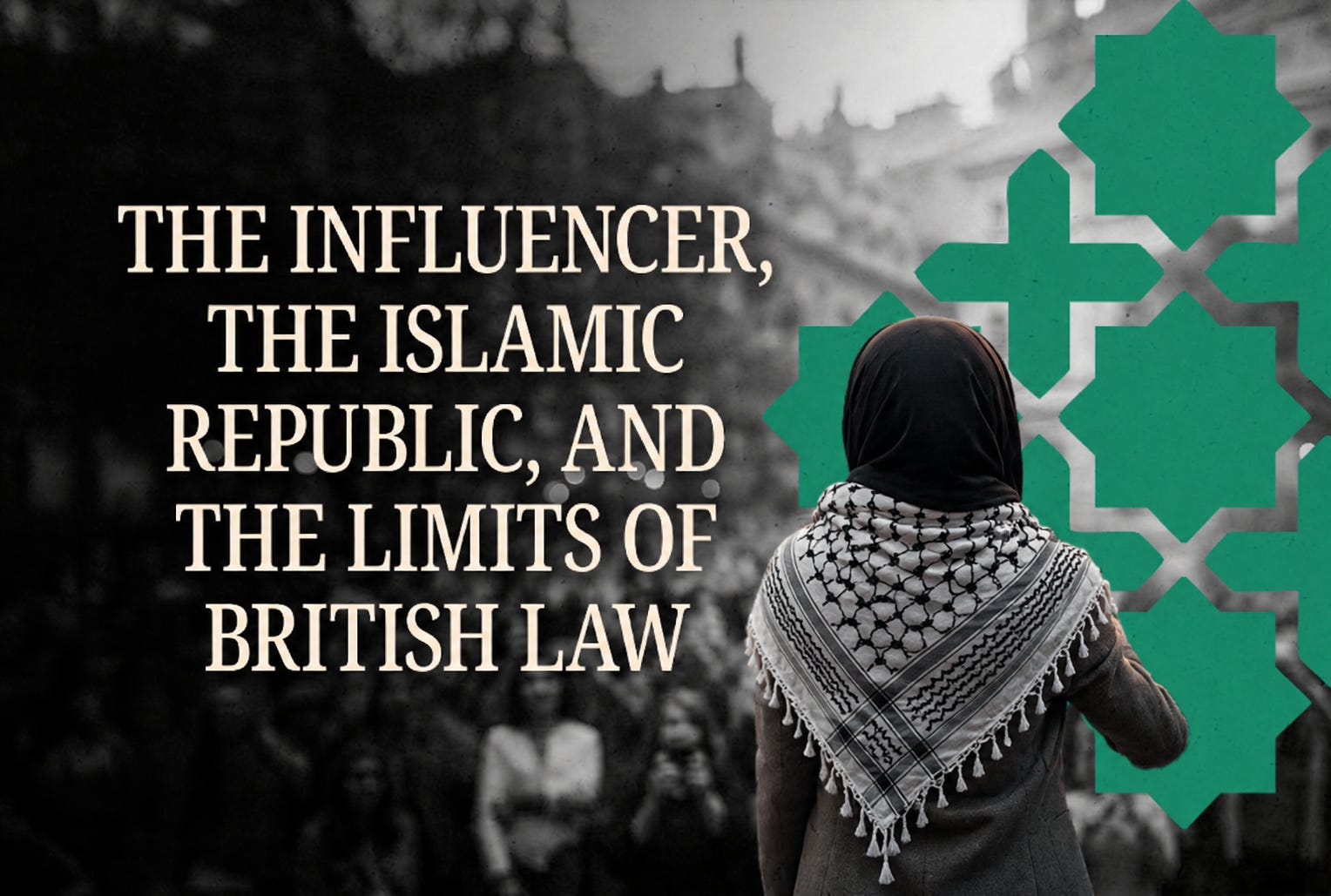
Standing on a stage in Tehran, donning a black headscarf and a Palestinian keffiyeh draped across her shoulders, British media personality Bushra Shaikh addresses an audience that has gathered to hear what she has to say.
“I am so sorry to see what your country is suffering because of the Epstein empire, the Zionist empire,” she tells a crowd waving Iranian flags.
“There are millions, billions of people outside of Iran who support you, who love you, that detest Donald Trump, Bibi Netanyahu, for what they are trying to do inside of your beautiful country.”
It’s clearly a pro-regime rally, where some participants are also waving the yellow Hezbollah flags—and it’s the latter that has got Ms. Shaikh into potential trouble with the British authorities.
In May, she was reported to counter-terror police after addressing the rally where several people in the crowd were holding the yellow flag of the Iran-backed Lebanese militia. It is proscribed in the UK as a terrorist organization.
It is also believed that Shaikh may have violated the National Security Act, which requires individuals to register with the UK Government if they are “directed by a foreign power to carry out political influence activities.”
But the controversy raises a more fundamental question: what, if anything, has Shaikh actually done that is unlawful?
And if not, what exactly can the British authorities do?
One area of scrutiny is whether Shaikh’s activities could fall within the scope of the UK’s Foreign Influence Registration Scheme (FIRS), introduced in July 2025 under the National Security Act.
The scheme was created to increase transparency around covert foreign influence by requiring individuals to register political influence activity carried out in the UK at the direction of foreign states or state-controlled organizations.
Home Office guidance states that registration is usually required for activities conducted in Britain, though activities undertaken abroad that have an effect in the UK may also fall within scope.
There are two tiers: a public political influence tier and an enhanced tier, which is not public. For the latter, registration is required within 10 days of formal or informal arrangements made with a “specified foreign power or entity” (namely, Iran or Russia).
Guidance specifically notes that social media content aimed at UK audiences may be covered, including material posted while overseas.
Failure to comply may result in a sentence of up to five years’ imprisonment and/or an unlimited fine.
But does Shaikh’s conduct meet the legal threshold for registration?
An investigation by Factnameh, an Iranian fact-checking organization, has alleged that Shaikh played a “highly active role in reproducing the [Iranian] government’s narrative” after taking part in two press tours this year organized by IRIB World Service, the international arm of Iran’s state broadcaster.
Fereidoon Bashar, the executive director of ASL19, which created Factnameh, said cultivating friendly journalists and public figures had been part of Iran’s strategy for some time. “There has been a long tradition of having prominent Western figures to Iran who are aligned with anti-imperialist, anti-colonial frameworks,” he said.
But since the 12-day conflict between Iran and Israel in June 2025, he said, there has been a “major shift in Iran’s communication approach.”
Factnameh identified more than a dozen participants in the tours, including a number of US journalists.
Another apologist for the Iranian regime is Calla Walsh, the co-founder of Palestine Action U.S. She was one of several handpicked delegates who were taken to Iran, where she expressed solidarity with the Islamic Republic following the 12-day war with Israel.
“It is the greatest honor of my life to be visiting the Islamic Republic of Iran right now, at this moment, while it is under genocidal siege by the United States and the Zionist entity,” said Walsh, standing at the IRGC aerospace expo, with missiles in the background.
During her two visits to the Islamic Republic, Shaikh appeared on Iran’s Press TV social channels, interviewed senior Iranian political figures, and posted material supportive of official Iranian narratives.
In one Instagram video, she described meeting the chief rabbi at Tehran’s Abrishami Synagogue, saying he “condemns Israel and affirms that the Jewish community in Iran is free to practice their religion—despite what gets told by nefarious political actors.”
In another post, alongside Iranian foreign ministry spokesman Esmaeil Baghaei, she wrote that she had been invited to Iran’s foreign ministry “to discuss possible next steps in the U.S.-Iran negotiations.”
Yet legal experts and security analysts say the threshold for action under FIRS may be considerably higher than public perception suggests.
Roger Macmillan, a security analyst and former director of Iran International, a London-based Persian-language channel, says the central question is not whether Shaikh amplified pro-Iranian messaging, but whether she was operating under the direction of the Iranian state.
“If she says she’s just echoing what she’s seeing on a press trip, there’s very little you can do,” he says.
“What makes a difference is the fact she’s on a documented state-organized trip. She’s putting opinions across at a time when internet access to ordinary Iranians is effectively nil, and she’s a regular on state-owned Press TV.”
If an individual denies being directed or paid, authorities would likely need evidence of an arrangement, instruction, payment trail or coordination to show activity was undertaken on behalf of a foreign state.
“If she has been paid, there are ways around detection,” says Macmillan, arguing informal payments or verbal understandings could leave little documentary evidence.
“This is how the Iranians operate—slightly under the parapet.”
The burden ultimately rests on the individual to declare themselves under the scheme, limiting the government’s ability to intervene unless evidence emerges.
“There are no individuals listed on there, so the question is: what does FIRS really do?” Macmillan continues. “If the government can’t actually do anything with it, it just means we know who they are.
“Does FIRS stop someone carrying out political influence on behalf of a foreign state? No. It just shows how weak FIRS is.”
He argues the scheme risks becoming transparency without the necessary deterrence, adding: “It’s great that we’ve got FIRS, but do we want political activists on behalf of a foreign country operating at this level, conducting hostile communications on behalf of foreign states from the UK? My answer is absolutely not.”
The challenge is balancing national security concerns with legal thresholds and free speech.
Supporting a foreign government narrative, however controversial, is not itself unlawful. The legal issue is whether an individual has crossed into undeclared political influence activity directed by a foreign state.
After Shaikh’s visit, a Home Office spokesperson told a British newspaper that ministers were “clear-eyed about the threats posed by Iran” and that the government would not hesitate to use powers available where activities threaten UK national security.
“This includes the Foreign Influence Registration Scheme,” the spokesperson said. “Anyone acting in the UK at the direction of the Iranian state faces a choice: register their activities or risk prosecution.”
Bushra Shaikh has denied receiving payment from any state actor and has dismissed reports about her conduct as “baseless accusations.”
In one video, she said: “I report on what I see… It is a duty upon every one of us to make sure the news we’re getting is accurate and correct.”
Whether Shaikh’s activities run afoul of the law may depend on evidence unlikely to be visible in public. But her case has already exposed a broader problem for British authorities—whether laws designed to tackle covert foreign influence are equipped for an era in which social media personalities can shape opinion for hundreds of thousands of followers while operating in the murky space between activism, journalism, and propaganda.
Middle East Uncovered is powered by Ideas Beyond Borders. The views expressed in Middle East Uncovered are those of the authors and do not necessarily reflect the views of Ideas Beyond Borders.