


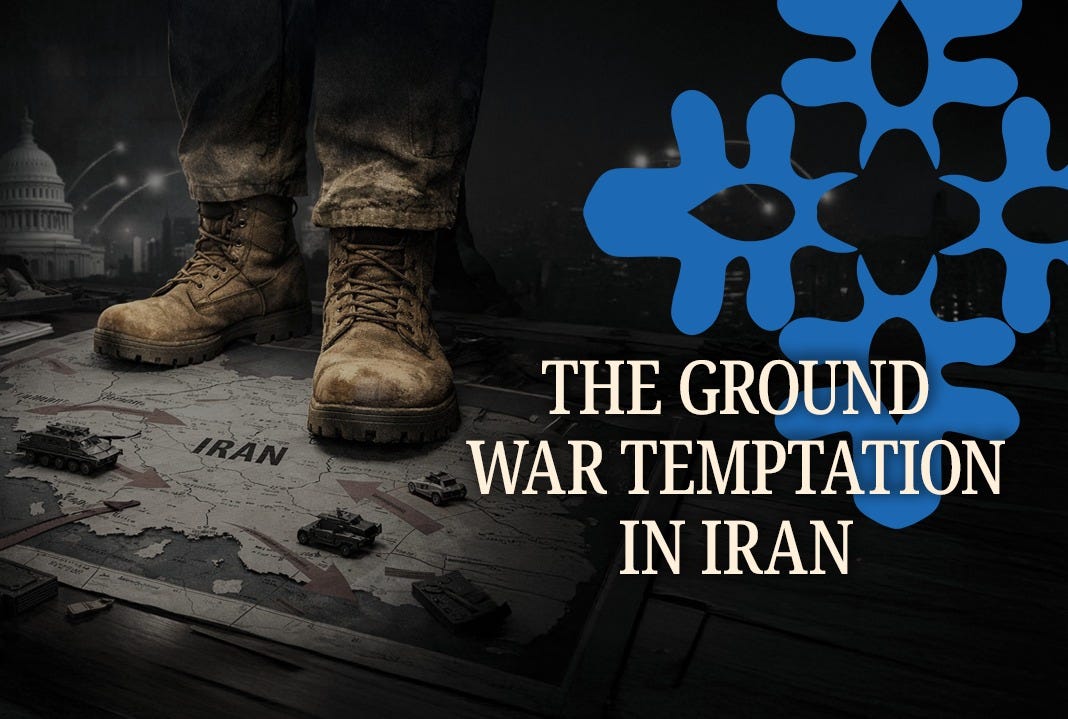
When the war in Iran began last week, no one really thought the United States would put boots on the ground.
That assumption was grounded in several obvious realities. A ground invasion of Iran would carry enormous military, political, and strategic risks. It could transform what some in Washington may have imagined as a swift decapitation campaign into a drawn-out and costly conflict, more like Afghanistan than a limited punitive strike. It would also expose President Donald Trump to profound political consequences. He rose to prominence condemning America’s endless wars and promising to avoid the kind of open-ended military adventures that defined much of the post 9/11 era.
But that assumption is being tested in real time.
On Monday, Trump signaled that he may be more open to a ground offensive than many expected. In remarks to the New York Post, he suggested that, unlike previous presidents, he does not share the same hesitation about sending troops into combat. Around the same time, Defense Secretary Pete Hegseth also refused to rule out the possibility. Neither man explicitly committed the United States to an invasion, but both helped move the conversation into territory that, only days ago, seemed politically and strategically off limits.
The basic reason a ground invasion now looks more plausible than it did a week ago is simple. The two outcomes that Trump likely preferred at the start of this conflict appear less likely today.
The first was a Venezuela-style outcome: the death of the supreme leader followed by the emergence of a more pragmatic insider willing to stabilize the system and cut a deal with Washington. The second was regime change from within, driven by a wave of popular protests strong enough to overthrow the regime.
At the moment, neither seems close to coming to fruition.
If a regime insider takes power, the leading possibility appears to be Mojtaba Khamenei, the son of the late supreme leader. That is hardly reassuring for anyone hoping for de-escalation. Mojtaba is widely seen as more hardline than his father and, for ordinary Iranians, potentially even less competent. A figure like that is not likely to negotiate with the governments that just killed his father. Israeli officials have signaled that any successor would become a target regardless of his identity. In practical terms, that severely limits the space for an internal transition that preserves the Islamic Republic while simultaneously making it more pliable.
The protest scenario looks equally uncertain, at least in the short term.
Yes, the regime remains deeply unpopular, with 80% of Iranians opposing it. But war often changes domestic political psychology. The death of a national leader, even a deeply controversial one, can rally parts of society that were previously passive, fearful, or disillusioned. Social media footage suggests that pro-regime and anti-American demonstrations are, for now, more visible than anti-regime mobilization. That does not mean the regime has regained legitimacy, but foreign bombardment may be strengthening nationalist reflexes at the very moment Washington hoped to trigger internal revolt. Even if the citizenry wanted to depose the regime, the fact remains that they are unarmed.
This is the danger that external military action often creates. Instead of breaking a hated government, it can temporarily fuse state survival with national identity. Reports of strikes hitting civilian infrastructure, including a school and a hospital, only deepen that effect. Even many Iranians who loathe the regime may become less willing to rise up if they feel their country is under external assault.
So if neither a cooperative successor nor mass protest is likely to deliver quick results, Washington needs to make clear exactly what the military objective is and how it plans to achieve it.
Trump has now spoken of four major objectives: destroying Iran’s missile capabilities, annihilating its navy, ensuring Iran can never obtain a nuclear weapon, and preventing Tehran from funding, arming, or directing proxies abroad.
Taken together, these goals amount to a project of total strategic neutralization. In plain terms, they imply that Iran must be demilitarized and stripped of its ability to project power beyond its borders. That is the kind of agenda that usually requires the enemy state to capitulate.
And that is where escalation becomes dangerous.
Air campaigns have a long historical record of producing dramatic tactical results. Air power can destroy infrastructure, eliminate commanders, degrade logistics, and disrupt communications. But it has a poor record of achieving broad political transformation on its own. Bombing can punish, weaken, and signal. It can rarely compel a deeply entrenched regime to surrender its core ambitions, especially one built around ideological commitment, corrupt institutions, and a long history of surviving pressure.
If Washington’s aims are truly maximalist, then air power alone may not be enough.
During the 1991 campaign against Saddam Hussein, the United States inflicted enormous damage from the air and encouraged Iraqis to rise against the regime. But the uprising was crushed, the regime survived, and Saddam remained in power for years. Air superiority did not automatically yield political victory. If anything, it exposed the limits of military force when not paired with a coherent, sustainable endgame.
That lesson hangs heavily over the current war.
There are signs that both Washington and its allies may already understand this. Reports suggest that outside actors are exploring whether Kurdish militias or special forces operations could do some of the work on the ground without requiring a full-scale American invasion. That would be the preferred option for any administration trying to avoid the domestic backlash of another major war. But if proxy forces prove inadequate, and if special operations cannot achieve strategic objectives on their own, then the pressure to consider a larger US ground role will grow.
Iran is one of the most difficult countries in the region to invade. It is vast, mountainous, heavily populated, and far more complex than the states where the American military has operated before. Any invading force would face immense logistical burdens, rough terrain, and the near certainty of prolonged resistance. Even a successful initial campaign could quickly turn into a brutal occupation with no clean off-ramp.
That is why the odds may still be below 50%. The regime could still be deposed from within. Iran could descend into a messy civil conflict, altering the strategic equation. Or Trump could simply decide that the cost of pursuing total victory is too high and declare partial success before stepping back.
But the important point is this: the probability of boots on the ground is now higher than it was just days ago.
That alone should alarm anyone who took Trump’s anti-interventionist rhetoric seriously. A president who built his brand attacking forever wars is now, at the very least, entertaining the possibility of entering one of the most dangerous and complex battlefields in the Middle East.
And once a war begins to outgrow its original ambitions, it often develops its own momentum that is difficult to contain. That is the true danger now. Not only that Washington may actively choose a ground invasion, but that it may drift into one because every other path to victory has begun to close.
Middle East Uncovered is powered by Ideas Beyond Borders. The views expressed in Middle East Uncovered are those of the authors and do not necessarily reflect the views of Ideas Beyond Borders.
