


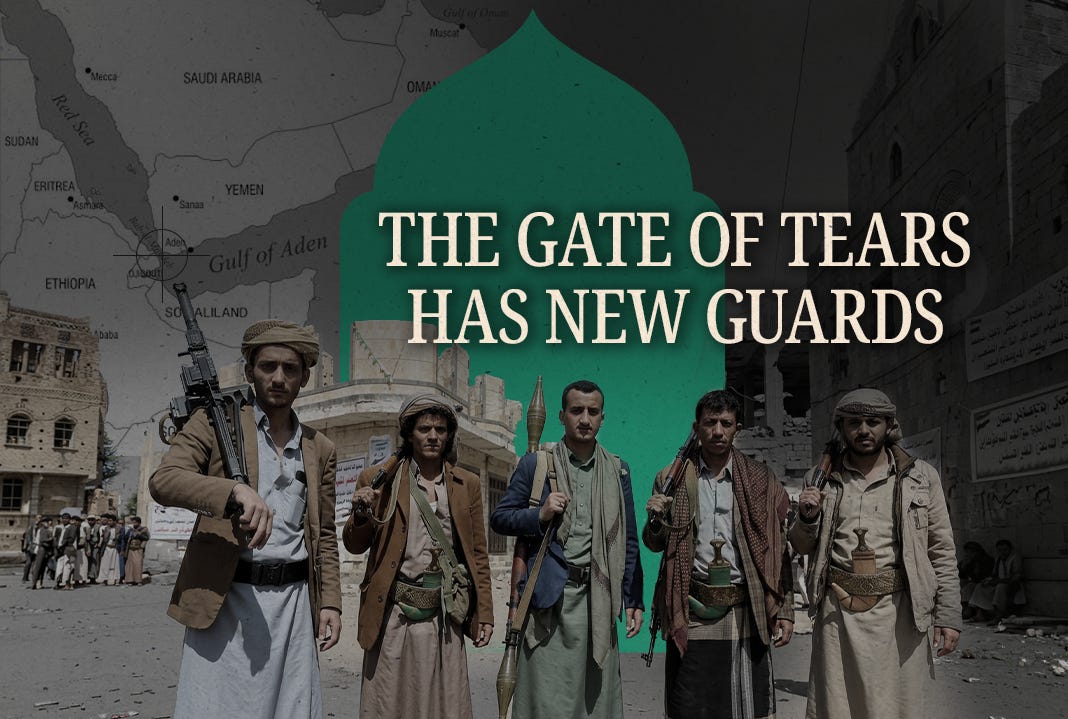
Bab el-Mandeb has long been known as the “Gate of Tears.” Yemen’s Houthis now appear determined to ensure it lives up to its reputation.
On July 20, the Iran-aligned militia announced an immediate maritime blockade against Saudi Arabia, threatening vessels entering or leaving Saudi ports. The Houthis have not yet physically sealed the strait, and their ability to enforce a total closure is unclear. But that distinction offers little comfort to shipping companies. By July 22, several tankers had already changed course, while European authorities warned vessels connected to Saudi Arabia, the United States, or Israel that they faced an increased risk of attack.
This is how a strategic waterway can be effectively closed without a formal naval occupation. The Houthis need only to fire enough missiles, launch enough drones, or issue enough credible threats to make insurers, crews, and shipping companies decide that the risk is too high to proceed.
Bab el-Mandeb connects the Gulf of Aden to the Red Sea and, farther north, the Suez Canal. Around 12 percent of global trade and roughly one-quarter of the world’s container traffic normally pass through the narrow waterway. When ships avoid it, they must travel around the Cape of Good Hope, adding one or two weeks to voyages between Asia and Europe and sharply increasing fuel, insurance and transportation costs.
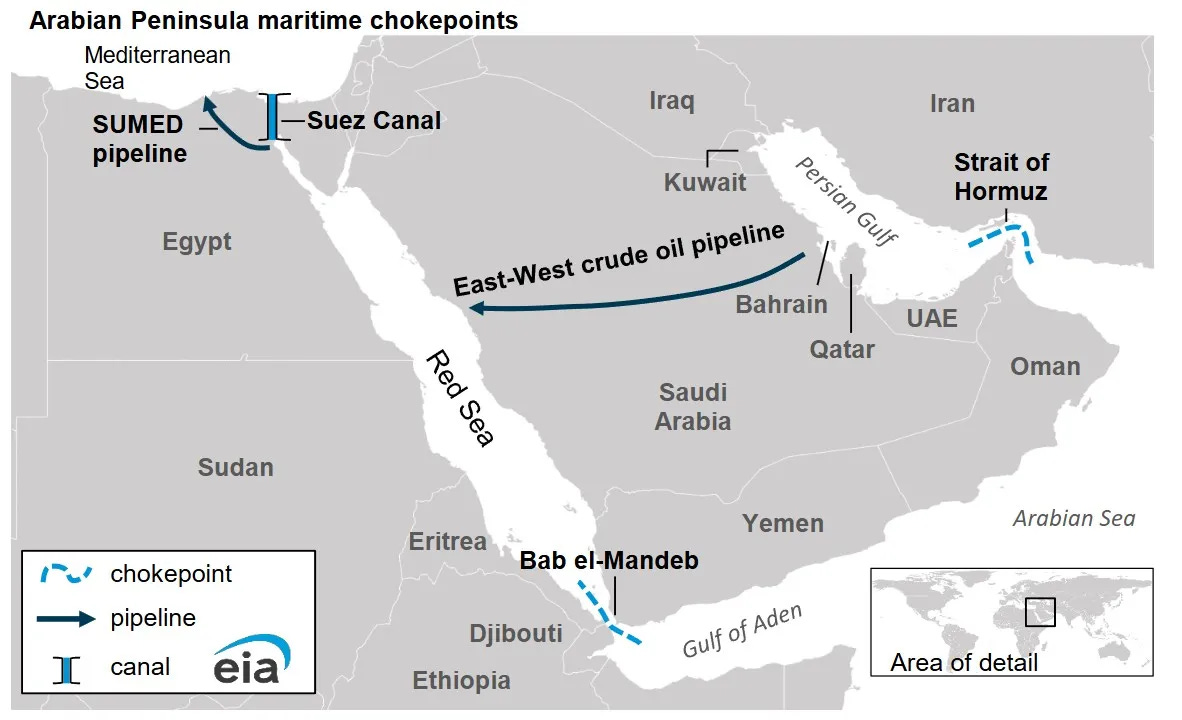
Its importance has grown because of the disruption in the Strait of Hormuz. Saudi Arabia has been using its East-West Pipeline to move crude to Yanbu on the Red Sea, allowing millions of barrels to bypass the Persian Gulf. More than seven million barrels of petroleum reportedly passed through Bab el-Mandeb each day in June, compared with roughly four million before the Iran war. Saudi Arabia alone has recently been exporting approximately four million barrels a day through Yanbu.
A Houthi campaign against those exports would place one of the world's most important energy routes at risk. Markets are highly sensitive to the possibility of disruption, even before supplies are affected. Crude oil prices rose by more than 6 percent this morning alone, illustrating how quickly concerns over the strait can ripple through the global economy.
Reuters estimated that a complete closure could remove as much as 7 percent of global oil supply. Even an incomplete blockade could raise energy prices, increase transportation costs, and accelerate inflation throughout economies that have no connection to Yemen’s civil war.
For the Houthis, civilian economic suffering is part of the strategy rather than an unintended byproduct.
The militia describes their blockade as retaliation against Saudi Arabia’s restrictions on Houthi-controlled Yemen and the recent strike on Sanaa International Airport. The confrontation escalated after an Iranian aircraft carried Houthi officials between Yemen and Iran, followed by Saudi action against the airport and Houthi missile and drone attacks on Abha International Airport.
The Houthis have their own local conflict with Saudi Arabia. They are not merely robots waiting for someone in Tehran to press a button.
But recognizing their local ambitions should not obscure the larger strategic reality.
The Houthis are a central component of Iran’s so-called Axis of Resistance. Their missiles, drones, political ideology, and regional posture have been developed through a long partnership with Tehran. Their latest escalation also directly benefits Iran by opening a second pressure point while maritime traffic through Hormuz is already under strain.
Whether the order was transmitted directly from Tehran may be impossible to prove publicly. But the outcome is the same: an armed faction ruling much of Yemen is using Yemeni territory to strengthen Iran’s position in a wider regional confrontation.
Iran gains leverage while the Houthis gain relevance. Ordinary Yemenis are left to endure the retaliation that follows.
They say the blockade applies to ships trading with Saudi ports. Tomorrow, a vessel may be targeted because of its ownership, previous destinations, cargo, insurer, flag, or alleged relationship with a country the Houthis consider hostile.
Shipping companies cannot base billion-dollar operations and the safety of their crews on Houthi “assurances.”
The uncertainty itself is a weapon.
The declared blockade represents the most serious direct escalation between the Houthis and Saudi Arabia in years. Major fighting had largely subsided after the 2022 truce, giving Yemenis an uneasy period of relative calm. That calm is now in jeopardy.
Saudi Arabia has promised to protect vessels and respond firmly to Houthi attacks. Should the militia begin striking tankers or laying naval mines, retaliation is almost inevitable. Such an exchange could reignite the Yemeni war and pull the country deeper into the confrontation between Iran and the United States.
The Houthis may believe that geography insulates them and assume that Saudi Arabia, the United States and other powers fear another prolonged conflict in Yemen. They may also be betting that threatening global energy supplies will force foreign governments to pressure Riyadh.
But it is ordinary Yemenis who will bear the costs. Whatever strategic gains the Houthis expect, Yemen will emerge poorer and less stable than before.
The international response must protect freedom of navigation while avoiding the illusion that airstrikes alone can solve Yemen’s political disaster. Airstrikes may be necessary to deter missile launches and protect commercial shipping, but they will not be enough on their own.
The Houthis claim they are blockading Saudi Arabia in defense of Yemen. In reality, they are once again blockading Yemen’s future. They have turned the country’s strategic location into a tool of Iran’s regional strategy, leaving Yemenis to bear the economic and military consequences.
Bab el-Mandeb may indeed be the Gate of Tears. But it is the Houthis who keep ensuring that Yemenis have reasons to weep.
Middle East Uncovered is powered by Ideas Beyond Borders. The views expressed in Middle East Uncovered are those of the authors and do not necessarily reflect the views of Ideas Beyond Borders.
