


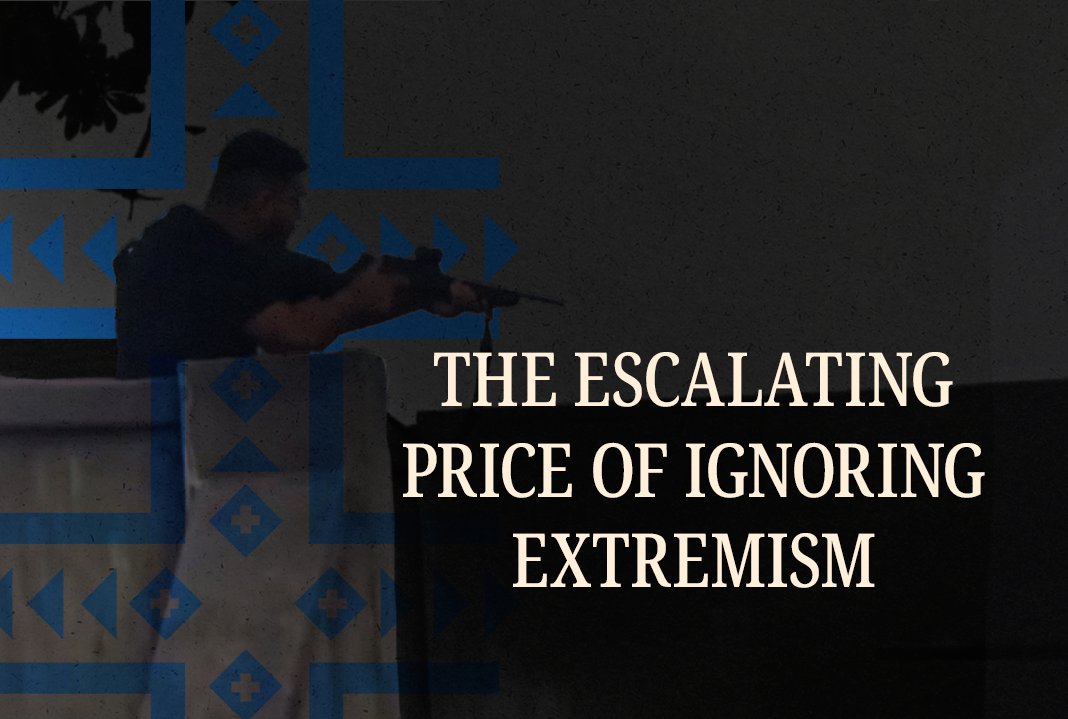
The deadly antisemitic attack at Bondi Beach on Sunday felt like the grim fulfilment of warnings long ignored.
In his final moments, holocaust survivor Alex Kleytman shielded his wife, Larisa, and saved her from the gunman’s aim—an instinctive act of courage that cost him his life. There is bitter irony in a man who escaped the Nazi extermination camps in Europe and endured one of the darkest periods in history, only to be murdered by the modern manifestations of the hatred he thought he’d left behind.
Father and son Sajid and Naveed Akram murdered 15 people who were on Australia’s Bondi Beach to mark the first night of Chanukah.
The footage of the attack, in which the killers are calmly taking aim at happy Jewish families, is utterly chilling. Only an ideology rooted in hatred and bolstered by moral self-righteousness could have led someone to commit such an act without hesitation.
The death toll could have been far higher had it not been for the heroic intervention of Ahmed al Ahmed, a 43-year-old fruit seller originally from Idlib, Syria, who confronted one of the attackers and helped prevent further carnage.
Sajid, 50, was killed in an exchange of gunfire with police at the scene, while 24-year-old Naveed remains in hospital and is likely to face criminal charges. Australian police believe they were “driven by Islamic State ideology.” The pair underwent military-style training while in the southern Philippines last month, according to officials. Two homemade ISIS flags were found in a vehicle registered to Naveed, who was previously assessed by the domestic security agency and deemed not to be a threat.
The Bondi Beach attack bears all the hallmarks of the same Islamist extremism that has struck Jewish communities globally—and few doubt that, left unchallenged, it will strike again.
What we saw in Australia didn’t emerge overnight. Harassment and intimidation of Jews across the West has increasingly tipped into physical violence.
In October, Syrian-born Jihad al-Shamie attacked congregants arriving for Yom Kippur at Heaton Park synagogue in north Manchester. Two Jews were killed and three injured before police shot the suspect dead.
Since then, there have been mixed feelings among Jews: fear, perseverance, and wariness. But everyone I spoke to in the community said the same thing about the attack: shocked but not surprised.
Jews were expecting reprisals following Israel’s war in Gaza, a response to the horrific attacks on October 7, 2023. Hundreds of thousands of pro-Palestinian demonstrators have held marches and rallies around the world in solidarity with Gaza, demanding an end to Israeli attacks on the besieged enclave.
While many claim to be concerned about the atrocities committed against the Palestinians, there have also been displays of overt antisemitism and dehumanizing slogans at such gatherings.
In Australia, mobs gathered at the Sydney Opera House just days after October 7, chanting “Fuck the Jews” and “Where’s the Jew” (or “Gas the Jews,” according to some reports).
Chants of “globalize the intifada” may sound like a call for solidarity with Palestinians, but many Jews understand the implications all too well—and it has manifested violently in Manchester and at Bondi Beach.
Though a ceasefire has been in place between Israel and Hamas since October, the long-term damage has already been done. Last year, then US director of national intelligence Avril Haines said the war “will have a generational impact on terrorism.”
The fallout from this conflict has been felt thousands of kilometers away from the Middle East. Australia has seen a spate of antisemitic attacks in the past two years. In 2024, the Islamic Revolutionary Guard Corps (IRGC) allegedly organized and carried out at least two terrorist attacks in Australia: one targeting a kosher restaurant in Sydney, the other a firebombing of a synagogue in Melbourne.
Australia’s experience with antisemitic attacks is part of a broader pattern of homegrown extremism. Just over a decade ago, an estimated 150 to 300 Aussies left the country to join ISIS, making Australia the highest per-capita foreign contributor to jihadist violence.
The Manchester terrorist also pledged allegiance to ISIS just before his attack. As a counterextremism expert told me following the incident, ISIS has urged its supporters since October 7 to carry out attacks on Jews worldwide. There is no distinction between Jews and the State of Israel. And it’s a sign of worse things to come.
The Bondi Beach attack is not just a security failure. It is a failure of leadership, not only in Australia, but across much of the Western world.
The mantra “antisemitism has no place in Australia” rings hollow when Jews are once again collectively mourning.
They will continue to gather for events and festivals, defiant in the face of this threat. But no doubt many will be questioning whether Australia, and Western countries in general, are still safe.
Societies can’t function if certain communities have to think twice before commemorating a religious holiday. This can’t be allowed to be the new norm.
Perhaps leaders can take notes from Ahmed al Ahmed, whose instinctive bravery on Sunday prevented further carnage. He acted courageously and without any delay because he understood the threat before him.
For years, Western leaders have been told repeatedly about the threat to liberal democracy and our way of life.
They must heed those lessons, or what happened at Bondi Beach will become yet another footnote in the long history of antisemitism.
Middle East Uncovered is powered by Ideas Beyond Borders. The views expressed in Middle East Uncovered are those of the authors and do not necessarily reflect the views of Ideas Beyond Borders.

As a human my heart hurts. As an Aussie (living Abroad) my heart hurts. Bondi Beach has always been known for its sunshine and surf. Now it is a site of violence, fear, and death. I will choose to focus on the courage and love of those who protected others. I will choose to continue to believe in the good inherent in humanity while we grieve the loss caused by those who choose hate.
I would personally agree that Anthony Albanese has exacerbated these problems in Australia with his executive actions and statements. I wish Bondi Beach weren't remembered for this.