


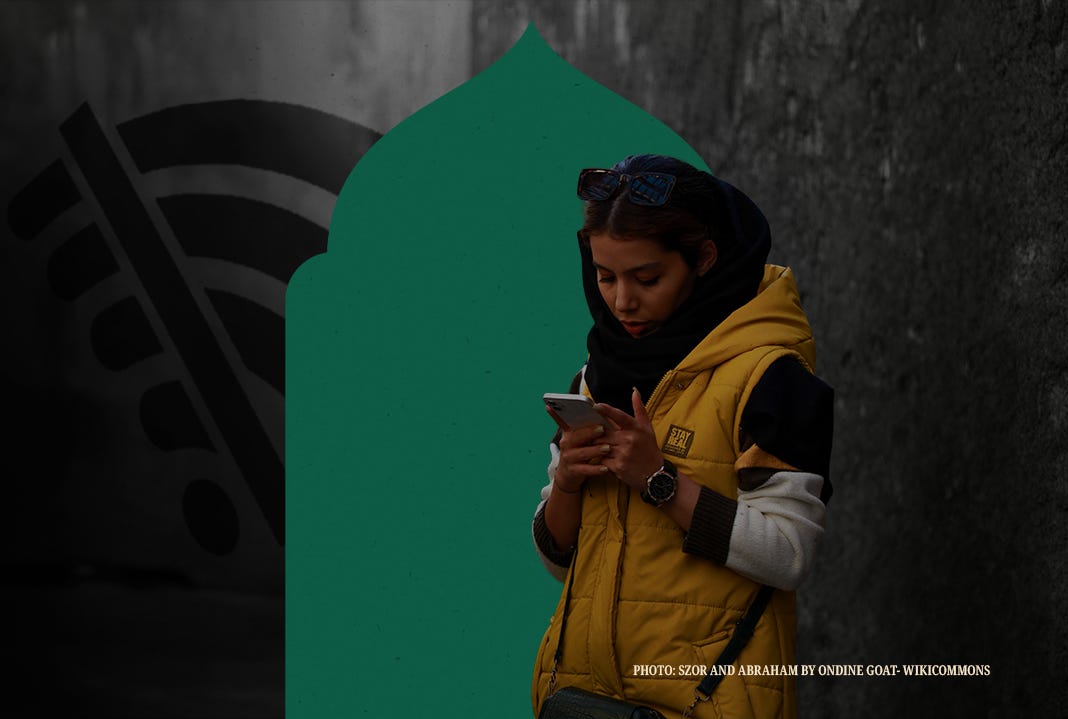
Rojin spent a year and a half training in front-end programming and was preparing to start freelancing when the internet was suddenly shut down nationwide. Now, she says she feels as though a year and a half of hard work has led nowhere. She has nothing to hold on to and no longer knows how to prepare for the future.
Rojin’s story is one of thousands of accounts being circulated these days among Iranian freelancers, Instagram shop admins, and online instructors: people who, because of a single government decision, lost their means of livelihood overnight. Internet access has still not been fully restored, and for many, even getting back online will not undo the damage already done.
More than 32 million people in Iran depend on the internet, directly or indirectly, to earn a living. Ride-hailing drivers, exporters of digital services, and small businesses that in recent years found their only escape from economic stagnation online—all of them were part of an economy that was brought to a standstill by the order to cut the connection. The internet blackout amounted, for many, to being forcibly laid off.
The unstated but obvious goal of the shutdown was to silence dissent and prevent images of January’s brutal crackdown on protesters from reaching the outside world.
But the consequences struck an economy already standing on the edge of a cliff. According to field reports, in the first days of the shutdown, the volume of active projects on one of the country’s largest freelancing platforms declined by as much as 96 percent. Even weeks after connectivity partially returned, activity across the freelance market was still less than a third of what it had been before the blackout.
Jina was one of the people caught in that fallout. She managed the Instagram accounts for the digital marketing department of a company located just outside Tehran. During the first blackout, which lasted roughly 40 days from December 2025 into January 2026, she kept working part-time, relying on domestic platforms and hoping the internet would return. But during the second stint, once the war had paused and her colleagues had gone back to work, she was told not to return to the office until the internet was fully restored, since her job depended entirely on it:
“Once that blackout passed two and a half months—and relying on domestic platforms hadn’t gotten us anywhere—the company settled my accounts after five years on the job, and I was out of work.”
According to a report by Radio Zamaneh, millions of Iranians have come to depend on internet access for their livelihoods in recent years, providing a way to receive orders, get paid, find customers, coordinate with colleagues, and deliver services. When the internet stopped working, the impact was immediate but difficult to measure. Unlike a formal layoff, much of the disruption happened off the books and was initially invisible in official statistics.
But more than 8 months after the initial blackout, we have a fuller picture. In just three months following the wave of shutdowns, 450,000 people lost their jobs, and the national unemployment rate climbed to 9.1 percent. The burden fell disproportionately on young people: today 1 in every 4 young Iranians is entirely without work and more than 2.5 million people are actively searching for jobs—all while point-to-point inflation has climbed to nearly 90 percent and household purchasing power keeps eroding by the day. These figures landed on a country already grappling with capital flight, sanctions, and structural mismanagement—a body with no capacity left to absorb another blow.
And the regime has offered little to fall back on, having failed for decades to create enough jobs for Iran’s growing workforce. Foreign investment remains limited by political risk, the state and quasi-state sectors devour a large share of resources, and structural corruption in institutions like the Islamic Revolutionary Guard Corps (IRGC) has blocked private-sector growth. For millions of Iranians, especially young people shut out of the formal job market, the internet offered a way to make a living. With little support from the state, and often despite the obstacles it created, they built jobs for themselves online.
Hajir was one of them. After finishing his master’s degree and losing hope of finding work in his field, he taught himself web design and, together with a friend, launched an online shop with the bare minimum of stock:
“We weren’t making much money, but it wasn’t bad for a start. Still, last year’s conditions, and an internet blackout that dragged on for five months, made us give up on it completely. Now my friend is back at his father’s house, and I drive for Snapp.”
By cutting the internet, the state took away even this self-made opportunity.
The regime typically defends these restrictions as necessary for “national security” or to contain “unrest.” But the reality on the ground tells a different story. A policy purported to protect the country is, in practice, strangling an economy that the state itself has never been able—or willing—to build an alternative for.
Awat, a cosmetics importer, had stocked up for the New Year sales season and was counting on his online shop to sell the products. Then the internet was cut off. Sales stopped, but the bills didn’t. He was left with unsold inventory, checks coming due, and debts he had expected those sales to cover.
His cousin, Hiwa, is a vocal instructor with 70,000 followers on Instagram. He held his classes online for students both inside and outside Iran, and all of his income came from his Instagram page and online teaching. Now he is stuck at home, with no classes and no income. As he put it, “It feels like they took my job away from me overnight. I don’t know how long I’m supposed to go without an income. Seventy thousand people follow me, but these days I can’t even hear a single one of them; my classes are gone, and I don’t know what to do with this silence.”
Rojin, Jina, Hajir, Awat, and Hiwa are part of a generation of Iranians who found ways to make a living in an economy that offered them few opportunities. They learned new skills, found customers online, and built something of their own. And they aren’t just mourning the opportunities already taken from them. They are also confronting the possibility that the next job, client, or chance to build something for themselves may never come.
Iranians have long lived with limits on what they can say and do. Now many are being pushed into a more immediate struggle: how to make enough money to survive.
If you found this piece interesting, you might also like Hesam Misaghi’s reporting:
The Longest Internet Shutdown in Human History

If you speak with Iranians in the diaspora these days, you will notice something strange: people have started to count time differently.
Middle East Uncovered is powered by Ideas Beyond Borders. The views expressed in Middle East Uncovered are those of the authors and do not necessarily reflect the views of Ideas Beyond Borders.
