


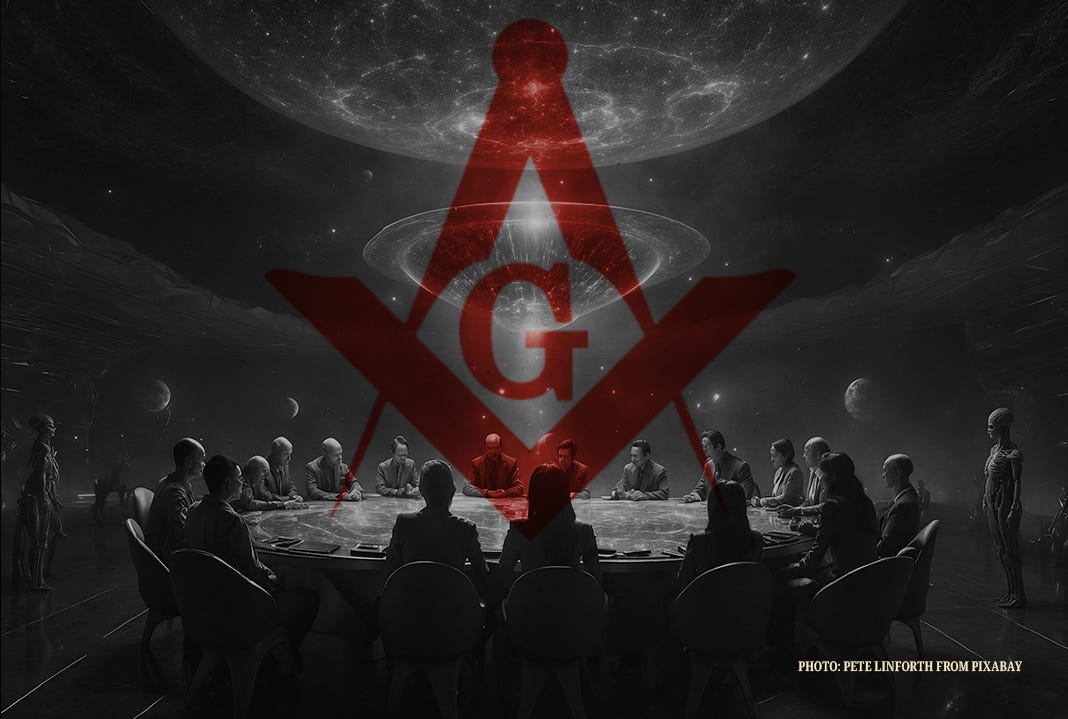
Growing up in Iraq, I was told that the Freemasons were everywhere, even though nobody seemed to have met one. They were supposedly a secretive, sinister organization working behind the scenes to undermine our society, support Israel, and control the world. Their influence explained everything from political instability to our governments’ failures. We heard about them so often that we came to accept their existence as an evil force.
We rarely questioned these claims. Why would we? They were repeated by people in positions of authority, reinforced by the media, and treated as established truths.
Years later, I decided to produce a series explaining what Freemasonry actually is. I expected some disagreement, but I underestimated how deeply these beliefs had taken root.
The reaction surprised me. People with university degrees, including PhDs, rejected the information I presented. Many insisted that the Freemasons were part of an ancient conspiracy that had operated continuously for thousands of years, carefully coordinating its activities across generations.
Some invoked The Protocols of the Elders of Zion, the notorious antisemitic forgery purporting to reveal a Jewish plot for world domination. Even when confronted with its fraudulent origins, they refused to reconsider their beliefs.
What struck me was that the absurdity of the conspiracy itself did little to weaken their conviction. How could a secret organization maintain the same objectives, structure, and coordination across two thousand years? How could such an extraordinary operation remain hidden while supposedly influencing nearly every major political development?
I could have made these arguments. Instead, I took a different approach: I presented documented information and let people examine it for themselves. I sought to understand why such beliefs remained so powerful, even among educated Iraqis.
The persistence of conspiracy theories in Iraq and across much of the Arab world is no accident. For generations, authoritarian regimes have encouraged their people to blame outside forces for the problems they face at home.
When economies fail, institutions collapse, or political freedoms disappear, the explanation is often familiar: Western interference, Israel, Zionism, Freemasonry, or some combination of these supposed enemies.
The message conveyed is that our societies are victims of powerful external forces rather than the consequences of decisions made by their own leaders.
This narrative serves authoritarian governments remarkably well. If the public believes that invisible enemies are responsible for its suffering, there is less pressure to examine corruption, incompetence, repression, and the failures of domestic institutions.
But governments are only part of the problem. Religious discourse, traditional media, and deeply ingrained cultural assumptions reinforce the same habits of thought. Over time, conspiracy becomes an explanation that requires no evidence precisely because it has been repeated so often.
The consequences extend beyond misunderstanding Freemasonry. They shape how people interpret history, politics, religion, and their own societies.
Consider how many people in the Arab world remain unaware that The Protocols of the Elders of Zion is a forgery. This is not necessarily because they have investigated its origins and rejected the evidence. Many have simply never encountered that information.
Before people can question a falsehood, they must have access to the facts that challenge it.
Another reason conspiracy thinking survives is the structure of education itself.
In much of the Arab Middle East, education still emphasizes memorization over inquiry. Students are expected to absorb prepared material, reproduce it in examinations, and demonstrate that they remember what they have been taught.
They are less frequently encouraged to challenge assumptions, evaluate competing explanations, or develop independent conclusions. This approach can produce people with impressive academic credentials who nevertheless struggle to question ideas they inherited from their surroundings.
Education should expand the mind’s capacity to investigate the world. Too often, our systems reward people for repeating accepted answers rather than thinking for themselves.
The problem is particularly visible in subjects that challenge traditional religious or political orthodoxies. Evolution, for example, is often neglected or taught inadequately. Ideas concerning individualism, humanism, and political freedom receive similarly limited treatment.
The result is an intellectual environment in which many people possess information but lack the tools, or the encouragement, to examine it critically.
Conspiracy theories thrive in such environments because they offer certainty. They offer simple explanations for complicated problems and identify enemies to blame without demanding serious investigation.
I believe those of us who have the freedom to question these narratives have a moral obligation to do so.
This responsibility is especially important for intellectuals, journalists, and academics living outside authoritarian societies, where they can speak without the same institutional and cultural restrictions.
Many Iraqis living in the United States, for example, have encountered Freemasonry in ordinary life. They have seen Masonic buildings, visited them, or learned about their activities. Their experiences make it easier to recognize the distance between the conspiracy theories they grew up hearing and the reality before them.
That knowledge should not remain confined to those fortunate enough to have left.
But challenging deeply held beliefs requires credibility. People are unlikely to reconsider their assumptions simply because someone tells them they are wrong, particularly when those assumptions have been reinforced since childhood.
In my own work, I try to distinguish between taking a position on an issue and becoming involved in partisan conflict. I make my views clear, but I explain them and ground them in what I believe serves Iraq’s public interest.
When addressing conspiracy theories, my approach is even more straightforward. I prefer documented information over moral condemnation or intellectual confrontation. People can reject an argument. It is harder to dismiss a fact when its source can be independently examined.
Fortunately, the traditional gatekeepers of information no longer enjoy the monopoly they once did.
Podcasts, YouTube, and social media have created opportunities for alternative voices to reach audiences that previously depended almost entirely on state-controlled media, religious authorities, and conventional educational institutions.
Of course, these platforms also amplify the very conspiracy theories and reactionary ideas we should challenge. The defenders of established orthodoxies have learned to use them effectively.
But they have also created space for people willing to discuss evolution, democracy, humanism, individualism, and the structural problems facing Middle Eastern societies with a degree of frankness that was once difficult to imagine.
There is an audience for this material. It remains relatively small, but it is growing.
This is why initiatives such as Ideas Beyond Border’s House of Wisdom 2.0 are so important. By making knowledge accessible in Arabic and introducing audiences to ideas that receive insufficient attention in traditional institutions, they help foster a culture of independent inquiry in the Middle East.
Such efforts deserve greater visibility and support.
I do not expect a single video, article, or podcast to overturn beliefs cultivated for generations. My experience with the Freemasonry series demonstrated how resistant people can be to information that contradicts their understanding of the world—but that resistance doesn’t mean the information shouldn’t be made available to them.
Our societies cannot begin to address their problems seriously while continuing to attribute every failure to invisible enemies. We must be willing to examine our institutions, our education systems, and the ideas we have inherited.
The objective is not to tell people what to think, but to give them the information and intellectual freedom necessary to think for themselves.
That is where meaningful change begins.
You might also be interested in:
Can a Secretive Fraternal Order Bridge the Middle East’s Divides?

A Muslim, a Jew, and a Christian walk into a lodge. It sounds like the beginning of an old joke. But here I am, sitting at a table at the heart of Freemasonry in central London, with three men who are masons.
Middle East Uncovered is powered by Ideas Beyond Borders. The views expressed in Middle East Uncovered are those of the authors and do not necessarily reflect the views of Ideas Beyond Borders.
