


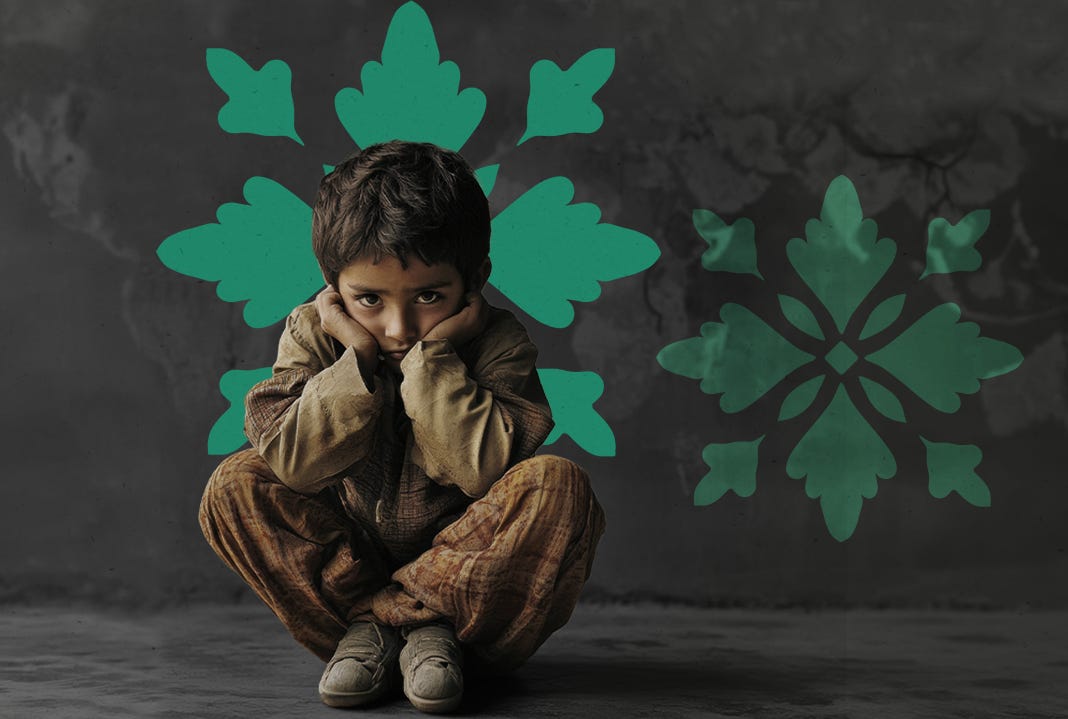
Four years ago, I sat in a Baghdad living room and watched a young girl named Layla, then about seven, glide around in a bright pink T-shirt, showing me a painting in a flimsy sketchbook. An elderly Iraqi-Christian activist had helped shield her identity as the daughter of a fallen ISIS fighter so she could start school. On paper, she did not officially exist, and her education could have been taken from her at any moment.
She is not a little girl anymore. Layla would be entering her early teens now. I don’t know what happened to her. I do not know whether she got her documents, whether she is still in school, or whether the stigma of her father’s ISIS affiliation eventually caught up with her, as it does for so many of her generation. An entire cohort of children who were infants and toddlers when I first wrote about them are now old enough to remember being stateless.
The core problem is the same one I encountered in 2022. There are thousands of children without a country to call home. What happens to them? And to the next iteration of terrorists?
When I first reported this story, the crisis was largely deadlocked, with Iraqi politicians telling me across the board that they had “more important” issues to address. At the same time, scores of women and children, to the tune of tens of thousands, were being held indefinitely in the battered al-Hol camp in Syria’s northeast, their governments of origin refusing to allow them back.
That standoff, or policy of ignorance, came to a head when Bashar al-Assad’s regime fell in December 2024. This year, it shattered completely with a forced reckoning.
On January 20, 2026, Kurdish-led forces handed control of al-Hol to Syria’s new government. Within a month, authorities announced the camp would close, and by the end of February, they said the mission was complete. Until mid-January, al-Hol and Roj combined had held around 28,000 people; most residents of al-Hol reportedly left in a largely unplanned and chaotic scramble once Damascus took over.
About 12,500 of those held across both camps were foreign nationals from more than 60 countries. Roughly 4,000 were Iraqi. Hundreds are children who know little beyond struggle, indoctrination and statelessness, and all with a questionable future ahead.
To its credit, Iraq did what it spent years being criticized for not doing. Baghdad accelerated repatriations after Assad’s fall, and by early February 2026 its national security adviser said the country had brought home all but 300 to 350 of the families who had been held at al-Hol. At its 2019 peak, the camp held roughly 31,000 Iraqis alone. Returnees are sent to a screening and rehabilitation site in Ninewa Governorate, not far from Mosul, the city which ISIS deemed its ideological capital.
Separately, American forces have been transferring thousands of male detainees out of northeastern Syria for trial in Iraq—some 5,700 as of this year. This includes at least 157 boys under 18, according to Iraq’s Supreme Judicial Council. A few hundred more boys are held in so-called rehabilitation centers, many after being forcibly separated from their mothers in the camps years ago, a practice human rights monitors have flagrantly called unlawful.
Meanwhile, the countries that could take their citizens home continue, in many cases, to look away. Britain and Denmark have stripped citizenship from some of their nationals in the camps, manufacturing statelessness rather than confronting it. Australia announced this year it will offer “absolutely no support” to the repatriation of 34 Australian women and children still linked to the camps and has issued at least one exclusion order effectively barring a citizen from returning home.
For years, governments said they couldn’t repatriate their own citizens because a non-state militia ran the camps they wouldn’t negotiate with. That excuse has dissipated now that Syria’s government controls them.
Iraqi nationality law technically allows nationality to pass from an Iraqi mother to her child, but the civil-registration system can make that right extremely difficult to exercise in practice. To register a birth, parents need a valid marriage certificate, something ISIS never provided in a form Baghdad accepts, and something a Yazidi woman held captive by the group never had. On top of that, any child with a Muslim or unknown father is automatically registered as Muslim, whether the mother agrees or not. So, a Yazidi mother, for example, can be left unable to register the child under her own lineage; thus, her child is considered a Muslim rather than Yazidi.
Since 2022, courts have also required DNA tests from up to three male relatives on the father’s side before they’ll issue a birth certificate to a child with suspected ISIS ties. For children whose fathers are dead, missing, or foreign, that’s often impossible to produce. A new registration law took effect in 2024, but it only changed fees and deadlines, not the root of the problem.
Activists have a fix in mind, only it hasn’t gone anywhere. In 2018, more than 30 women-led Iraqi and Kurdish groups launched a campaign called “My Name is My Mother’s,” pushing to let kids be registered under their mother’s name when the father is absent, unknown, or an ISIS fighter. Years on, it’s still a concept that has gone nowhere.
Today, ISIS remains a deadly force in the region. It no longer governs territory, yet it functions as a violent, decentralized network across Iraq and Syria, with a chillingly fast-growing footprint in Africa. Every year a child grows up without a nationality, without school, without a legal identity, is a year that child has more reason to look for belonging somewhere else. This is not automatically because these kids are dangerous, but because a country that won’t claim you leaves you very few places to turn, and this is precisely what ISIS propaganda thrives on.
Yes, the camps that once defined this crisis are finally shuttering. Still, a camp closing is not the same as a child being claimed. Until these kids have a name the state will recognize, they will keep growing up belonging to no one, and that peril will almost certainly come back to haunt.
Middle East Uncovered is powered by Ideas Beyond Borders. The views expressed in Middle East Uncovered are those of the authors and do not necessarily reflect the views of Ideas Beyond Borders.

Thank you for writing this article. This is a big concern that needs to be addressed.