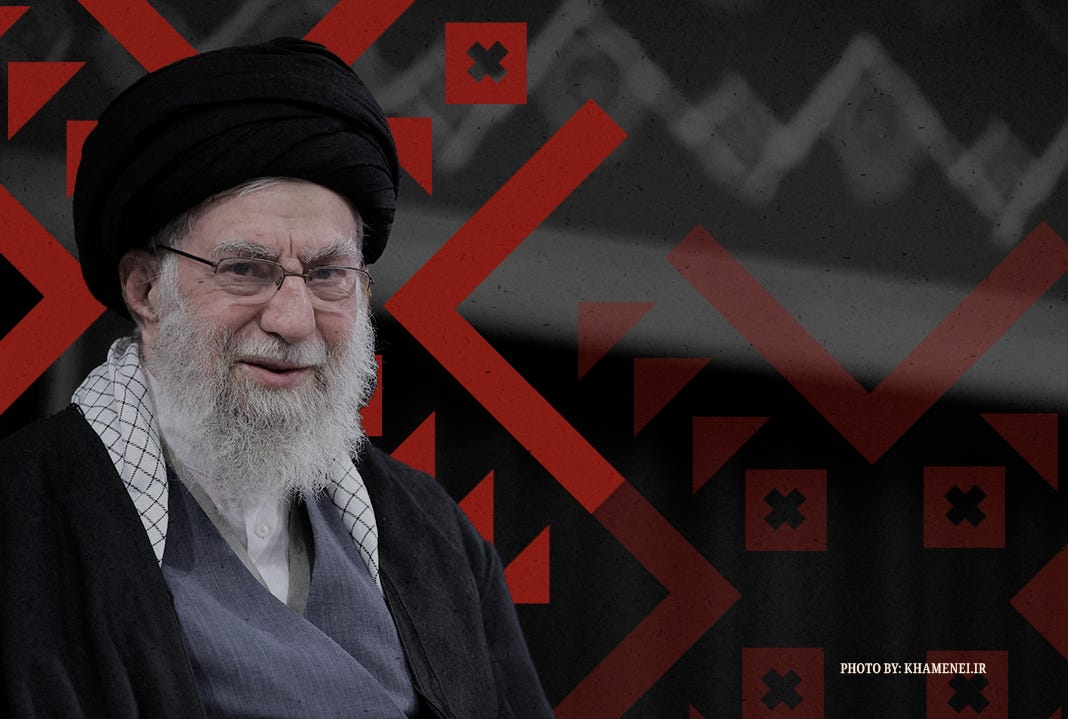
The Bloody Legacy of Ayatollah Khamenei
For more than 35 years, Iran’s Supreme Leader presided over executions, forced disappearances, and the lethal suppression of dissent. Reports of his death were met with open celebration inside Iran.
Ali Hosseini Khamenei ruled Iran for more than three and a half decades. He outlasted presidents, uprisings, sanctions, and generations of dissent, building a system that fused theology with security apparatus and leaving little room for political oxygen. When news broke that he had been killed in a joint U.S.–Israeli strike, reactions inside Iran suggested a suffocated nation could finally breathe again.
In some neighborhoods, people poured into the streets. Fireworks peppered the night sky. Videos circulated online of young Iranians dancing and people shouting, “The dictator is gone!” Other Iranians remained cautious, wary of reprisals, still uncertain about what comes next. But it is unmistakable that for millions of citizens, Khamenei’s death triggered a sigh of relief more than 35 years in the making.
To understand why, one has to understand the system he oversaw.
When Khamenei assumed the position of Supreme Leader in 1989, he succeeded Ayatollah Ruhollah Khomeini, the revolutionary cleric who reshaped Iran after the 1979 Islamic Revolution into a theocratic state rooted in the doctrine of Velayat-e Faqih, or guardianship of the jurist. He inherited not just a title but a constitutional mechanism explicitly designed to concentrate power in the hands of a single unelected authority. The office commands the armed forces, appoints the head of the judiciary, influences state broadcasting, selects key members of the Guardian Council—the body that vets electoral candidates—and ultimately sets the boundaries of acceptable political life. Over the decades that followed, Khamenei fortified that revolutionary architecture, tightening its grip and expanding its reach.
Over time, he used that authority to steadily strip Iranians of political agency—narrowing who could run, what could be said, and how dissent could be expressed without fear of retaliation.
The Islamic Revolutionary Guard Corps (IRGC) grew from a parallel military force forged to safeguard the 1979 revolution into a political and economic empire. It became a central pillar of domestic oppression and regional projection. The Basij militia (formally Sâzmân-e Basij-e Mostaz’afin, or “Organization for Mobilization of the Oppressed” is a large, volunteer-based paramilitary militia in Iran that acts as an auxiliary branch of the IRGC) embedded itself in neighborhoods and campuses. Elections were held, but candidates who strayed too far from the ideological line found themselves disqualified before ballots were printed.
Khamenei rarely governed in the daily sense; he did not need to. His authority functioned as a ceiling. Presidents came and went, reformist waves waxed and waned, but the system he constructed remained intact.
The defining chapters of Khamenei’s later tenure were written in the streets.
In 2009, after a disputed presidential election, millions of Iranians joined what became known as the Green Movement. Protesters alleged fraud and demanded accountability, and the state responded with force. Demonstrators were beaten, detained, and in some cases killed. Images of a young woman, Neda Agha-Soltan, bleeding to death on a Tehran street became an emblem of the crackdown.
Khamenei sided unequivocally with the security apparatus. The protests were framed not as civic dissent but as foreign-backed sedition, something he would go on to repeat time and again whenever Iranians dared to demand better.
A decade later, in November 2019, nationwide demonstrations erupted over fuel price hikes. Security forces used live ammunition against unarmed civilians. Human rights organizations estimated that hundreds—possibly more than a thousand—were killed in a matter of days. The internet was shut down across much of the country, isolating Iranians from the outside world as the violent suppression unfolded.
Then came 2022.
After 22-year-old Mahsa Amini died in morality police custody for allegedly violating Iran’s strict mandatory hijab law, protests spread with a slogan that would echo globally: “Woman, Life, Freedom.” The movement was led in large part by young women and teenagers who openly defied compulsory veiling. Once again, the response was severe. Rights groups documented hundreds of deaths, mass arrests, allegations of torture, and expedited trials. Several protesters were executed after proceedings that international observers described as deeply corrupt. Forced confessions were routine under Khamenei.
Each wave of unrest deepened the divide between ruler and ruled, but the state he built was carefully constructed to withstand dissent.
Iran has maintained one of the world’s highest per-capita execution rates. Under Khamenei’s leadership, the use of capital punishment expanded beyond ordinary criminal cases to include political charges such as “enmity against God” and “corruption on earth.” Human rights monitors reported hundreds of executions annually in recent years, including cases linked to protest activity.
Prisons like Evin became a place that, for many detainees, especially women, came to represent a kind of hell on earth. Former detainees described solitary confinement, forced confessions, sexual abuse, and psychological torture. Journalists, lawyers, labor activists, and women’s rights advocates, including 2023 Nobel Peace Prize laureate Narges Mohammadi, all found themselves vulnerable to arbitrary arrest.
Religious and ethnic minorities faced additional persecution under his tenure. Baháʼís were systematically barred from higher education and public employment. Kurdish and Balochi regions experienced heightened security operations. Women’s rights were systematically stripped, essentially rendering them second-class citizens.
As opposition mounted in the latter years of Khamanei’s rule, he responded by steadily shrinking the space for civil society.
Under Khamenei’s watch, Iranian intelligence services were repeatedly accused of targeting dissidents abroad—plotting kidnappings, surveillance operations, and assassination attempts against critics living in exile. Among the most prominent targets was journalist and women’s rights activist Masih Alinejad, who faced multiple Iranian plots to abduct or kill her on U.S. soil. Distance did not guarantee safety. The new tactics were designed to show that dissent, even from abroad, would be pursued and punished.
The Iranian government has repeatedly rejected accusations of systemic abuse from international governments and rights organizations, arguing that it was enforcing Islamic law and protecting national sovereignty. But the consistency of the allegations—across years and protest cycles—left an indelible mark on Khamenei’s legacy.
Khamenei expanded Iran’s regional footprint through alliances with armed groups in Lebanon, Iraq, Syria, and Yemen. Support for Hezbollah, involvement in Syria’s civil war in defense of Bashar al-Assad, and backing of various militias formed what Tehran described as a defensive “axis of resistance.” The deadly attacks perpetrated by Hamas in Israel on October 7, 2023, were supported by his regime.
These ventures drained resources from an already strained economy and entangled Iran in proxy conflicts. Hundreds of thousands left the country in search of a better future elsewhere. Ordinary Iranians bore the economic consequences of sanctions layered atop structural mismanagement and corruption as billions flowed abroad and IRGC leadership lived lavish lives. The Iranian passport became one of the most globally denied.
Inflation climbed steadily, eroding purchasing power as the national currency lost much of its value. Youth unemployment remained persistently high, leaving millions of educated young Iranians struggling to find stable work. For a generation born after the 1979 revolution, the regime’s promise of ideological steadfastness and resistance often translated not into prosperity or mobility, but into fewer economic horizons and opportunity.
Khamenei projected calm authority in public appearances with his measured speech, deliberate pacing, and religious framing. He often depicted unrest as a product of foreign interference and portrayed resistance as a moral virtue. He was a leader insulated from the daily realities of his citizens.
In recent years, Iranians reached their limit. “Death to the dictator” was chanted openly. Graffiti targeted him by name. The people had had enough, whatever the consequences. In January, thousands poured into the streets to protest not just their declining purchasing power, but the regime itself. The state’s response was ruthless: security forces opened fire on demonstrators, enforced a near-total internet blackout, and carried out what human rights groups described as mass killings across cities nationwide. Estimates of deaths exceeded 30,000 as authorities used lethal force to disperse crowds and suppress dissent on an unprecedented scale.
In the immediate aftermath, the state continued to respond with surveillance, arrests, and messaging campaigns emphasizing cultural authenticity and resistance to Western influence. But for an increasingly youthful Iranian population, these maneuvers resonated less than they did with previous generations. The new generation—digitally connected, globally aware—forcefully declared that a theocratic system that denied them basic agency had any claim to rule at all.
When reports emerged yesterday that Khamenei had been killed in a joint U.S.–Israeli strike, the geopolitical implications dominated headlines worldwide. Analysts debated the risks of escalation and succession scenarios. But inside Iran, cheers and celebrations filled the streets with the sound of a people who, for the first time in decades, might just be on the brink of freedom.
For families who have lost children in protests, political prisoners still behind bars, and young women who cut their hair and burned their hijabs in defiance, his death symbolizes the end of an era they spent years resisting.
But this is day two of what many believe will be a protracted military engagement, and people are afraid. The institutions Khamenei shaped remain intact for the time being. The Assembly of Experts has reportedly selected Alireza Arafi as his temporary successor. The IRGC is armed, and the citizenry is defenseless to fight back. A single death of a tyrannical dictator does not dismantle a system built over decades.
But it does matter.
Khamenei presided over a republic that brought death and destruction upon the people he was charged with leading. He will be remembered by unmarked graves, economic devastation, prison cells, public executions, and a generation that went unheard.
The question now is how the state he built will confront the society he leaves behind. And Iranians face a steep uphill battle ahead, no matter what happens next.
History will record the date of his death. Iranians will decide what it ultimately means.
Middle East Uncovered is powered by Ideas Beyond Borders. The views expressed in Middle East Uncovered are those of the authors and do not necessarily reflect the views of Ideas Beyond Borders.


