


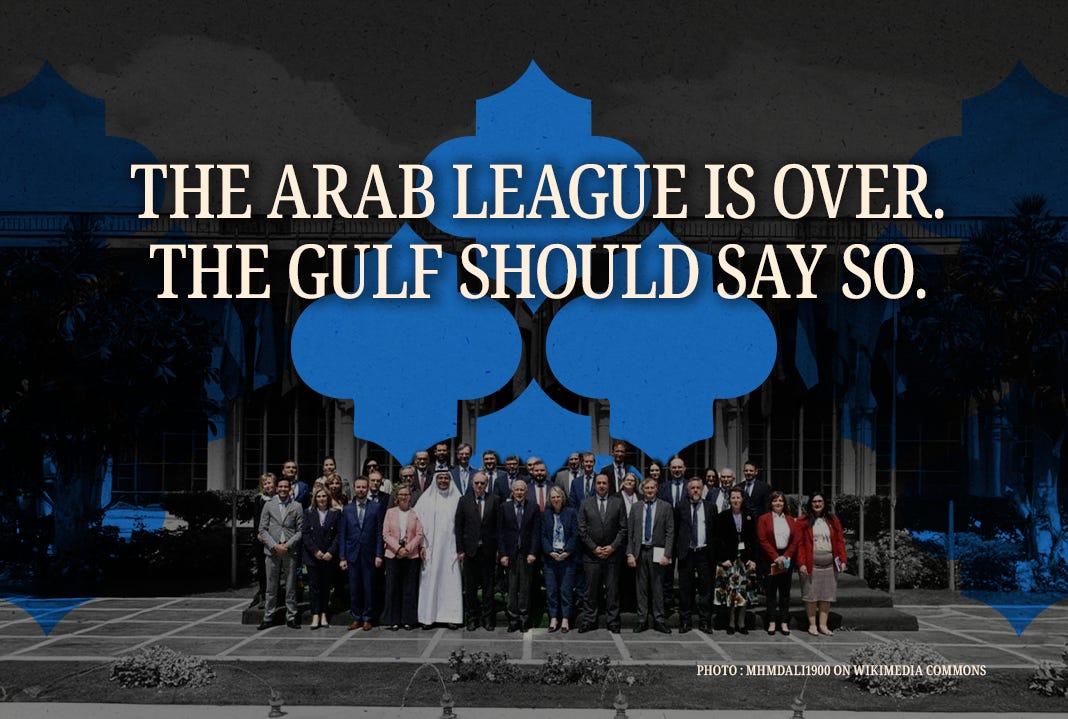
The Arab League endures the way a long-abandoned structure does: still standing, still recognized, but no longer where anything important happens. Its summits continue on schedule, yet they no longer organize the region’s politics. Those have moved elsewhere—into bilateral deals, security pacts, smaller blocs, and arrangements shaped as much by outside powers as by the states themselves.
As the Arab League dies, it is time for its members to recognize the Gulf’s new regional order.
Whereas the Arab League has weak institutions and ideological ties, the Gulf, through the Gulf Cooperation Council (GCC), has become the only successful bloc in the region, building something the average Arab can either be proud of or envy. The region needs results, and the Gulf must lead the charge.
The Arab League was born when Cairo emerged as the center of Arab political imagination. After WWII, wartime diplomacy produced the Alexandria Protocol of 1944 and, later, the founding Charter signed in Cairo on March 22, 1945. The League was built to bring the Arab nations under one roof, sharing a common cause and a sense of unity. Yet, the foundation depended on a central pillar: Egyptian convening power.
Today, that pillar no longer holds the same weight. While Egypt remains consequential, it also maintains constraints that render pan-regional leadership increasingly difficult. Economic pressure has tightened Cairo’s margin for geopolitical entrepreneurship. International Monetary Fund (IMF) reporting and international coverage show repeated stabilization cycles, reliance on external financing, and large Gulf-linked investment inflows have been critical lifelines in recent years.
Although a country managing macro and microeconomic stress may still influence the region, it cannot lead a project built on expansive regional coordination and ideological cohesion. The Arab League is missing its ideological anchor.
As Egypt’s Arabism shrinks, the Arab League collapses with it, as it never built mechanisms strong enough to function without a leader. This has become increasingly evident through state behavior, as the League’s basic maintenance has decayed. In 2017, Secretary-General Ahmed Aboul Gheit complained publicly that member states were not paying their dues: only 23% of the funding requirement had been received at that point in the year; only 44% of the budget had been covered the year before; and some members had not paid for three years.
Institutions that matter do not have to beg their members to bankroll their existence. That kind of refusal is evidence that the Arab League is on its way out.
The Arab League’s weaknesses are not episodic; rather, they arise from deep structural deficiencies.
First, the League’s early institutional instincts became its routine. Authoritarian leaders, most of whom arrived on coup tanks, learned to weaponize “Arab unity” as a shield to get the Arab League’s attention. They crafted agendas through collectivist language, got rid of accountability measures, and used the League as a stage to manufacture consensus, but never delivered its promised outcomes for the people. It became a vicious cycle: protecting regimes first, coordinating states second, and serving societies last—if ever.
In practice, the League evolved into an institution that normalized power grabs, sanctified repression through diplomatic language, and wielded “unity” as a tool to ensure regime survival. Its continuance preserved the illusion that something larger existed, even when member-states refused to act like members of anything.
The League’s voting decisions outlined in Article 7 of the Charter have effectively killed collective action. Today, unanimous Council decisions bind all member states while majority decisions bind only those states that accept them. This structure incentivizes veto-by-indifference. Any state can block a binding action simply by refusing unanimity, or can ignore majority decisions by refusing acceptance. To pass anything, the safest policy becomes the vaguest.
The Arab League also suffers from paralysis, caught in the same cycle with every crisis: internal division, carefully crafted public statements, delayed action, and outcomes shaped by actors outside the League.
The 1990 Iraqi invasion of Kuwait is one of the clearest examples of Arab collective security failing to stop catastrophe.
Kuwait explicitly appealed to the Arab League to activate its joint defense mechanisms and organize a military response, but divisions among member states blocked any unified action; even a basic condemnation was never issued, with several governments refusing to sign and others opposing the use of force altogether An emergency summit was delayed by disagreements and ultimately produced a split outcome—some states backed intervention, others rejected it, and key actors hedged or abstained.
In the absence of an effective Arab response, the crisis was quickly absorbed into the international system: the UN condemned the invasion within days, and a U.S.-led coalition of dozens of countries—not the Arab League—carried out the military campaign that expelled Iraqi forces and restored Kuwaiti sovereignty. This pattern—internal division, procedural delay, and reliance on external power—has repeated across subsequent regional conflicts, where wars spill beyond borders, rival states back opposing sides, and the League’s consensus-driven diplomacy produces statements that register concern but rarely alter outcomes.
In the latest war, a new test arrived at the Gulf’s doorstep. As Iran’s missile and drone strikes hit Gulf states, the Arab League’s response followed its familiar script: an emergency ministerial meeting, condemnations, and a call for the UN Security Council to act. The GCC, meanwhile, spoke and coordinated as a bloc, demonstrating what functioning blocs do when they are attacked. While the League agonizes over issuing statements, the Gulf actually produces policy.
The League’s fiction depends on pretending that “Arab” is a sufficient category for strategic coordination. Geography and incentive structures would disagree.
What concrete mutual benefit binds countries such as Mauritania and Bahrain tightly enough to form a meaningful security or economic bloc? One sits at the Atlantic edge of North Africa; the other sits on the Gulf’s contested waters. Their threat perceptions barely touch, and their economies do not interlock naturally. Their strategic horizons do not overlap in ways that can ever produce shared policy outcomes. This is only one of many such examples.
Arab nationalism reached its peak when it was utilized for power, most famously under the former president of Egypt, Gamal Abdel Nasser, who turned pan-Arabism into an instrument for geopolitical and domestic legitimacy. Despite my opposition to Nasserism on almost every level, it did offer a sense of purpose—misdirected, coercive, and often catastrophic, but purpose nonetheless.
Then came the long, slow march toward decay. Arabism diluted as its leaders lost power, promoting slogans without capacity and unity without any enforcement mechanism. A vacuum opened for another supra-national glue to unite the region, one that political Islam rushed to occupy.
In practice, political Islam was a leech on the region, feeding on collapsing economies, converting grievance into recruitment, and treating institutions as prizes to be won. It destroyed whole states, leaving behind failed governance and an exhausted, often radicalized, public.
Arabism and political Islam lost favor by mistaking identity for strategy. While identity mobilizes crowds, only shared interests, credible institutions, and binding commitments can govern states—a lesson the Arab League refuses to absorb.
By contrast, the GCC maintains coordination and strong institutions, sharing waterways, facing exposure to energy-market shocks, harboring deterrence anxieties, and experiencing economic interdependence. That coherence does not guarantee perfection, but it at least produces functionality. Research on Arab regionalism has long pointed out that smaller blocs tend to function better than the Arab League. Groups like the GCC have been able to coordinate more effectively not just because they include fewer countries, but because their members share closer political priorities and face similar security concerns—making agreement and action easier to achieve.
Voices in Gulf discourse have finally begun saying the quiet part out loud. Withdrawal, or at least a serious downgrading of the League’s relevance, is necessary for prosperity. The region must replace frameworks built on ideological unity with practical alliances. Doing so, however, would trigger outrage from capitals that treat “Arabism” as a rhetorical shield while exposing what the League has become.
In practice, institutions like this don’t disappear just because they stop delivering results. The Arab League is likely to keep holding summits and issuing statements, maintaining the appearance of a unified Arab political arena, even as actual coordination shifts elsewhere—toward smaller blocs and ad hoc coalitions built around shared interests rather than shared identity.
A declaration of death would not betray Arab identity. It would admit that identity alone cannot govern, defend, or develop. The League was born to reflect the Middle East of the 1950s, but today that world is gone—and it is time to state that plainly, rather than preserve a fiction no longer anchored in reality.
Middle East Uncovered is powered by Ideas Beyond Borders. The views expressed in Middle East Uncovered are those of the authors and do not necessarily reflect the views of Ideas Beyond Borders.

Who ever wrote this piece has no idea of what is really going on or how the MidEast and its leaders operate..in its short lived past the Arab league stripped countries of it memberships, removed countries from its rotating leadership and condemned other counties while still leaving them a seat at the table but with no representation from that said country.. saying the Arab league is done for because of what the UAE (mini country)might think it can or can’t do is laughable. It’s like saying the UN charter. Is done for because of what Israel another (mini country) is doing in Palestine.. the second never affected it nor would the first affect the AL.