

The Arab Initiative Racing Against a Global Surge in Antisemitism
A team of translators is tackling antisemitism by confronting its roots in the Middle East through education, empathy, and a return to a forgotten tradition of coexistence.

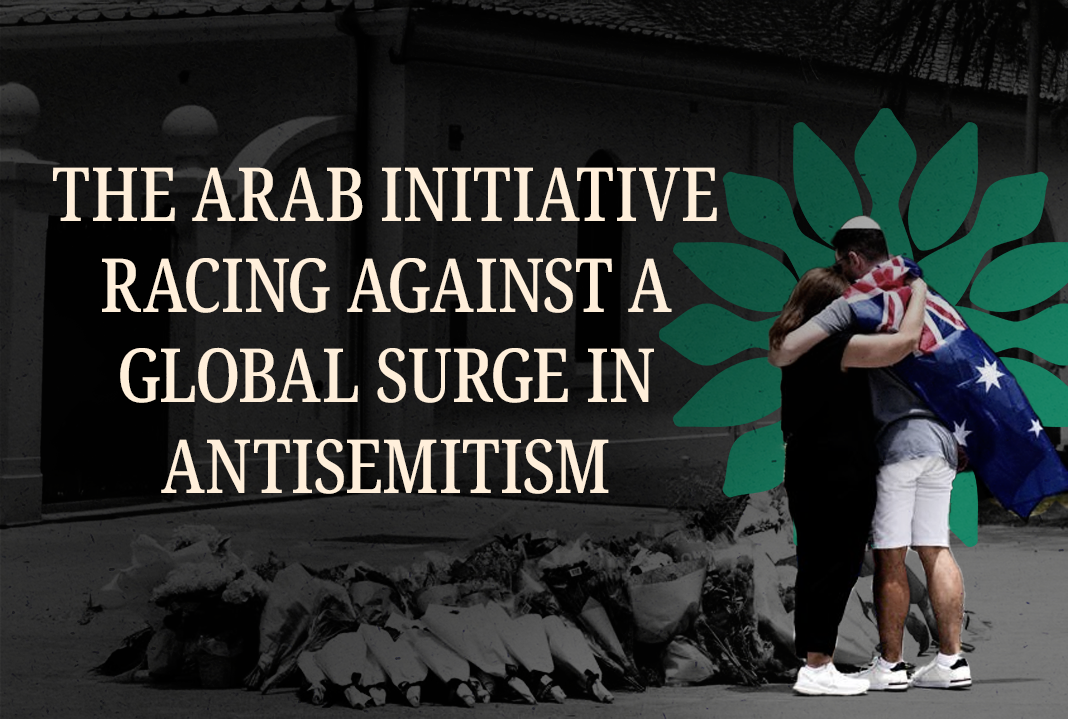
The antisemitic terror attack in Sydney yesterday was a harrowing reminder that hatred against Jews is not an abstract relic of the past. It is real, violent, and deadly—and it’s spreading. People were targeted simply for being Jewish. No political grievance or historical narrative can ever justify such violence.
At moments like these, solidarity must be clear and unconditional.
Over the years, I have spoken with many Jewish families of Arab origin whose roots extend back centuries to Baghdad, Aleppo, Cairo, Fez, and Sana’a. What many of them emphasize is a historical truth often ignored today: antisemitism, as an organized ideology of racial hatred, is largely a European invention. Pogroms, blood libels, racial theories, and ultimately the Holocaust were born in Europe. In the Muslim world, Jewish communities experienced periods of discrimination, but they were also scholars, physicians, merchants, and civil servants deeply embedded in society.
What changed this relationship was the Israeli–Palestinian conflict. A political tragedy was gradually transformed into a civilizational narrative, and antisemitism, once marginal in much of the region, was imported, amplified, and normalized. Jews ceased to be seen as neighbors and contributors to civilization, and were instead reduced to symbols and enemies.
This intellectual collapse is precisely what House of Wisdom 2.0, the initiative I lead at Ideas Beyond Borders (IBB), seeks to reverse.
More than a thousand years ago, Baghdad’s original House of Wisdom (Bayt al-Hikma) was one of the greatest centers of knowledge in human history. It was not defined by religion or ethnicity. Muslims, Jews, Christians, Zoroastrians, and skeptics worked side by side translating, debating, and expanding knowledge in philosophy, mathematics, astronomy, medicine, and engineering.
Jewish scholars were central to this project. Jewish physicians served Abbasid courts. Jewish translators preserved and transmitted Greek science. Jewish philosophers such as Maimonides shaped Islamic thought and later influenced European philosophy. This shared intellectual tradition helped produce what we now call the Islamic Golden Age.
Civilizations rose when diversity was treated as strength, not a threat.
We launched House of Wisdom 2.0 to revive this forgotten tradition in a modern context. Our mission is not political advocacy, but intellectual restoration: combating extremism, antisemitism, and Holocaust denial by expanding access to credible knowledge in the languages people actually speak.
My team has translated more than 70 high-quality Wikipedia articles on the Holocaust into Arabic alone, alongside additional work in Persian, Dari, Kurdish, and Pashto. These articles address topics that are often distorted or entirely absent in Arabic-language discourse, including Holocaust denial, extermination camps, gas chambers, survivor testimonies, resistance movements, and the Holocaust’s impact across Europe. Others document lesser-known histories, such as the Holocaust in Poland, France, Hungary, Norway, Belarus, and the Baltic states.
These articles receive tens of thousands of views. This work does not preach or scold. It documents. It corrects the historical record and makes denial harder to sustain.
In Pashto and Kurdish, languages spoken in regions where Holocaust education is almost nonexistent, House of Wisdom 2.0 has produced foundational articles explaining the Final Solution, Nazi concentration camps, Jewish rescue efforts, and international responses to the genocide.
We also translated How to Fight Anti-Semitism by journalist Bari Weiss into Arabic, making one of the most important contemporary analyses of antisemitism accessible to a new audience. The book confronts antisemitism from the far right, the far left, and Islamist movements, grounding the discussion in history rather than ideology.
Education matters most when it reaches people. Recently, we released a video about the historical House of Wisdom in Baghdad and the pluralistic civilization that produced it. The video explicitly highlighted how Jews, Muslims, and Christians worked together to advance science, medicine, and philosophy.
The response was extraordinary.
The video surpassed 11 million views, with millions more across platforms. Thousands of comments reflected genuine surprise. Many viewers encountered, for the first time, a narrative in which Jews were not portrayed as enemies or conspirators, but as partners in a shared civilization.
This response reveals something we all need to be reminded of in this moment: antisemitism in the Arab world is not inevitable. It is learned—and it can be unlearned.
Alongside House of Wisdom 2.0, IBB has also addressed antisemitism through BelArabi, an Arabic-language podcast and video program that tells Jewish stories in a human, deeply relatable way, something still extremely rare in Arabic media. BelArabi produced three major episodes confronting antisemitism from within Arab cultural memory itself.
One episode explored the life of Henri Curiel, a Jewish Egyptian peace activist assassinated for his political and anti-colonial work. Another told the story of Dr. Raymond Schinazi, a Jewish Egyptian doctor expelled from Egypt as a child who later returned to help develop treatments that saved millions of Egyptians from Hepatitis C, a story of exile, reconciliation, and scientific service that became the most viewed video on IBB platforms, surpassing 10 million views. A third episode, Helmy and Anna, presented the story of the Holocaust in Arabic in an engaging, empathetic format, a nearly nonexistent approach in Arabic discourse.
Together, these productions humanize Jewish experience, reconnect it to Arab history, and challenge antisemitism not through confrontation, but through storytelling, empathy, and shared memory.
Condemning antisemitism does not require abandoning empathy for Palestinians. These are not competing moral positions. Rejecting hatred against Jews is not a political concession. It is a moral obligation.
Ideas Beyond Borders and House of Wisdom 2.0 stand in unconditional solidarity with Jewish communities worldwide against violence, hatred, and Holocaust denial. We reject the attempt to excuse antisemitism as resistance or to justify dehumanization through political grievance. One can criticize governments and policies without erasing historical truth or legitimizing hatred.
The Arab world deserves better than imported bigotry. It deserves truth, dignity, and intellectual honesty.
The historical record is clear. When Jews, Muslims, and Christians worked together, civilizations flourished. When knowledge gave way to fear and scapegoating, civilizations collapsed.
House of Wisdom 2.0 is doing the slow, unglamorous work of rebuilding trust in facts, history, and shared humanity—one article, translation, and video at a time.
With antisemitic violence now surfacing across continents and poisoning public discourse at an unprecedented scale, confronting this crisis can no longer be treated as optional work. It is an urgent moral obligation—and for my team and me, a commitment we will continue to pursue with everything we have.
Middle East Uncovered is powered by Ideas Beyond Borders. The views expressed in Middle East Uncovered are those of the authors and do not necessarily reflect the views of Ideas Beyond Borders.
 | A guest post by
|
There is no global surge in anti semitism, that’s pure fabrication. Once again anti Zionism is conflated with antisemitism. There will always be in any society those who chose to hate and are easily manipulated into a particular mindset. It is this we should focus on changing through education and collaboration not more hate speech!
Fantastic! Excellent work, all the truth. The conflict in Great Jerusalem won't be resolved until the full territory is reunified in a single state with all communities empowered and protected, and jewish communities return and thrive in their traditional cities throughout west Asia and northeast Africa. only one small flaw - bari weiss advocates exclusion of arabs and genocide against gaza, in fact she engineered her career on playing the 'injured' card. not to worry, once citizens in west Asia are educated on history they can judge current polities for themselves. are you helping widen distribution of Pankaj Misra's 'the world after gaza'? it has an excellent survey of the Shoah. and Frederick Starr's 'Lost Enlightenment' traces the work of jewish scientific scholars in central Asia from around 500-1200 AD especially in Abbasid Khorasan. Including the jewish materialist scholar Hiwi.