


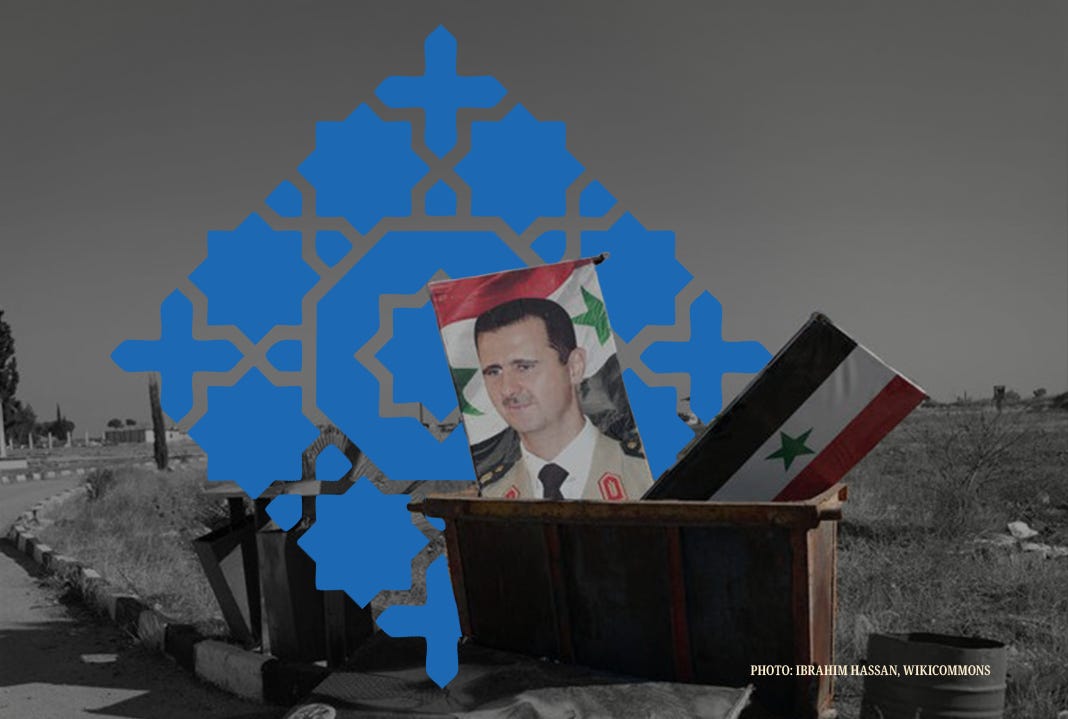
DAMASCUS, Syria — Earlier this month, a Syrian court sentenced former dictator Bashar al-Assad to death, along with his brother Maher and his cousin Atef Najib. The Assads heard nothing of it; they are still in Russia. Najib was in the room. The man Syrians associate with the arrest and torture of the schoolboys of Daraa in 2011 sat in the courtroom and listened as the judge condemned him.
There were celebrations outside the courthouse and in Daraa, and the families of the dead had earned every minute of them.
Then everyone went quiet.
I expected an argument. Whatever else we disagree about, I assumed a death sentence issued against Assad would set off at least a week of back and forth—not only on social media but in the streets here in Damascus, the taxis, the coffeehouses. People who wanted to see him get the rope. People who oppose the death penalty on principle. People worried about what a rushed trial does to a country that has barely started rebuilding its court system. Instead, the verdict landed like something we had all heard before. Expected. Distant. Almost beside the point.
I cannot even remember how I heard about it. I must have been scrolling through some website or another. And this is Syria, a country famous for its talkative taxi drivers, where a death sentence against Assad is a perfect occasion to strike up a conversation with an expat. Not one of them did. When I tried to start one myself, the drivers were dismissive. It is good, they would say. Then back to silence.
This isn’t because people are afraid. Most of them approved of the sentence. People are indifferent. Assad is living with his family in a luxury apartment in Moscow, and the odds of a Syrian verdict prying him out of it are close to zero. And anyway—how is any of this going to lower prices, create jobs, or stop the crime wave rolling across the country?
That reaction tells you more about the state of the transition than the death sentences do.
People here are busy. Prices are punishing. Garbage sits uncollected. Clinics that limped along last year are worse now. The electricity shortage is becoming a financial burden: a two-month statement can swallow a large piece of a public employee’s salary, and the metering errors have generated demands that families have no conceivable way to pay. The United Nations puts roughly nine out of ten Syrians below the poverty line. That is the audience the verdict was delivered to.
Meanwhile, the public sector has been emptied in waves—ghost workers, regime remnants, administrative dead weight, depending on which justification was on offer that month. Corruption went out the door. So did most of the people who knew how the ministries actually worked. The vacancies have gone to loyalists of the new authorities, many of them sincere, few of them prepared, all of them expected to learn how to do the job while the state tries to survive the week.
We are past the point where improvisation will cut it.
The trial was one example. The charges were historic, but the proceedings were sloppy. Legal monitors flagged thin evidence, a defense that barely functioned, and procedures unequal to the gravity of what was being adjudicated. Human rights groups objected to the death penalty and to the fact that Syria still has no concrete framework for transitional justice at all. We got the showmanship of a historic reckoning without the institutional weight to carry one out.
Which is not to say these men should not have been prosecuted. They should have been prosecuted years ago. But a verdict cannot be made credible by being popular. If due process is treated as optional where guilt is obvious, it will be worth nothing where guilt is contested—and it will be contested soon enough, in cases with murkier defendants that carry far more political weight.
To be fair, the new authorities inherited a wreck: a destroyed economy, hollowed-out institutions, millions of displaced people, a contested map, foreign armies and foreign agendas, and fourteen years of war stacked on top of half a century of dictatorship. Nobody rebuilds in twenty months what the Assads spent decades dismantling. And the government has accomplished real things abroad—recognition, sanctions relief, investment commitments that looked impossible in December 2024.
But the difficulty of the task at hand does not excuse the absence of a plan. A transition means moving deliberately from one political order toward another. It needs a destination, public mileposts, a sequence of reforms, and some standard by which Syrians can judge whether we are getting closer to it or further away. We have a provisional constitutional timetable. We do not have a credible, publicly owned account of what we are transitioning into, or how we are meant to get there together.
Without that, the transitional authorities are just tinkering. Change a tariff. Dismiss a director. Absorb a faction. Reverse the decision. Announce a commission. Improvise a trial. Hope something sticks. And some of it does. But an enormous share of the government’s energy now goes into managing the fallout of its own earlier improvisations turned mistakes.
The problem is not a shortage of good intentions. I think many of these officials are serious people who want the country to succeed. Wanting it is not a vision, though, and gravity of manner is not competence. The ideological blinders they wear are noticeable from Mars. What worries me more is how few of them can say out loud that they are out of their depth, or that they need Syrians from outside their own camp—secular technocrats, independent professionals, political figures with no desire to become anybody’s clients—to help.
I watched a veritable stream of such people come back to the country after Assad fell, some for the first time since the revolution began in 2011, some for the first time in decades. Highly qualified experts in their respective fields, all of them. Most trickled back to their host countries within a few weeks or months. I see very few of them around today.
I am not sure I can come back on a permanent basis myself. So far my interest has been less in paving the way for a return than in spending time with my aging mother. And I expect my fellow expatriates who came home hoping to invest in reconstruction to trickle out the same way, before long.
In less than four months, Syria will celebrate the second anniversary of Assad’s fall. There will be festivities, and the occasion warrants them. But the real test began the next morning, and nearly two years later, we still do not know what Syria is becoming. We have a collection of survival tactics, a handful of diplomatic wins, and a bet that time, money, and international patience will somehow pull a coherent state out of perpetual improvisation.
We are wagering on a miracle, and the transitional authorities currently lack the moral authority to see it come to fruition. I hope I am wrong. But more on that next week.
Middle East Uncovered is powered by Ideas Beyond Borders. The views expressed in Middle East Uncovered are those of the authors and do not necessarily reflect the views of Ideas Beyond Borders.
You argue that ‘to be fair’ the current thugs who occupy Damascus inherited a destroyed country. Yet, you fail to acknowledge that they are the ones who destroyed it in a rampage of slaughter, plunder and deliberate destruction comparable to Ghengis Khan. All done in hand with Syria’s greatest enemies - Turkey, Israel and USGOV.