


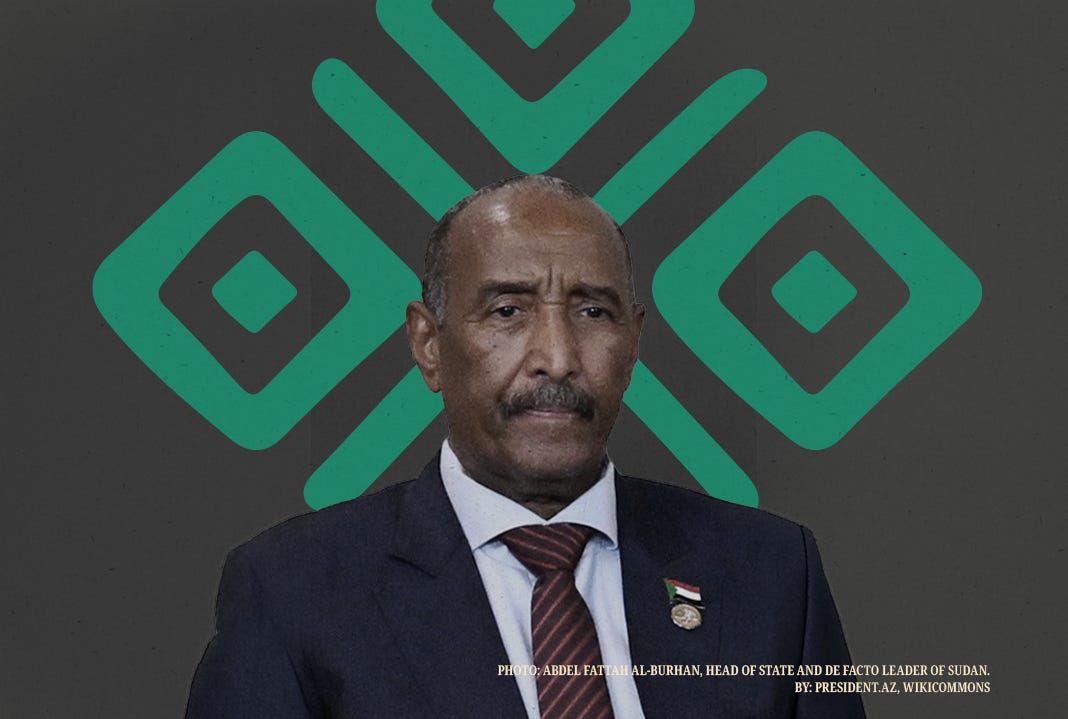
Sudan’s army stands accused of dropping chlorine on its enemies. Washington says it did and has imposed sanctions. Yet the two governments with the most sway over that army, Egypt and Saudi Arabia, have not publicly backed America’s demand that inspectors be let in to check.
The war began on April 15, 2023, when the army and Rapid Support Forces (RSF) exchanged fire in Khartoum. Once, the men giving the orders ruled together. General Abdel Fattah al-Burhan leads the army, and Mohamed Hamdan Dagalo, also known as Hemedti, leads the paramilitary. It has been more than three years since millions of civilians fled their homes, and neither side has prevailed.
Burhan’s army presents itself as the legitimate state defending the nation against a rebel militia. Washington no longer accepts that description, and the chlorine allegations deepen the doubt.
So, who should demand proof when a military stands accused of gassing its enemies? The countries that sway it most have not publicly joined that call.
Omar al-Bashir, the dictator who had run Sudan for thirty years, fell in April 2019 after months of street protests. Generals and civilians then agreed to govern together until elections. That arrangement ended on October 25, 2021, when Burhan dissolved the ruling council and detained the civilian prime minister, Abdalla Hamdok. Dagalo stood with him.
Since then, the army has fought alongside allies from Bashir’s old Islamist movement, which the revolution had tried to push out of politics. The largest is the Al-Bara' ibn Malik Battalion, a militia that grew out of Bashir’s Popular Defense Forces. The U.S. Department of the Treasury's Office of Foreign Assets Control (OFAC) sanctioned the brigade last September, citing Iranian training and more than 20,000 fighters.
In March, the State Department designated the brigade and its political parent, which Washington calls the Sudanese Muslim Brotherhood, a terrorist organization.
Washington’s language toward the army has also hardened. Massad Boulos, President Trump’s senior advisor for Arab and African affairs, says America does not recognize the current Sudanese government. American officials also withheld a visa Burhan needed for the United Nations General Assembly, linking it to a ceasefire proposal. He responded that Sudan cannot be blackmailed.
Let’s start with what the evidence shows.
Chlorine is a common chemical used to purify drinking water. Released as a gas from a bomb, it burns the lungs and can kill. Washington concluded in May 2025 that Sudan’s government used chemical weapons in 2024, and it has since imposed sanctions.
Two investigations published on September 5 add details. Built on leaked military material supplied by a regional intelligence service, they describe hundreds of chlorine-filled bombs, tests in the desert, chlorine apparently diverted from civilian water treatment, and efforts to scrub a storage base afterward. Intercepted messages suggest Burhan knew of the program.
Port Sudan, the Red Sea city where the army-run government has operated since the fighting reached Khartoum, denies the allegations. It says it is willing to work with the Organisation for the Prohibition of Chemical Weapons, the Hague-based treaty watchdog known as the OPCW, and that its own investigative committee was never meant to replace it. Outside experts call the dossier consistent with a weapons program but say only inspectors on the ground can settle the question. Washington has asked Sudan to grant access without conditions.
Neither Egypt nor Saudi Arabia has publicly joined that demand. Both belong, with America and the United Arab Emirates, to “the Quad,” the four-nation group trying to broker a ceasefire.
Egypt, which has deep military ties to the army, never joined the Chemical Weapons Convention. Saudi Arabia did, and holds a seat on the OPCW’s governing council through 2027, as Sudan itself does. Riyadh also co-hosted the 2023 Jeddah ceasefire talks, and in April Crown Prince Mohammed bin Salman received Burhan there. Under the treaty, any member can request a challenge inspection of another. Blocking one takes a three-quarters vote of the council.
Several countries have asked the OPCW to seek clarification from Sudan. The OPCW has not named all of them. Former OPCW investigators warn that physical evidence fades with every month of delay.
Burhan’s recent Foreign Policy essay asks the world to trust Sudan to engineer its own peace. It calls for a single national army and treats the RSF as a rebel militia. The paramilitary grew out of the Janjaweed, the Arab militias Bashir’s government unleashed in western Sudan’s Darfur region to fight a rebellion that began in 2003. The United Nations says 300,000 people were killed.
Burhan was in Darfur then, too. He was sent there as the army’s regional commander, and researchers say he coordinated army and militia attacks on civilians. He denies wrongdoing and has never been charged.
None of this absolves the RSF. After they took the Darfur city of El Fasher last October, following an 18-month siege, United Nations investigators found hallmarks of genocide against the Zaghawa and Fur communities. Last month in Geneva, the same fact-finding mission told the Human Rights Council it has reasonable grounds to believe both sides committed serious violations that may amount to war crimes.
Washington’s refusal to confer legitimacy is welcome, but words alone change little. The Quad’s plan calls for a three-month humanitarian truce, and it needs enforcement. Washington has asked the Security Council to extend to all of Sudan the embargo on weapons shipments that has covered Darfur since 2004. That would squeeze both armies and the foreign governments supplying them. The United Nations says it is ready to investigate the chemical weapons claims if member states grant a mandate.
Civilians also need a seat at the peace table. Abdalla Hamdok, the former prime minister detained by General Abdel Fattah al-Burhan in 2021, now leads Sumud, a civilian coalition that says it supports neither side in the war.
Neither Burhan nor Dagalo should be allowed to trade a ceasefire for a claim to power. Sudanese took to the streets in 2019 to end rule by generals. A peace written by the men who ended that revolution would betray them.
Middle East Uncovered is powered by Ideas Beyond Borders. The views expressed in Middle East Uncovered are those of the authors and do not necessarily reflect the views of Ideas Beyond Borders.

The Sunni Mecca Pact (Turkiye, Pakistan, Saudi) is digging ever deeper into interventions in civil wars to back regressive, terrorist factions that also oppose in some cases industrializing unifying states, such as Ethiopia and Iran. This is wrong headed and will punish these powers with defeat after defeat until they get on the right side of self determination, disinterested exchange for processization and industrialization of all countries.