

Slavery Did Not Bypass the Middle East
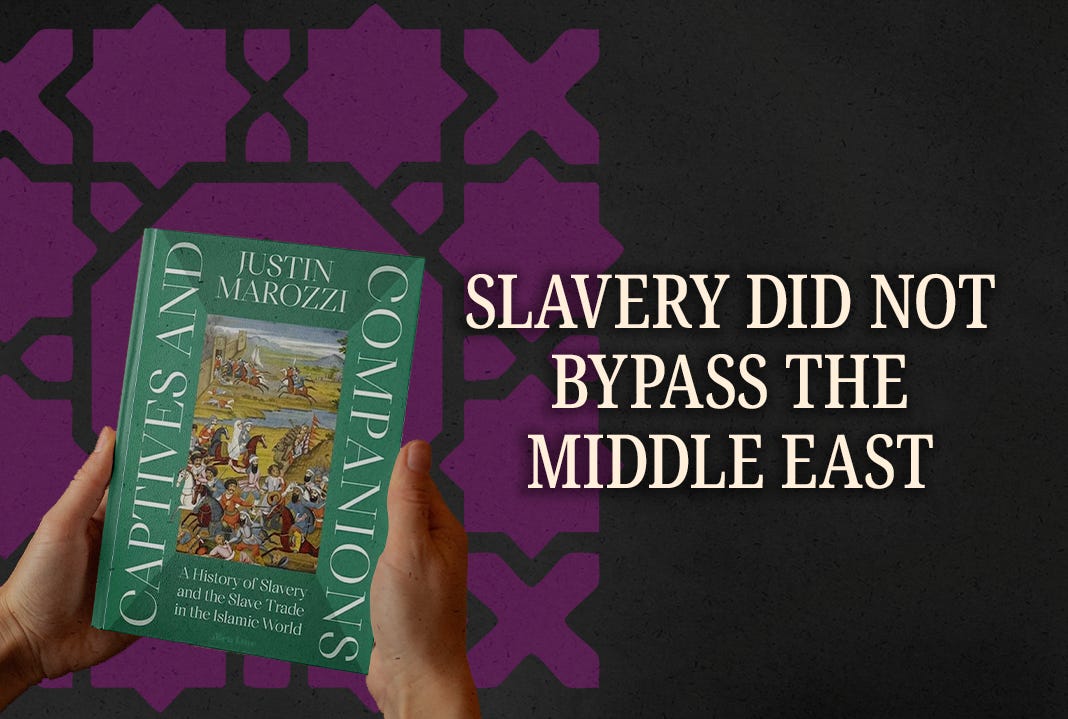
In “Captives and Companions,” Justin Marozzi documents the scale, duration, and normalization of slavery across the Islamic world, and the lack of historical reckoning that followed its decline.

Despite being born in the Middle East, I grew up learning far more about slavery elsewhere than in the region of my own origin. The Atlantic trade, American plantations, European abolition—these were the stories we were told, reinforced by textbooks, films, museums, and public debate. Slavery was something that happened “over there,” carried out by others, confined to an infamous chapter of Western history. What occurred closer to home was glossed over or not mentioned at all, wrapped in euphemism and explained away as an anomaly.
It was almost as if there was a collective decision to avoid reckoning with the more uncomfortable parts of our history.
Slavery in the Middle East and the broader Islamic world was not a minor or short-lived practice. It was widespread, embedded in social and political life, and lasted for centuries. It affected everyday households, labor, military structures, and systems of rule, and it continued even as governments changed and outside pressure mounted. Because it ended slowly rather than through a single defining moment, it never forced the kind of public reckoning seen elsewhere and instead slipped out of view over time.
Conservative historical estimates suggest that between 10 and 18 million people were enslaved and transported through Islamic slave systems between the seventh and nineteenth centuries. These networks spanned the trans-Saharan routes, the Red Sea, the Indian Ocean, and the Mediterranean, stretching from West and Central Africa to North Africa, the Levant, Anatolia, Persia, and the Gulf, and in some regions continued into the early twentieth century.
In the Crimean and Black Sea regions alone, historians estimate that roughly two million slaves were captured and sold between the fifteenth and seventeenth centuries. By the mid-nineteenth century, Zanzibar had become one of the world’s largest slave markets. British officials reported that nearly every household owned slaves—ranging from a few among the poor to hundreds or even thousands among the wealthy. These were widely adopted systems in which slavery functioned as a default labor arrangement rather than a moral aberration.
The lack of acknowledgement in the modern Middle East has made it easier for later generations to think they were more removed from the system than they actually were.
Justin Marozzi’s Captives and Companions lays out the historical record in detail. Marozzi draws on a wide range of sources from different periods and regions, and the accumulation of evidence makes denial difficult without the book ever needing to push its point. It doesn’t engage in moral posturing, but paints a clear picture that’s hard to dismiss.
The world Marozzi reconstructs is not divided neatly along civilizational lines. The Mediterranean emerges as a shared economy of captivity. Christians enslaved Christians. Muslims enslaved Muslims. Jews were caught between competing powers. Europeans preyed on Europeans, while North African corsairs captured Italians, Spaniards, Greeks, and even Icelanders. European pirates enslaved North Africans in return. As Marozzi writes, “Corsairing and piracy was a free for all which paid little respect to faith or nationality.”
That observation undermines modern attempts to weaponize history in defense of identity—to point outward while refusing to look inward, or to treat slavery as a moral cudgel rather than a shared human catastrophe.
Yet the Mediterranean story, brutal as it is, is only part of the picture. Beyond it lay the Saharan and trans-Saharan routes—older, longer-lasting, and far less acknowledged. For centuries, caravans transported men, women, and children northward from sub-Saharan Africa, feeding labor markets across North Africa, the Middle East, and the Indian Ocean. These routes predated the Atlantic trade and outlasted it.
Marozzi recounts the arrival of a caravan of 1,400 enslaved Africans in Murzuq, Libya, in the early nineteenth century. The accounts describe these scenes as routine. Observers wrote about people so exhausted they could barely walk, children emaciated from hunger, and captives forced to carry heavy loads while their enslavers rode alongside them with whips. In some cases, enslaved people were left to die on boats rather than brought ashore, simply to avoid paying a per-person fee—decisions driven by cost and efficiency, not just cruelty.
What makes Captives and Companions especially relevant for readers in the region is that it draws on Islamic and Ottoman sources alongside European ones. Marozzi includes letters from Muslim captives, reports by Ottoman officials, and petitions from communities protesting the illegal enslavement of women and children. He also cites personal accounts, including an Andalusian poet enslaved in fifteenth-century Spain who wrote about the physical and psychological toll of enslavement, and a Muslim captive in Marseille in 1682 who described galley slavery rife with hunger, chains, beatings, and religious humiliation.
And yet one of the book’s most unsettling insights is how often Muslim captives wrote relatively little about their suffering—not because it was mild, but because it was internalized as normal. As Marozzi notes, “Captivity was God’s will, and every Muslim had to accept it and not make too much of it.” Endurance came to be seen as a virtue, while protest was deemed inappropriate. Over time, this mindset made it easier to forget what had happened.
Marozzi also debunks a familiar defense: that because some enslaved individuals rose to positions of power, the system itself was somehow benign. He documents these trajectories in detail—slave soldiers who became generals, enslaved boys who rose to govern, and concubines who wielded political influence. But rare cases of success do not justify the system itself. The fact that some people were able to improve their position does not change the violence of capture, the trauma of separation, or the indignity of being owned.
This is particularly evident in the Ottoman case, where slavery was integrated into governance and military organization. Systems often romanticized today as meritocratic are shown to be, instead, deeply normalized forms of human ownership. Even legally protected minorities were not always safe. Marozzi documents petitions from Armenian communities protesting the enslavement of their women and children, despite their formal status as protected subjects. As he writes, “The enslavement of zimmis was a permanent feature of Ottoman society for a considerable time.”
The most disturbing moment in the book comes when Marozzi draws a direct line to the present—linking historical enslavement practices to the enslavement of Yazidis by ISIS in 2014. ISIS did not invent slavery. It revived arguments and justifications already embedded in the historical playbook—who could be enslaved, who was excluded from protection, and who could be treated as legitimate targets. The widespread shock revealed how little this history had been confronted or remembered.
Western readers do not emerge unchallenged either. European abolitionism comes across not as a simple moral victory, but as selective and often shaped by self-interest. Britain opposed the slave trade while continuing to tolerate slavery when it suited its economic priorities. As one historian quoted by Marozzi notes, “The tender conscience of the British abolitionists was not yet troubled by the consumption of slave-grown goods.”
What Captives and Companions ultimately calls for is a more honest look at how extensive and long-lasting the practice was. Slavery in the Islamic world lasted longer than the Atlantic trade, spanned a wider region, and adapted more readily to political change. Because it ended unevenly and lacked a clear break, it was never fully confronted or incorporated into public memory, making education selective and denial easier.
For societies still grappling with sectarianism, hierarchy, and selective empathy, this history matters. The categories that once justified enslavement—infidel, heretic, deviant, outcast—did not disappear. They were repurposed. If they are to be dismantled in the present, they must be confronted honestly in the past.
Rather than demanding self-flagellation, Marozzi’s book calls for historical adulthood: the willingness to look squarely at what was, without using the past to excuse or attack. The question it leaves readers with is not whether slavery existed—that is settled. It is whether we are prepared to remember it clearly enough to ensure it does not return under another name.
Middle East Uncovered is powered by Ideas Beyond Borders. The views expressed in Middle East Uncovered are those of the authors and do not necessarily reflect the views of Ideas Beyond Borders.
Very well taken points and extremely well worded: "... modern attempts to weaponize history in defense of identity", "treat slavery as a moral cudgel rather than a shared human catastrophe." Thank you for bringing the information in this book to our attention. Also thank you for bringing "Letter to a Young Muslim" - another great contribution to the discourse of our times - to our attention.
I'm now very interested in this book :) There's seems to have been an overcorrection when comparing slavery in the West vs the "East".