


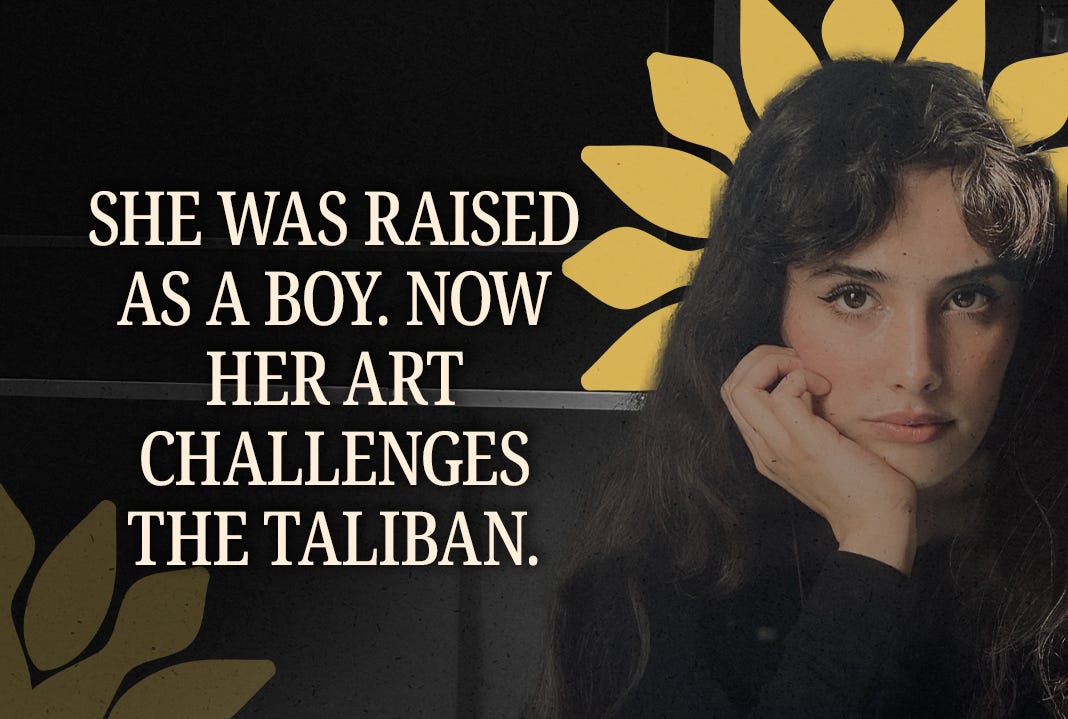
In the fall of 2023, Fatima sat alone in Doha’s airport terminal waiting for her flight to Boston when a sudden realization struck her. She looked around anxiously, questioning why she was there and what she was thinking when she boarded that flight to Qatar. The shy, subdued girl that she was, Fatima panicked and hoped that her next flight bound to America would somehow return her to Pakistan, where she had just left her weeping brother behind the airport gates a few hours ago.
Of course, she had reasons to be anxious about the journey ahead. Fatima Wojohat, now 23 years old and living in Franklin, Massachusetts, has lived a life where she has adopted a completely different identity based on a cultural gender construct that defined her for most of her life. Fatima, despite being born a girl, was raised to pretend to be a boy. This practice is known as Bacha Posh, in which a girl is dressed as a boy from an early age, usually for safety, pragmatic mobility, or economic reasons. Fatima’s teenage years were spent trapped in an identity that did not really belong to her. Was she really ready to embark on a journey to America, knowing she struggled to talk to strangers without hiding behind her mother?
In Afghanistan, a deeply entrenched patriarchal culture exists that is rarely acknowledged or discussed in wider literature. In a society where conservative values are widespread and access to education is limited, men have historically been entrusted with guarding family honor—often by exerting control over female relatives, who are frequently viewed as potential sources of shame rather than sources of pride. The arrival of a son is celebrated with gifts for the mother, while the birth of a daughter is seen as much more somber and, in some cases, unwelcome. In lower-income households, especially, mothers who bear only daughters may face mistreatment for their perceived failure to produce male heirs, boys who represent vital working hands for struggling families. In some cases, girls in these households are dressed and raised as boys until puberty.
Fatima was not just any Bacha Posh. Her family did not see girls as liabilities, nor did they suffer from poverty; there was more to it than just that. Born in Pakistan, Fatima returned to Kabul with her family at age 5. “My mom said to me that if I wanted freedom and security in this country, then I needed to cut my hair, adopt a male name (Safa), and become a boy,” she told me.
“I remember the first day of school with my younger brother, who is also my best friend. I asked him where I should sit. With the boys or the girls?” she recalled, “I didn’t know where I would fit.” Fatima’s brother asked her to sit with him because he was afraid the other kids would make fun of his sister if they knew she was a girl without long hair or a dress.
Usually, Bacha Posh starts at a very young age and ends after puberty. But in Fatima’s case, it lasted until she was 17. “My elder sister was also a Bacha Posh, but she stopped being one at a young age,” she said. When asked about why she didn’t stop being a Bacha Posh, Fatima replied: “I noticed that I had tremendous freedom and liberty in that country [living as a boy], so I continued with it until late in my teens.”
Fatima’s parents were both government workers who spent their days at their jobs and returned home at night to three daughters and a young son. During the day, her father worked as the minister’s photographer, and her mother was an administrative assistant at the Ministry of Hajj and Religious Affairs of the Islamic Republic of Afghanistan. They believed that by pretending their daughters were boys, they would feel more secure in a country plagued by severe abuses and injustices affecting children, especially young girls. Fatima said, “I was indeed mad for some time thinking that a good portion of my childhood was not spent with dolls and femininity, but on the other hand, as I grew older, I realized that we lived in a very wretched society, and it was for my own protection.”
Afghanistan has consistently been ranked as one of the worst countries in the world for women, often holding the very bottom spot in major international indexes. The World Economic Forum’s Global Gender Gap Index ranks Afghanistan last globally, and Georgetown University’s Women, Peace and Security Index has placed it at the bottom of 177 countries every year since 2021. The UN Women’s 2024 Afghanistan Gender Index revealed a shocking 76% gap between men and women in areas like health, education, financial inclusion, and decision-making—the second-largest gender gap worldwide. Afghan women currently access only 17% of their potential in opportunities and personal choices, compared to a global average of 60.7%. Nearly 80% of young women are completely excluded from education, employment, and training.
As she grew up, Fatima slowly realized she needed to become the agent of her own life and direct it as she wished. From a young age, she had a special gift for sketching faces and portraits. “My family and relatives would ask me to draw their portraits,” she told me, “I was not perfect, but I tried my best.” It was clearly an understatement from Fatima, because she would prove not only to her family and relatives that she is truly an artist, skilled and passionate, but also to her city as she won multiple provincial art competitions and was praised by state officials.
Fatima’s mother saw her daughter’s potential and decided to reach out to one of Afghanistan’s most influential and well-organized art collectives, Artlords. She secured a place for her daughter and boosted her social skills by having her join the group. At 17, Fatima was among the youngest members of Artlords, alongside university students and graduates. She described the first day as if “my mom was dropping me off at a day care, she even told them what time I should have my lunch,” showing her initial struggle to socialize after living all her life in a duality.
Fatima’s talent and skills quickly proved she was a valuable addition to the Artlords team. The collective is famous for its street murals across Kabul. Fatima’s first street art was a piece she created with her teammates outside Istiqlal High School, depicting Zalmai Khalilzad at the signing ceremony with Taliban officials in Doha during the 2020 peace agreement—an agreement that ultimately led to the return of the Taliban just a few months later, plunging Fatima and millions of Afghan girls into house arrest.

Fatima described her mother as brave, outgoing, kind, and a poet at heart. Her mother remembers all too well the first time the Taliban ruled Afghanistan. One evening, while Fatima’s mom was visibly pregnant with her elder sister, she went to see her parents on the other side of the city. Of course, Fatima’s father had to accompany his wife. “My mom said Taxis would avoid couples at that time, fearing that they might not be in wedlock,” she said. “So my mom and dad decided to walk all the way to Khair Khana from our house in Share-e-now.” The journey was abruptly cut short when a Taliban truck pulled up next to them and immediately started questioning the couple separately. When asked to provide marriage certificates, the couple had nothing to show as the papers were at home. “They started beating my father with the Kalashnikov stock while they kicked my mother in her belly, hoping to terminate the pregnancy; they said this child is a bastard.”
In August 2021, as the Taliban rolled into the streets of Kabul again, Fatima’s mom rushed home, remembering the first regime and thinking about the future of her children. Fatima’s mom cried to her father, “Last time they wanted to kill our daughter, this time they will take them away.” Her mom refused to work at the ministry anymore.
Fatima turned to art once again to avoid the depressive cycle of waking up and going to sleep in the confinement of their own home. “Life became dull,” she described the first weeks of Taliban rule while adding, “My biggest dream was to attend the American University of Afghanistan, study political science, and secure a job as a diplomat with the foreign ministry.” Fatima’s art was always personal to her, and she was hoping to keep it that way.
After witnessing the Taliban’s brutality and their oppression of women in Afghanistan, Fatima decided to push back and resist, starting with the Taliban’s supreme leader. “I learned how to do digital art on my phone and started drawing with my fingertips,” she added, “I used to publish on Instagram, and then delete everything and turn off my location because I would get death threats from the Taliban telling me that they are going to find me.” For 3 years under Taliban rule, Fatima courageously drew, sketched, and painted the Taliban’s supreme leader, their draconian laws, abuses, and human rights violations in the context of caricatures and political art. She grew her Instagram following from a few supporters to thousands, even attracting the attention of diaspora media such as Afghanistan International.


“We did not feel safe after 3 years in the country because our own family and relatives would tell me to stop my work,” she said. “I honestly did not care if I was caught, but I did not want my family, who are innocent, to be persecuted because of me.” At that point, the family had received confirmation numbers for their humanitarian parole applications to the United States—a program that allowed vulnerable Afghans to request temporary entry but has since been halted by the new American administration. Believing they might soon be able to leave, they sold all their belongings and moved to Pakistan.
The family endured economic hardship in Pakistan, where everything is twice as expensive for Afghan immigrants, and where the Pakistani landlords constantly ask Afghan families to marry their daughters. “The owners of the houses would ask us to be married to him if we wanted to live in their building,” she recalled. But Fatima did not lose hope. A few months later, the director of Scholars at Risk asked Fatima to apply to Dean College. She did, and a few weeks after, she found herself on the doorstep of the American embassy in Islamabad, waiting in line to acquire her student visa.
“I never stopped working even while in Pakistan,” she recalls, “I was told at the time that the Pakistani police have a connection with the Taliban, but I still worked and posted my art online.”
In September 2023, Fatima left her family behind to seek a better future in the United States. The girl who had once lived as a boy named Safa, caught between the freedoms and contradictions of the Bacha Posh tradition, suddenly found herself alone. At the same time, her family waited another year before they could meet again, this time in California. Fatima is in her 3rd year of studies at Dean College, where they formed a new art department just to accommodate her, instruct her, and save her life. They requested that Professor Amy Adams, whom Fatima has spoken highly of, take on the challenge of elevating an already gifted young artist from Afghanistan who stood against the Taliban’s supreme leader.
Fatima held her first exhibition at the Franklin Public Library—America’s first public library, founded through a donation by Benjamin Franklin, who believed deeply in the power of knowledge and education for democracy. For Fatima, an Afghan artist who had defied the Taliban through her work, the exhibition was a powerful moment. Three months later, she held another show, displaying more than 50 original pieces.
She was quick to point out one thing, however: Her artwork is not for sale. “The artwork that I create is for me personally; they have extreme meaning to me and are of importance,” said Fatima while adding, “If people want me to paint for them, they just have to ask; I don’t want my paintings to be sold because they are precious to me.”
Fatima’s story reflects the complex reality many Afghan women currently face. Living as a boy gave her a glimpse of the freedom and independence typically reserved for men in Afghanistan’s deeply patriarchal society. Yet despite the barriers placed before them, Afghan women have repeatedly shown their determination to resist a system that seeks to strip them of their agency.
Fatima used her art to challenge the Taliban and their oppressive ideology, a choice that ultimately forced her to flee her country. Now in exile, she continues that fight from afar through work that confronts dominant narratives about Afghanistan and amplifies the voices of Afghan women. Her story reflects the breathtaking tenacity of thousands of Afghan girls navigating a society shaped by restrictions many around the world can scarcely imagine. This International Women’s Week is a reminder that true gender equality remains out of reach while regimes like the Taliban continue to deny women their fundamental rights.
Middle East Uncovered is powered by Ideas Beyond Borders. The views expressed in Middle East Uncovered are those of the authors and do not necessarily reflect the views of Ideas Beyond Borders.