


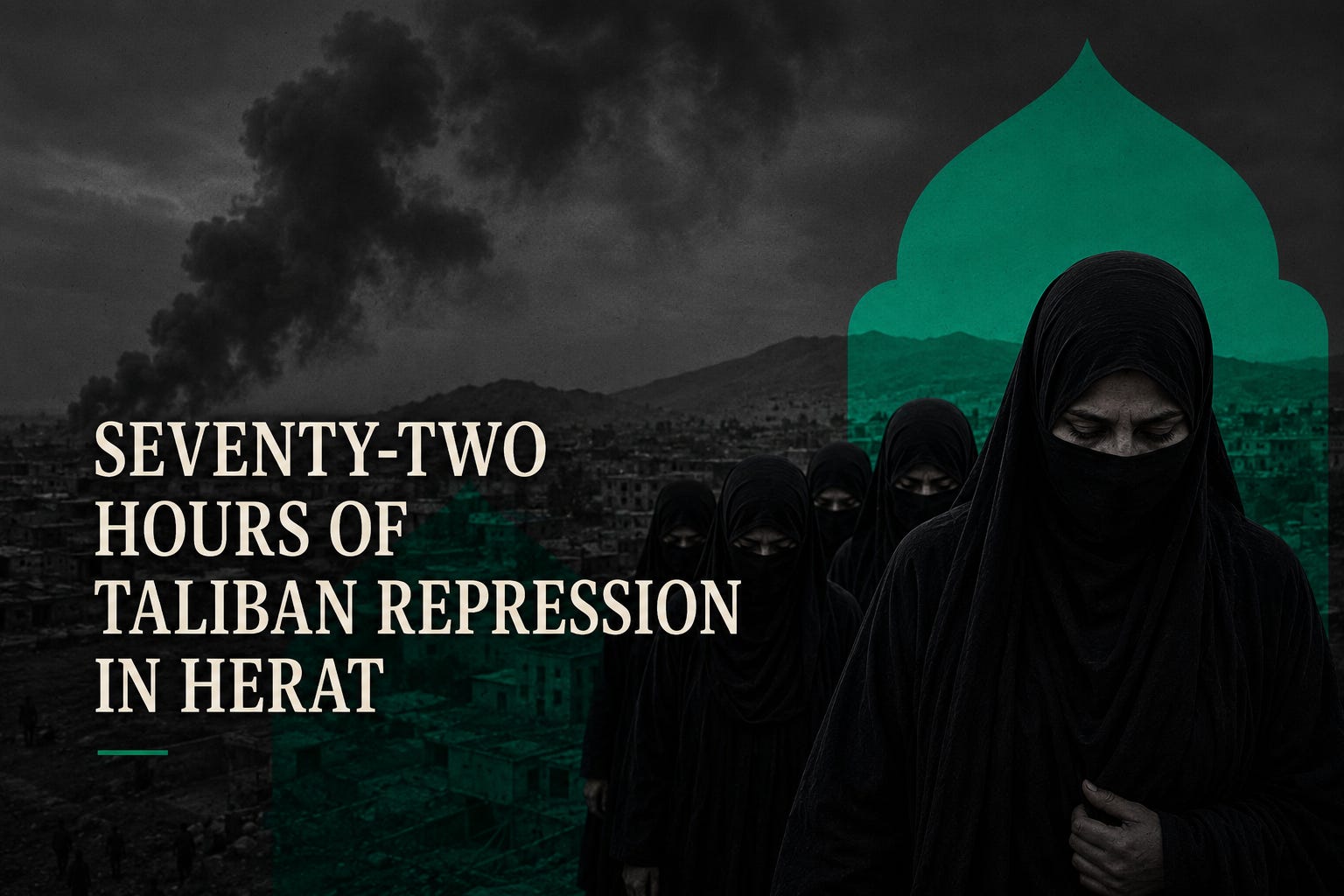
In the span of seventy-two hours, the Taliban turned Herat into a laboratory of fear—arresting women on the street for the shape of their veil, shooting into crowds demanding accountability, and killing a child who had innocently wandered into the wrong moment in history.
The crackdown began stealthily, as they often do under this regime: uniformed patrols fanning out through the Jebrail district with lists of violations and an expanding definition of transgression. Within days, dozens of women and girls had been detained on charges of failing to meet Taliban dress code standards. Eyewitnesses described scenes of arrests that defied even the Taliban’s own proclaimed criteria—women already wearing conservative Islamic dress, seized anyway, hauled away in vans while neighbors watched in silence or looked at the ground in shame.
The arbitrariness was the point. It always is. When a law can change at the whims of those who enforce it, it protects no one.
“Women already wearing conservative Islamic dress were seized anyway—hauled away while neighbors watched in silence.”
Eyewitness accounts, Jebrail district, Herat
The Crackdown
Public outrage, suppressed but not extinguished, resurfaced on June 9. Residents of Herat gathered in protest—not with weapons or flags, but with voices and bodies in the street, the oldest and most vulnerable form of political speech. The Taliban’s response was to open fire on the crowd.
According to multiple local sources and eyewitness testimony reported by Afghanistan International, the fusillade left several protesters wounded, others detained and dragged into vehicles, and one person confirmed dead: a 12-year-old child, struck by Taliban gunfire as forces shot directly into the gathering.
A child old enough to understand injustice. Not old enough to have imagined this outcome. The Taliban did not issue a statement of regret.
They rarely do.
Documented in 72 Hours—Herat, June 2025
Dozens of women and girls arrested for alleged dress code violations in Jebrail district
Multiple eyewitnesses confirm detainees were already wearing conservative Islamic clothing
Taliban forces discharge firearms into a civilian protest crowd on June 9
Several protesters wounded; an unconfirmed number detained
At least one civilian killed; local accounts confirm the death of a 12-year-old child
Independent casualty verification blocked by Taliban access restrictions
The World’s Response
The timing of this tragedy unfolded against a backdrop of renewed international deliberation over engagement with the Taliban—diplomatic conversations, relief pipeline negotiations, and in some capitals, discussions about how to normalize what has proved impossible to reform.
While Afghan women were being arrested for their appearance on the streets of Herat, delegations elsewhere were preparing new political channels with the men who ordered those arrests. The juxtaposition is the permanent condition of Afghan women under Taliban rule: their suffering does not pause for diplomacy. Diplomacy, however, has repeatedly paused—and looked away—from their suffering.
“Their suffering does not pause for diplomacy. Diplomacy, however, has repeatedly paused—and looked away.”
The question hanging over every chancellery and UN anteroom is no longer whether the Taliban violates human rights. That is settled, documented, and beyond dispute. The question is whether the international community has decided, in practice if not in rhetoric, that those violations are a price it is willing to let Afghan women pay indefinitely in exchange for stability, counterterrorism cooperation, or the stifling of a crisis that generates uncomfortable headlines.
What Comes Next
Independent verification of the full casualty toll from June 9 is limited at this point. The Taliban have systematically restricted journalist access, intimidated local sources, and confiscated recording equipment. What reaches the outside world arrives in fragments—a voice note, a witness account relayed through a third country, or a photograph taken at personal risk.
What is known is this: Herat’s women did not provoke this crackdown. They existed. They dressed. They protested peacefully when their neighbors were taken. They were met with live ammunition. A child is dead.
The people of Herat are, again, paying the price for demanding dignity—a dignity the international community has enshrined in every charter, covenant, and declaration it has ever produced, and which it has proven, repeatedly, unwilling to defend when the cost is inconvenient.
Their voices deserve to be heard in every chamber where their fate is being decided. Not as a footnote to geopolitical calculation or a humanitarian asterisk, but as the central fact—the only fact—that matters.
Middle East Uncovered is powered by Ideas Beyond Borders. The views expressed in Middle East Uncovered are those of the authors and do not necessarily reflect the views of Ideas Beyond Borders.

As someone who served in Afghanistan and knows Herat beyond headlines, I find the deeper issue here is not simply repression—it is the transformation of security into a mechanism of social control.
A state may impose order through force, but force alone cannot produce legitimacy, trust, or durable stability. When ordinary citizens begin to associate security institutions with fear rather than protection, the damage extends far beyond any single incident.
Herat has a long history of civic, cultural, and social resilience. Its people deserve security that protects their dignity, not a system in which arbitrary enforcement and fear become substitutes for public legitimacy.
The international community should also be careful not to confuse the absence of visible resistance with the presence of stability. Silence can be produced by fear. Stability is something very different.
— Wahidullah Noorzai | Former Senior ANP/ANCOP Officer, Strategic & Security Analyst