


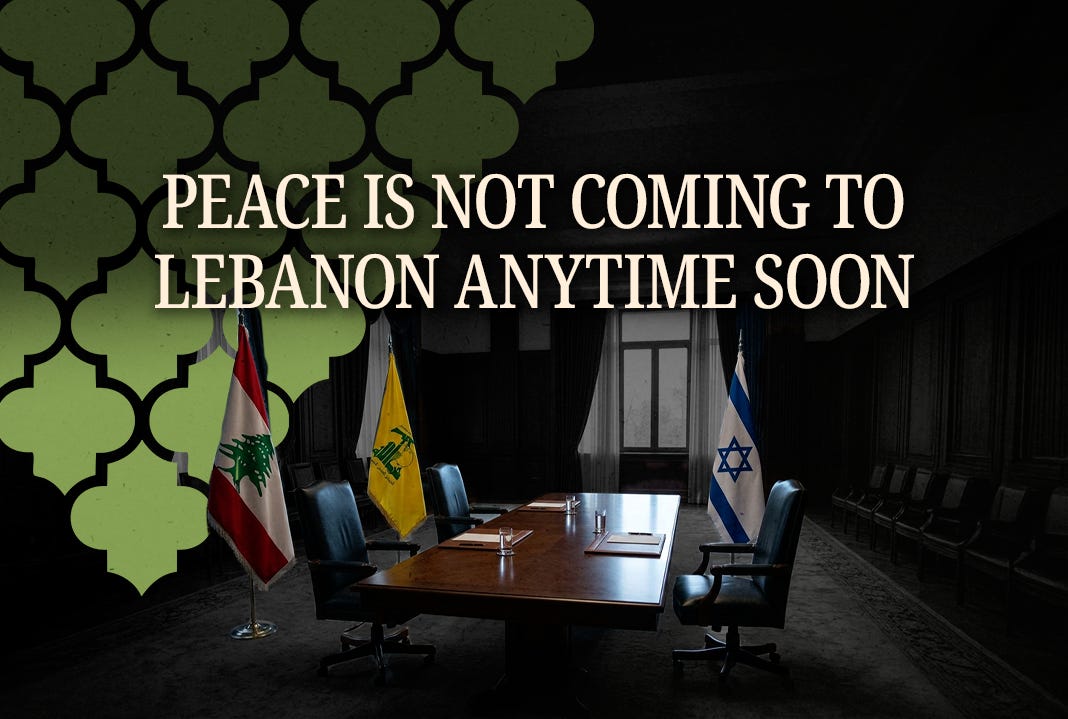
A peace deal between Lebanon and Israel is, unfortunately, not happening in the near future. Not because peace is irrational, but because the political conditions for peace do not exist. Israel is entering an election year. Lebanon’s political system is so divided between rival religious factions that the government struggles to function effectively. Hezbollah is still armed, and the Lebanese state is unwilling and unable to confront the central question of sovereignty. And without Hezbollah’s disarmament, there can be no real peace.
This is the hard truth Lebanon keeps avoiding: negotiations are the only path forward, but Lebanon is not yet capable of negotiating as a state.
On the Israeli side, Prime Minister Benjamin Netanyahu has little room to make concessions. Israel is heading toward elections in October 2026, and the northern front will be politically explosive. Any agreement that does not neutralize Hezbollah will be denounced by Netanyahu’s right-wing and far-right partners as surrender. For those constituencies, security is measured solely by the removal of Hezbollah’s military threat. In an election year, Netanyahu has no incentive to disappoint the camp that keeps him afloat politically.
However, Lebanon’s problem runs deeper. This is not a normal state debating an ordinary foreign policy question. Lebanon’s political system is divided along sectarian lines, with rival religious factions able to block major national decisions and prevent the state from acting cohesively. Hezbollah is not merely an armed group operating outside the state; it is the dominant force within much of Lebanon’s Shia political insiders.
Polling cited by Al-Monitor before Operation Epic Fury suggested Hezbollah enjoyed support from roughly 85 percent of Shia respondents, even as support among the broader Lebanese population remained below 10 percent. That does not amount to a national mandate. It points to something more dangerous: a major political constituency in Lebanon is tied to an armed organization whose strategic priorities are ultimately aligned with Iran rather than the Lebanese state itself.
No Lebanese government can sign a peace agreement with Israel while Hezbollah keeps its arsenal. Israel will not accept it. The United States will not underwrite it. And no serious treaty can coexist with an armed party able to start a war whenever Tehran’s regional calculations require it. U.S. Secretary of State Marco Rubio recently put the issue bluntly: a Lebanon-Israel peace deal may be achievable, but Hezbollah is the problem.
The Lebanese state knows this. It simply refuses to behave as if it does.
For decades, Lebanese officials have hidden behind sweeping statements void of any actual meaning: “national dialogue,” “defense strategy,” “consensus,” “resistance,” “Lebanon’s weakness,” “regional complexity.” These phrases don’t translate into viable policies. They are anesthetics meant to quell a suffering population. They have allowed the state to postpone the question of sovereignty indefinitely.
The government is indeed incapable of disarming Hezbollah by force. But incapacity doesn’t erase responsibility. The state’s failure is not only military but also moral and political. It has normalized the presence of an armed group backed by Iran operating above the authority of the state, while treating full state control over weapons and military force as an unrealistic goal rather than a basic requirement of sovereignty. Time and again, Lebanon’s leaders have allowed Hezbollah to pull the country into conflict, only to later praise the group for managing the crises it helped create.
The Lebanese Armed Forces still retain respect among many, but that trust has steadily eroded over time. Take May 7, 2008, when Hezbollah and its allies seized parts of Beirut by force and turned their weapons against fellow Lebanese citizens while the army stood by without intervening. The message was unmistakable. When challenged, Hezbollah, not the Lebanese state, held the real power over the use of force in the country.
That memory still governs Lebanon today. Every discussion of disarmament contains the ghost of another May 7th. This is why talk of state authority rings hollow. The Lebanese ultimately fear both Israel and Hezbollah.
This brings us to Nabih Berri, the speaker of the parliament and a popular Shia politician. Anyone counting on Berri to break with Hezbollah is delusional. Berri’s role is not to rescue the state from Hezbollah; it is to manage the interface between Hezbollah, the state, and the outside world. The recent dispute with President Joseph Aoun was revealing. Aoun said steps regarding negotiations had been coordinated with Berri and Prime Minister Nawaf Salam. Berri immediately contradicted him, saying the president’s remarks were inaccurate “to say the least,” particularly regarding the November 2024 arrangement and negotiations.
The sequence of events matters here. His contradiction occurred only after Berri received a call from Iran’s parliamentary speaker, Mohammad Bagher Qalibaf, with both sides stressing that ceasefire efforts must prioritize halting hostilities over other issues. When the Lebanese state inches toward a position Hezbollah dislikes, Berri becomes the barrier. He is not an alternative to Hezbollah; rather, he is an integral part of the same obstructionist architecture.
This is why the fantasy of Lebanese diplomacy without Hezbollah’s disarmament is dangerous. It assumes that Lebanon can negotiate peace while one faction retains the right to wage war. Far from diplomacy, that is fraud perpetrated at the national level.
And yet, despite all of this, negotiations remain the only path Lebanon can take. Not because Israel is benevolent or the United States is impartial. Not because peace would erase decades of violence, distrust, and political failure. It is the only path left because every alternative Lebanon has pursued has ended in destruction, paralysis, or collapse.
This is a broad, bitter lesson of the entire Arab-Israeli conflict. Every major Arab nation that confronted Israel eventually had to face the same fact: war could not by itself recover land, secure rights, or build a durable political future.
Even Gamal Abdel Nasser, a great icon known for his confrontational stance toward Israel, came to understand the limits of confrontation. This is precisely what Nasserist propagandists prefer to bury. After 1967, Nasser knew that talk alone could not reverse a military disaster. Recent debate around leaked recordings attributed to conversations between Nasser and Muammar Gaddafi revived this uncomfortable point: Nasser was not blind to the need for a political settlement if it could recover occupied Arab land and prevent further catastrophe. His rhetoric remained maximalist; his strategic mind was less romantic. Even Nasser understood that endless war was not a winning strategy.
Anwar Sadat of Egypt understood this even more clearly. War with Israel is not only war with Israel. It is, strategically, war with the United States. In 1973, Sadat learned that Israel’s military endurance was inseparable from American power. A critical Egyptian account of Sadat’s evolution quotes him saying that America had entered the war with its full weight and that he found himself facing America itself. Even more revealingly, the U.S. State Department’s historical record quotes Sadat telling Kissinger after the October War: “I am making this agreement with the United States, not with Israel.”
Sadat’s 1973 war was not a war of total liberation, but rather a war to move stagnant waters—Sadat himself said it. He knew Sinai could not be recovered by force. War created leverage; negotiations and only negotiations recovered the land. Egypt regained Sinai through a treaty, not through permanent confrontation. Jordan, too, secured its interests through negotiation.
The Arab-Israeli conflict offers no example of war restoring rights in a durable way. But it does offer many examples of war destroying societies, empowering security machines, radicalizing publics, and making external patrons more powerful. Lebanon should know this better than anyone.
The conclusion is bleak but unavoidable. No peace is possible while Hezbollah keeps its weapons. No state can exist while an externally controlled party can declare war without the permission of the Lebanese government. No negotiation can succeed while Nabih Berri and others function as custodians of Hezbollah’s veto. And no Lebanese recovery is possible while the state keeps pretending that sovereignty can be indefinitely postponed.
Lebanon needs a cold, hard reckoning. The country must move toward negotiations because the alternative is not dignity, but permanent decay: a border of ashes, a state without authority, a people without protection, and a future mortgaged to decisions made in Tehran.
Hold your horses, then. Peace is not near. But the path is straightforward. Lebanon must either become a state capable of negotiating—which means confronting Hezbollah’s arsenal—or remain an arena where others perpetually negotiate over its ruins.
Middle East Uncovered is powered by Ideas Beyond Borders. The views expressed in Middle East Uncovered are those of the authors and do not necessarily reflect the views of Ideas Beyond Borders.

This question of non-state armed groups threatening a nation-state's sovereinty, whether purely domestic or sponsored by another state, is something the UN General Assemby and Security Council must address. Nations need the right to appeal to the UN to invite a Section 7 force to help them dislodge such entities, from cartels to terrorist groups. This is a global problem. Such groups are a threat to peace and security and to national sovereignty.
She was 12 years old. A drone fired three times. This was during a ceasefire. We don't know her name. That's the first crime. Not the last. New article https://austinsikora.substack.com/p/we-dont-know-her-name?utm_source=share&utm_medium=android&r=32cg97
#Lebanon #WarCrimes gaza-is-still-a-crime-scene