


According to Hezbollah, Palestinians in Gaza have committed an unforgivable offense: failing to show the group the gratitude it believes it deserves. In a street-interview video shared by a pro-Hezbollah news outlet, Palestinians are asked which Arab countries stood by them during the war. They name Egypt, Jordan, Saudi Arabia, Qatar and the United Arab Emirates. Nobody mentions Lebanon.
The video is heavily edited, and it offers no reliable picture of what Palestinians in Gaza actually think. We do not know how many people were interviewed or which responses were excluded, which means drawing conclusions from the footage would be dishonest.
However, the video served a useful purpose because the reaction to it exposes the expectations attached to Hezbollah’s proclaimed defense of Palestine.
The video was accompanied by a remarkable caption. The outlet laments the bloodshed and destruction of southern Lebanon’s villages, supposedly sacrificed to satisfy Gaza’s “sycophants” and “ingrates.”
Palestinians enduring displacement, deadly flooding, and hunger are being accused of ingratitude because a selectively edited video fails to show the appreciation Hezbollah expects of them.
Nobody can deny the losses suffered in Lebanon over the past three years. But Palestinians had nothing to do with Hezbollah opening a military front against Israel, nor did they decide how long that front should remain active.
The caption effectively presents Hezbollah’s military intervention as a favor for which Palestinians owe a debt of gratitude.
But what exactly has Hezbollah’s proclaimed commitment to the Palestinian people meant in practice?
For decades, Hezbollah has presented Palestine as the justification for its weapons and military interventions. Sometimes, according to Hezbollah’s rhetoric, “defending Palestine” required traveling hundreds of kilometers in the opposite direction. Apparently, the road to Palestine can take some remarkable detours.
In July 2015, Hassan Nasrallah declared that the road to Jerusalem passed through Zabadani, Qalamoun, Homs and Al-Hasakah. These were not Palestinian cities occupied by Israel. They were Syrian battlefields where Hezbollah was fighting alongside Bashar al-Assad’s forces against Syrians, and sometimes Palestinian refugees.
Nasrallah’s argument was strategic. Assad’s survival was essential to the regional alliance confronting Israel. Thus, protecting Assad became part of “liberating” Jerusalem.
But what happened when Palestinians themselves were deemed a hurdle in the way of that alliance?
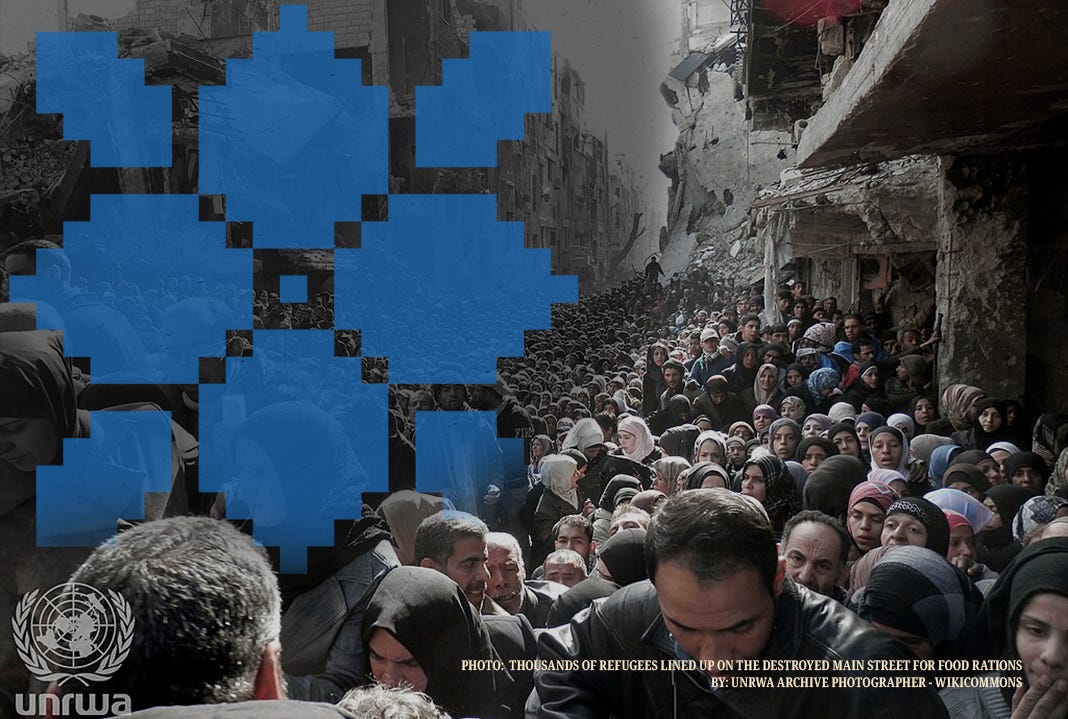
Long before Gaza’s current devastation, Palestinian refugees in Yarmouk, an unofficial Palestinian refugee camp on the outskirts of Damascus, experienced a catastrophe of their own.
Beginning in 2013, Syrian government forces and allied militias imposed a devastating siege on the camp, severely restricting food, medicine, and humanitarian assistance.
Residents survived on weeds and leaves. Hospitals struggled without essential supplies. Civilians risked being shot while searching for food. Hundreds died from famine and famine-related conditions.
These were Palestinians too.
Yet Hezbollah was fighting to preserve the same government whose forces were besieging Yarmouk and restricting food, medicine, and humanitarian aid to Palestinian refugees.
That makes Hezbollah’s invocation of Gaza much harder to square with its record in Syria. When Palestinian civilians were starving under a government Hezbollah was fighting to keep in power, their suffering did not stop Hezbollah from backing Assad. Years later, Palestinian suffering in Gaza became one of Hezbollah’s principal justifications for opening a military front against Israel.
The perpetrators and circumstances differed, but both catastrophes involved Palestinian civilians facing starvation under siege. Why, then, did Hezbollah fight Israel in the name of protecting Palestinians in Gaza while fighting alongside Assad’s forces as Palestinians starved in Yarmouk?
Hezbollah’s relationship with Hamas offers another explanation for its priorities.
Both organizations participate in Iran’s regional “Axis of Resistance,” supported and coordinated to varying degrees by the Islamic Revolutionary Guard Corps (IRGC).
Iran has financed, armed, and trained Hamas, while Hezbollah has facilitated military cooperation within the network. Supporting Hamas can therefore be seen as a commitment to assist another arm of the IRGC, and that has nothing to do with a Palestinian civilian’s welfare.
After bragging for months that the fight with Israel on the Lebanon front would never cease unless Israel ended the war in Gaza, Hezbollah dropped that condition in November 2024 and accepted a separate ceasefire that made no mention of the devastated strip.
This brings us back to the video’s caption. A heavily edited street-interview video tells us remarkably little about Palestinian public opinion. Yet it provoked a response from Hezbollah that treated the absence of gratitude as a profound betrayal.
The people of Gaza did not choose Hezbollah’s military strategy. Hezbollah did, as part of an Iran-backed regional alliance. Iran, not the Palestinians, should be held responsible for Lebanon’s destruction.
Hezbollah’s record in Yarmouk and its conduct over the past few years suggest that protecting Palestinians was never the principle driving its actions. Yet it has spent decades invoking Palestine to justify its weapons, alliances and wars.
That is the contradiction at the heart of Hezbollah’s rhetoric. Palestine is treated as a cause when it serves the movement’s strategy—and Palestinian civilians become collateral damage when they do not.
You might also be interested in:
The Journalist Taking on Hezbollah From Inside Lebanon

For decades, Hezbollah has claimed to be the voice of Lebanon’s Shia muslims. With its arsenal of weapons, its grip on politics, and its patronage from Iran, the group has constructed a mythology: without Hezbollah, Lebanon’s Shia would be defenseless and voiceless. But listen closely to dissidents inside the community, and a different story emerges.
Middle East Uncovered is powered by Ideas Beyond Borders. The views expressed in Middle East Uncovered are those of the authors and do not necessarily reflect the views of Ideas Beyond Borders.
Isn't the real endgame for Hezbollah a Shia Islamic state throughout the region? The Palestinian resistance issue with the goal of a free democratic Palestine is not what the goal is here. It's Palestine as part of a larger Islamic Republic - a theocracy like Iran, or even under Iran. Israel, being a Jewish state, of course wouldn't fit in that larger picture at all and has to go. Am I right? Hezbollah means "Party of God." Forget other factions or points of view...