

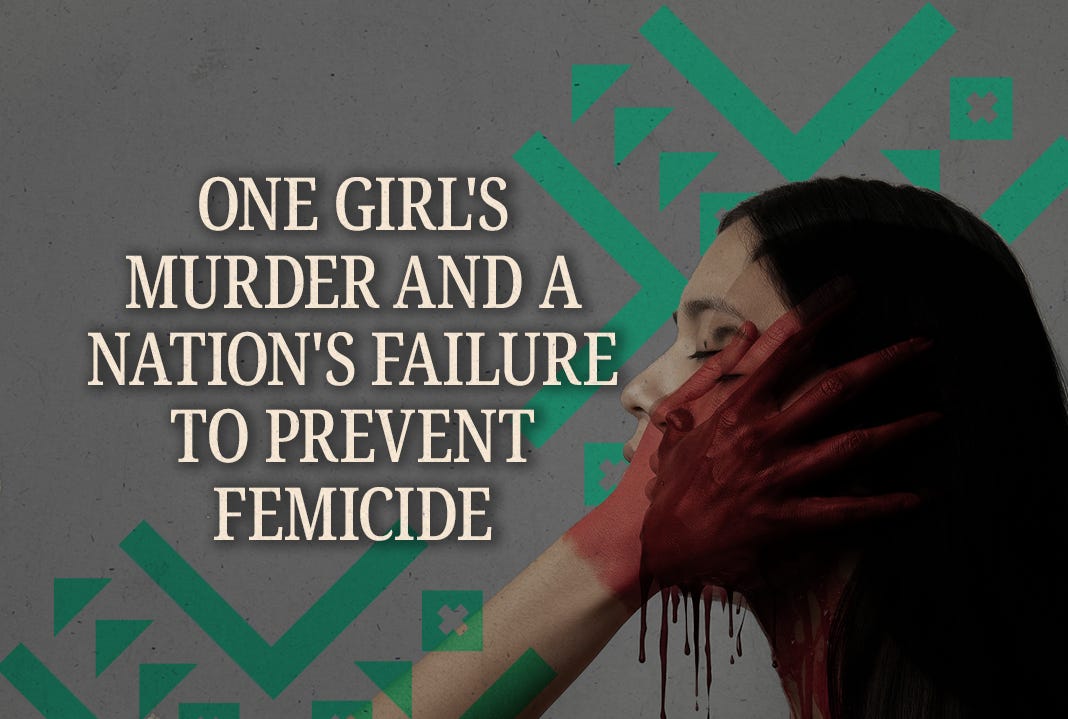
One Girl's Murder and a Nation's Failure to Prevent Femicide
10-year-old Fatima's brutal killing exposes a growing crisis in Taliban-ruled Afghanistan, where impunity and fear often force families to bury the truth alongside their daughters.

Editor's Note: This article contains descriptions of sexual violence and the killing of children that some readers may find distressing. "Sarah" and "Fatima" are pseudonyms used to protect the identities of the source and victim. In a country where justice is often out of reach and many such crimes go undocumented, we believe it is important to bear witness to these stories.
PARWAN, Afghanistan - It was around 8:30 am on July 7 in the Shinwari district of Parwan province when Sarah, a young healthcare worker, was called into a room to examine a patient. Sarah is not a doctor, at least not yet; she was there that day auditing one of the clinic’s wards in her capacity as a healthcare assistant.
“I heard shouting and screaming from the hallway before they called us to come and check her out,” recalls Sarah, who is an aspiring doctor and is currently studying medicine at an online university in Afghanistan. “A lady had just brought in a 10- or 11-year-old girl in her arms as she was crying. The Taliban officials asked us, only female healthcare workers, to see what was wrong with her.” Sarah was the first to get to the room where a young girl (we will call her Fatima), soaked in blood, lay in bed. “I went to check on her, but she was already deceased,” she says.
As the room filled with other female staff, they were all left paralyzed by the horrific scene in front of them. “We noticed that she was killed with a sharp object, most likely a knife, striking first her throat right under her chin,” she says with a trembling voice, adding, “We counted 17 stab wounds all over her abdomen and body, and since blood was still coming out of them, we stitched and closed them.”
Soaked in blood, Sarah and her colleagues continued examining Fatima’s body. It quickly became clear that this was more than a homicide. They found scars, bruises, and signs of tissue damage on her legs, thighs, arms, abdomen, and face. After consulting one another, they conducted a further examination and concluded that Fatima had likely been raped either before or after she was killed.
“I could not sleep for weeks after that incident because all I could see in front of me was the picture of that girl that day,” Sarah recalls.
Fatima’s case is far from unique. Since the Taliban returned to power in 2021, reported cases of rape and femicide (the intentional killing of women or girls because of their gender) have increased across Afghanistan, despite the regime’s crackdown on journalists, watchdogs, and dissidents who document such crimes. According to Afghan Witness, more than 332 cases of femicide were documented between August 2021 and June 2024. Even that figure is likely a significant undercount, with researchers describing it as only “the tip of the iceberg.”
Afghan Witness found that nearly half of documented femicides were committed by a family member or relative of the deceased. Another 12 percent were attributed to Taliban members, while 39 percent were carried out by “unknown actors.” Even when perpetrators are identified, accountability is rare. Deeply ingrained notions of family honor and shame often discourage relatives from pursuing justice, while a legal system that offers women little protection leaves many cases unresolved.
“After we examined the body, we filed a report and asked for the body to be sent to Kabul to the coroner’s office for forensic analysis,” says Sarah, adding, “I handed the report to the management office at the clinic since we are not allowed to talk to anyone in there [since they are all men].”
Not only was the report never sent to Kabul, but when Fatima’s parents finally arrived after an hour, they begged Sarah not to disclose that her child was raped.
“Her mom begged me and asked me not to tell anyone about her daughter being raped; she cried and said, ‘I have 5 more daughters, and nobody will marry them out of shame if they find out.’”
Fatima’s father demanded his daughter’s body be handed over, and they buried her two and a half hours after she was first brought into the clinic.
“Fatima’s father told me that now he has to marry off the rest of her daughters as fast as possible to save face,” Sarah told me.
The identity of the alleged perpetrator, and what happened afterward, made the case even more disturbing. Based on Sarah’s subsequent conversations with people close to the family, the man who murdered Fatima was her uncle by marriage, a neighbor who, they said, lured her into his home by claiming her aunt wanted to speak with her. According to those familiar with the case, Fatima was raped, murdered, and her body was left in a shallow stream across from the family’s house.
It was Fatima’s cousin who found her and alerted her aunt, who had been sowing wheat in a nearby field. Her aunt carried the 10-year-old to the clinic, hoping she was still alive.
Sarah says the suspect spent just nine days in prison before being released on bail. Devastated by her daughter’s death, Fatima’s mother has pleaded with her husband to leave the village.
The lack of accountability, proper investigative mechanisms, forensic analysis, and administrative authority is not merely an unfortunate consequence of the Taliban’s return to power, but the result of a system designed to function this way. Under the regime, women are afforded little value or protection, and crimes against them rarely warrant the resources or attention needed to deliver justice. Many of the killings and kidnappings of “public” women in Afghanistan have been carried out by Taliban members without any repercussions. Zan Times has documented these cases in a digital map of women who have been imprisoned or killed by Taliban members or unknown actors in recent years, illustrating the scale of this systematic oppression.
Cases of femicide in Afghanistan are on the rise and severely underreported.
On July 12, 2026, the body of 11-year-old Roida was found in her home in the Qazaq area of Sar-e-pol province. She had been fatally stabbed by an unknown perpetrator while her mother was outside. Earlier that June, the body of 8-year-old Saira was discovered several days after she disappeared from her uncle’s house in Kunar province, where she had been spending her school holidays. The perpetrator remains unknown, and the investigation produced no publicly known results. On June 8, 2026, Chiman Hosseinzadaeh and her daughter, Sara Yousufi, were found shot dead in Sar-e-pol province after Chiman reportedly refused to allow a local Taliban official to marry her 15-year-old daughter.
Sarah also shared reports she had heard of other young girls who were raped and killed in the same district. She was careful to distinguish rumor from firsthand knowledge, stressing that she had not witnessed these cases herself. Still, against the backdrop of rising femicide, such accounts are difficult to dismiss outright. “I heard from some of the villagers from the same area about a stepbrother who, in retaliation for his stepmother’s cruelty, raped his 2-year-old stepsister,” she says. “She did not survive.”
When the Taliban returned to power in 2021, dismantling the institutions and legal protections for women was among their first priorities. The result has been a system with little accountability, few mechanisms to investigate crimes against women, and even fewer avenues for justice. Cases of femicide continue to emerge, but many are never documented, investigated, or publicly reported.
It is rare for healthcare workers like Sarah to speak publicly about what they witness. They work under intense scrutiny and severe restrictions, including a ban on smartphones in many medical facilities, making it far more difficult to document abuses or share evidence with the outside world. Stories like Fatima’s reach the public only because people like Sarah are willing to take extraordinary risks to tell them.
Middle East Uncovered is powered by Ideas Beyond Borders. The views expressed in Middle East Uncovered are those of the authors and do not necessarily reflect the views of Ideas Beyond Borders.