

Oil, Power, and the Collapse of the Caracas-Tehran Alliance
As Venezuela recalibrates its strategic direction following the capture of Nicolás Maduro, Iran risks losing one of its most important footholds outside the Middle East.

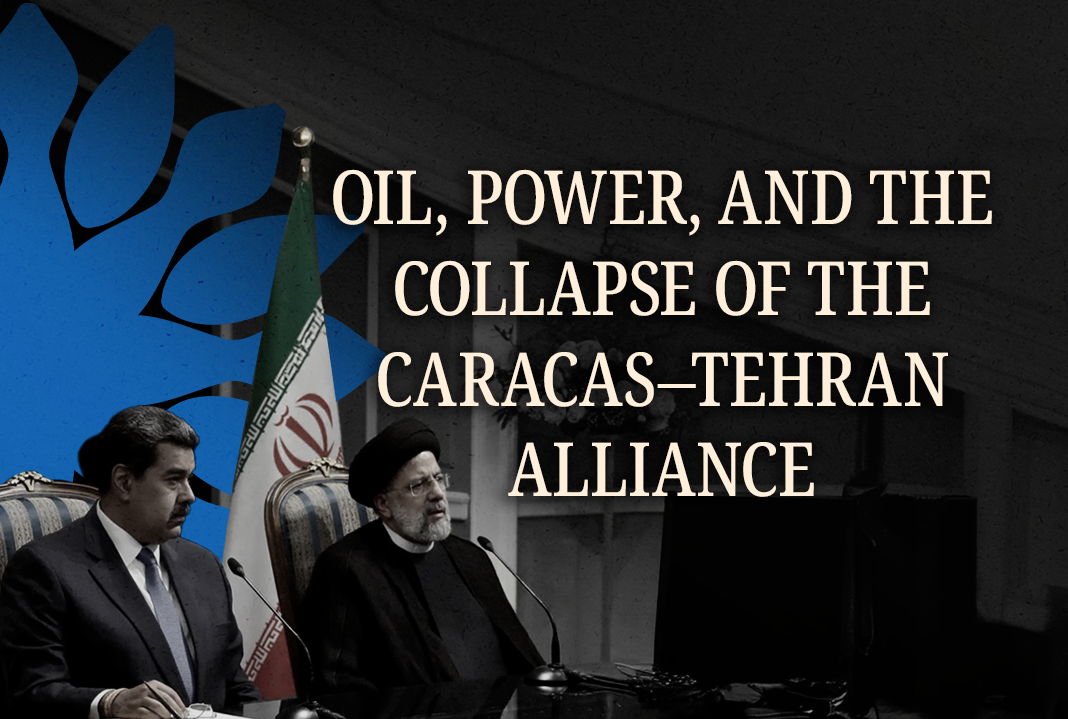
For more than two decades, the alliance between Caracas and Tehran has been one of the most durable and least transparent pillars of global anti-Western alignment. First under Hugo Chávez and later under Nicolás Maduro, Venezuela has become a hemispheric platform for Iran’s political, financial, and energy projection, openly challenging the United States and its allies. This axis was never merely symbolic, and treating it as such was always a mistake. It has translated into oil agreements, technological cooperation, systematic sanctions evasion, alternative financial routes, and a strategic convergence that has operated well outside ordinary accountability frameworks.
That structure is now under visible strain. The capture of Nicolás Maduro by U.S. forces and his transfer to New York to face federal charges has signaled a shift not only in Venezuela’s internal politics but also in the geopolitical balance that has allowed Iran to expand its influence in Latin America. The U.S. operation, preceded by explicit warnings and followed by unusually blunt statements from Washington, has thrust Venezuela and the Middle East into a new phase. What is now underway is an open contest over Venezuela’s strategic orientation, particularly its oil.
From the outset, the U.S. administration has made clear that the intervention is not limited to a criminal or judicial objective, but to running Venezuela. The political narrative surrounding it, including statements by President Donald Trump himself, has consistently linked the military action to hemispheric security, the fight against drug trafficking, the dismantling of terrorist networks, and the need to break hostile strategic alliances. The alliance with Tehran has been singled out repeatedly, and not by accident.
This is where the situation becomes more complicated. The issue is not only Maduro’s removal but also what comes next and under what conditions. In this context, Delcy Rodríguez has assumed an uncomfortable central role. Following Maduro’s forced exit, Rodríguez has assumed executive functions amid intense external and internal pressure. Washington does not recognize her as a legitimate leader, nor does it present her as a long-term political solution. At the same time, she has been treated as a tactical interlocutor, with any form of normalization or economic relief explicitly conditioned on a clear break with the former regime’s strategic partners.
Iran sits at the top of that list. U.S. demands have been direct and, at times, deliberately inflexible. An immediate reduction of cooperation with Tehran. The suspension of energy agreements. An end to Venezuela’s use as a logistical or financial platform for sanctioned actors. Gradual alignment with an internationally supervised framework for managing the oil sector. This is not simply about foreign policy preferences. It is about control over a strategic resource, a petrostate, whose direction can reshape regional and global balances.
Oil is the center of gravity of this reconfiguration. For years, Venezuelan crude has been used as a geopolitical currency to sustain anti-Western alliances, finance irregular networks, and enable sanctions-evasion schemes, including shipments to Iran through shadow fleets and loosely monitored barter arrangements. That system did not emerge by accident; it was designed as a survival mechanism for an isolated regime willing to trade sovereignty for protection and cash flow.
The current phase points in the opposite direction. The United States has signaled its intention to redirect Venezuelan exports toward Western markets, under systems of control, supervision, and eventual participation by U.S. energy companies. Whether this model proves sustainable is an open question, but its strategic logic is clear. Limiting Iran’s access to Venezuelan crude weakens one of Tehran’s few remaining energy lifelines under sanctions, while simultaneously strengthening Washington’s ability to influence global supply and price dynamics at a moment of high international volatility.
Venezuela is no longer going to be treated as an energy satellite of the anti-Western axis, but as a contested strategic asset. That distinction matters and helps explain much of the urgency surrounding current negotiations and public statements.
Political messaging has been reinforced from other fronts as well. Israeli Prime Minister Benjamin Netanyahu has publicly endorsed the U.S. action, praising Washington’s resolve and framing the operation within a broader struggle against Iran’s global reach and its allied networks. Netanyahu’s appearance alongside Trump at key moments prior to the intervention was not incidental. It sent a deliberate signal, linking developments in Latin America to a wider strategic logic centered on containing Iranian influence.
For Israel, Iran is not a distant actor operating at the margins of the Western Hemisphere. It is part of a global architecture that combines financial resources, illicit routes, and political alliances to sustain power projection across regions. From Jerusalem’s perspective, the weakening of the Caracas–Tehran axis is read as an indirect gain in a much broader contest. The convergence between U.S. and Israeli interests reinforces the conclusion that the operation in Venezuela is not an isolated episode but rather an element of a larger geopolitical strategy.
International reactions have been predictable and, in some cases, revealing. Russia and China have condemned the intervention as a violation of Venezuelan sovereignty and international law, well aware that the precedent could one day affect their own interests. At the United Nations, debate has focused on legality, jurisdiction, and the limits of unilateral action. Yet beyond the legal arguments, the political reality is difficult to ignore. The alliance structure surrounding Venezuela is being forced to change, whether its defenders like it or not.
For Venezuela’s democratic opposition, this moment presents serious dilemmas. Maduro’s removal opens a window of opportunity, but it also carries obvious risks. Replacing authoritarian tutelage with external actors would be a political and moral failure. Democratic reconstruction requires free elections, constitutional restoration, and effective sovereignty. It also requires a realistic reading of the geopolitical pressures shaping any transitional authority.
For Venezuela, this is the central political risk at present. Oil policy, relations with the United States, and the redefinition of foreign policy must be embedded in a democratic project of Venezuela’s own. They cannot be reduced to a simple substitution of dependencies, however tempting that may appear in the short term.
The breakdown of the Caracas–Tehran axis has long been inevitable. Its survival depended on an isolated and discretionary regime willing to trade national autonomy for political survival. What remains unresolved is the nature of the replacement: a democratic Venezuela reintegrated into the international system and capable of making sovereign decisions, or a Venezuela reduced to a geopolitical chessboard, managed by external powers with limited domestic legitimacy.
That outcome has not yet been decided. But the current moment leaves a clear lesson. In the twenty-first century, authoritarian alliances are not merely a domestic problem. They are a global security issue. And Venezuela, for far too long, has been one of their most important nodes.
Juan Miguel Matheus is a Venezuelan politician in exile. He is the Bowden Fellow at the Bech-Loughlin First Amendment Center at the University of Texas at Austin. His work focuses on democratic erosion, authoritarian resilience, and constitutional transitions in Latin America.
Middle East Uncovered is powered by Ideas Beyond Borders. The views expressed in Middle East Uncovered are those of the authors and do not necessarily reflect the views of Ideas Beyond Borders.
 | A guest post by
|