


Last week I woke up in Berlin, reached for my phone, and made the mistake of checking the news before having my first cup of coffee.
Videos showed young people protesting in Europe, waving flags, and demanding justice. Among the flags visible in the footage was one I knew particularly well: the flag of the Islamic Republic of Iran.
As an Iranian Bahá’í, I have a complicated relationship with that flag. It represents a government that has persecuted people like me and my family for decades. And there it was, at a demonstration ostensibly concerned with “injustice.”
Elsewhere in Europe, images of shops being broken into and looted during recent unrest in France also troubled me. I did not know whether those responsible shared the politics of any particular demonstration, and I had no reason to assume that the people carrying that flag had anything to do with the looting.
Still, the images left me thinking about a question that reaches beyond any one protest: when, if ever, does a sense of injustice become an excuse to take what belongs to someone else?
I needed a coffee. Possibly two.
I began wondering why we so easily recognize the injustice of violence against a person, yet sometimes hesitate to recognize the injustice of taking what belongs to them.
I am not suggesting that theft and murder are equivalent. They are not. But theft can reveal a dangerous assumption that my convictions, my grievances, or my sense of righteousness somehow grant me the license to override someone else’s rights.
In Iran, that assumption has laws, courtrooms, and officials to enforce it.
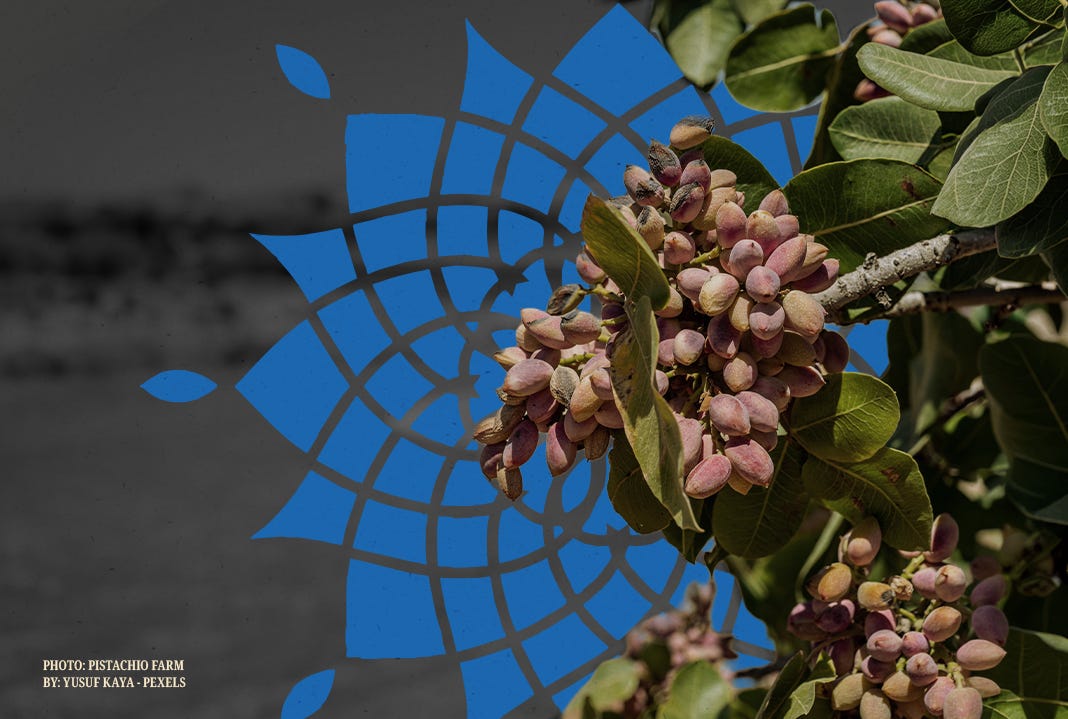
Consider a pistachio farm in Isfahan. According to the Bahá’í International Community, a Bahá’í family had owned and worked the land for decades. Authorities abruptly sealed the farm, seized the harvest, and sold it. The case against them focused on the family’s religious beliefs and activities rather than any credible property offense. Land that had supported a family for years became vulnerable to state seizure because the state disapproved of their faith.
Then there is a case that hits much closer to home.
One of my closest friends, Sepehr Atefi, is a filmmaker and journalist in Europe. In August this year, Iranian security agents raided his parents’ home in Isfahan, reportedly for the second time in several months. According to Sepehr’s public account, agents spent more than six hours searching the house and his father’s workplace. They took valuables, household appliances, communications devices, the family car, and even children’s toys.
Imagine that. Children’s toys.
According to Sepehr, when his mother objected, agents described the possessions as “forbidden goods” and suggested the family had failed to learn its lesson by not changing its religion. The implication was chilling. Because of their faith, the family was treated as though they had no real claim to their own possessions.
The Atefi family case is not isolated. Other Bahá’í homes in Isfahan have been raided in recent months. In October, IranWire reported that agents seized jewelry, electronics, cash, and ordinary household items from several homes. These disputes reach far beyond land titles, into living rooms and family heirlooms.
There is a particularly revealing legal irony here. Article 49 of Iran’s Constitution authorizes the state to confiscate wealth acquired through unlawful means. Yet the Bahá’í International Community has documented how this provision has been used to seize property lawfully acquired by Bahá’ís. A law meant to target illicit wealth has been weaponized to confiscate property from people because of their faith.
Cases like these are part of why I have come to think so strongly about property rights and the economic system that best protects them.
This is where my defense of capitalism begins.
It is not perfect, but I believe it is the best economic framework we have developed, especially when joined to the rule of law, competition, equal rights, and accountable institutions. Its great moral achievement is not that it makes money sacred, but that voluntary exchange allows people who disagree profoundly to cooperate without surrendering their conscience.
A Christian can sell a house to a Muslim. An atheist can employ a Bahá’í. Two people can disagree about God and still agree on the price of a bicycle.
Neither has to convert the other before the transaction can take place. That principle is fragile. Markets need courts, fair rules, and protections against fraud and coercion. Property rights are not an exemption from taxation or other public obligations. But a government should not be able to decide that your home, posessions, or savings can suddenly be taken from you because of your religion, identity, or political persuasion.
I want to be careful about the connection I drew that morning. Looting during unrest in Europe is not the same as the Iranian state systematically persecuting Bahá’ís. The scale and power involved is different. So are the consequences.
What stayed with me was the instinct behind both: the belief that a cause we consider righteous can somehow give us permission to cross lines we would otherwise recognize as wrong.
That does not mean everyone at a protest shares the same beliefs, or that a flag carried by one person tells us what everyone participating thinks. It certainly does not mean that every criticism of capitalism amounts to a defense of theft.
But I become uneasy when moral certainty starts doing the work of justification. Once people convince themselves that their cause is righteous enough, it becomes easier to explain away what happens to someone else’s home, business, savings, or livelihood.
That is the part that feels familiar to me. I have seen what happens when that conviction becomes law.
For Bahá’í families in Iran, property is much more than an asset on a balance sheet. It represents decades of work, a family’s security, the freedom to earn a living, and the ability to build a life without having to ask permission to believe differently.
Perhaps that is why I keep returning to the phrase theft as the original sin. I do not mean it literally, and I am not suggesting that stealing is the worst crime a person can commit. I just mean that once we accept that our own righteousness gives us the right to take away what belongs to someone else, much larger abuses become easier to justify.
Looking at that flag on my phone, I wondered whether the people carrying it understood what it represented to families like mine and my friend’s. Perhaps they did not. Perhaps they genuinely believed they were standing for justice.
But that is exactly why I wish they would ask themselves a harder question: If your idea of justice allows you to take away another person’s rights because you disapprove of who they are, what exactly makes it justice?
By then, my coffee had gone cold.
At least nobody had confiscated it in the name of a higher cause.
You might also be interested in:
Iran’s Persecution of the Baháʼí Faith Exposes Its Deepest Insecurity

I grew up as a Baháʼí child in Iran. In our Baháʼí children’s classes, we were given drawings of the earth to color—people from every race standing hand in hand, smiling. Above them was a verse from Baháʼu’lláh: Ye are the fruits of one tree and the leaves of one branch.
Middle East Uncovered is powered by Ideas Beyond Borders. The views expressed in Middle East Uncovered are those of the authors and do not necessarily reflect the views of Ideas Beyond Borders.
