

Lebanon’s Stolen Chance(s) at Peace
The latest round of conflict leaves Lebanon in a familiar bind, bearing the cost of regional power struggles while resolution remains beyond reach.

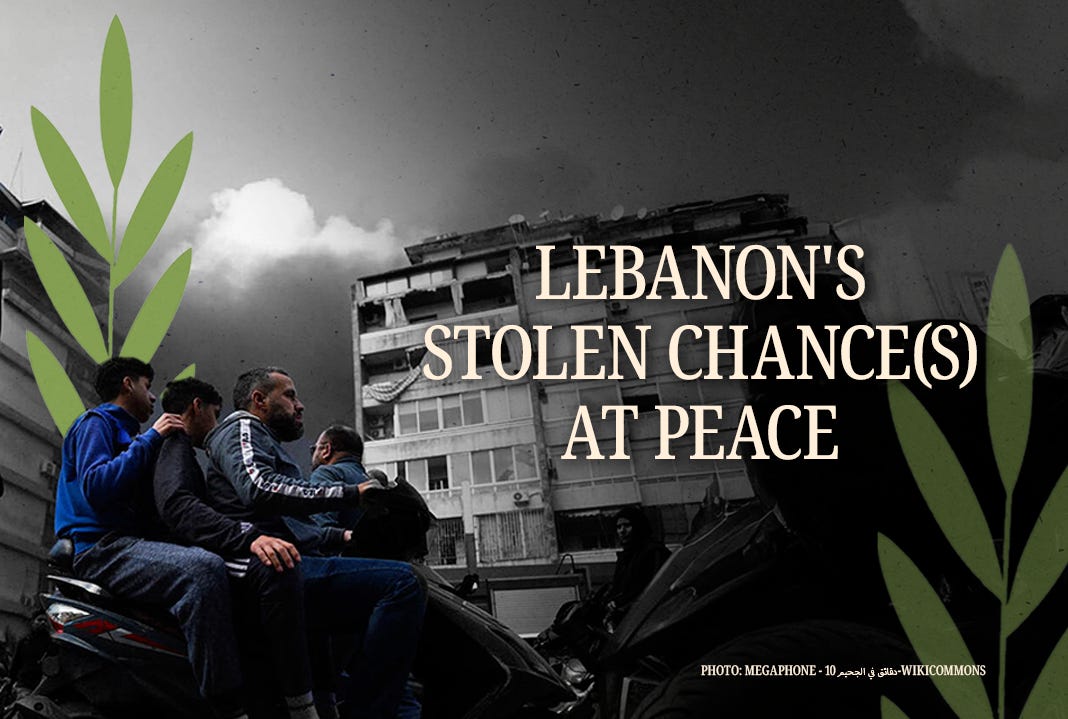
There is an old Lebanese saying that states: “Wherever the pregnancy happens, the labor pains are felt in Lebanon.” It is crude, bitter, and repeatedly proven right. A crisis erupts in the region, and Lebanon pays the price. Tehran escalates, southern Lebanon burns. Washington and Iran negotiate; Lebanese villages are destroyed. As other countries make decisions, Lebanon absorbs the consequences, again and again.
The latest escalation replayed this pattern, casting Lebanon as a support act in the regional power struggle. As negotiations raised the possibility of peace, those who claim to serve the country’s interests moved quickly to dismantle it. For Hezbollah, this is a battle for survival. For Lebanon, it is the price of submitting to powers driven by external interests.
Meanwhile, an estimated 1.2 million people, amounting to a fifth of the country’s population, are trapped in limbo, displaced by a conflict that could easily escalate further.
So far, broader diplomatic efforts have done little to contain Hezbollah, which views the prospect of peace as an existential problem. If Lebanon can negotiate through its government, what role remains for an armed group to speak on the country’s behalf? And if Lebanon can deal directly with Israel, why would Tehran need Hezbollah as its intermediary?
Hezbollah entered the war after the assassination of Iranian Supreme Leader Ali Khamenei because Iran needed it to, not because the Lebanese government authorized it, or the Lebanese citizens chose it. Hezbollah acted because Tehran needed a lever, and the group exists in Lebanon to serve precisely that purpose.
The war also served Hezbollah’s interests, retaining its role as a shield for Iran and ensuring the group’s relevance as it confronts mounting opposition at home.
In recent months, tolerance has ebbed toward Hezbollah’s stranglehold on the Lebanese state, with Prime Minister Nawaf Salam announcing a formal ban on the group’s military activities in early March. Beirut has never been effective in enforcing its authority over Hezbollah, but politically, the significance is clear. Hezbollah’s actions will no longer be presented as a national decision. They are being recognized for what they were: an armed faction pushing an unwilling country into another war.
Iran and Hezbollah understood the danger peace would pose to them immediately. They rejected Lebanon’s direct track with Israel because it threatened to remove Lebanon from Iran’s regional chessboard.
Iran does not want Lebanon to negotiate as Lebanon. It wants Lebanon to negotiate as an Iranian asset. Hezbollah does not want a ceasefire that strengthens the Lebanese state. It wants any ceasefire to pass through the axis, through Tehran.
This is why Iran’s behavior during the latest skirmish was so revealing. Southern Lebanon has been absorbing Israeli strikes for months. Villages were emptied and Shia families, the very people Hezbollah claims to protect, watched their homes collapse into dust.
Despite the devastation, Iran did not treat the Israeli onslaught as a red line. For the Iranian regime, a village can be destroyed, a farmer can be killed, and a family can be displaced without disturbing the “regional architecture”.
But Beirut’s southern suburbs, it seems, are different. When Israel struck there, Iran acted with urgency. The message is becoming clear: the south is expendable, but Hezbollah’s central infrastructure is sacred. Ordinary Shia citizens may lose their homes, but the machine must survive.
Then, on June 7, Iran opened fire on Israel with a symbolic strike, marking the first attack since the April ceasefire. Israel threatened to retaliate, but Washington stepped in to order restraint. So Israel settled for a symbolic response, and the great regional drama ended where it always ends: Iran saved face, Israel claimed deterrence, Trump preserved his protracted negotiations, and Lebanon went back to being bombed in installments.
This is the horror of Lebanon’s dilemma, a country that’s forced to play the understudy in the performance of its own destruction.
The Iranian Embassy’s recent social media post captured the contradictions at play. Lebanon appears inside the map of Iran, with a message saying that Lebanon is “the heart of Iran.” Perhaps this is meant to mean that Lebanon is beloved by Iran. In reality, it looked like a confession. Iran does not see Lebanon as an independent country. It sees Lebanon as an organ in its body politic. And when Tehran hurts, Lebanon bleeds.
Hezbollah’s defenders may say this is an exaggeration. It is not. A Lebanese party that prioritizes Iran’s position is not a resistance movement; it is a mercenary structure with Lebanese victims. Its members may be Lebanese. Its dead, may be Lebanese. Its supporters may genuinely believe they are defending their community. But strategically, Hezbollah functions as Iran’s armed franchise. Its calendar is Iranian. Its escalation is Iranian. Its veto is Iranian. Its war is Iranian. However, the funerals, naturally, are Lebanese.
This is what makes the U.S.-Iran agreement so dangerous for Lebanon. The danger is not only what the agreement says. It is what Iran and Hezbollah now claim it means: that Lebanon’s border, Lebanon’s war, and Lebanon’s dead can be folded into Tehran’s bargain with Washington.
The agreement has been signed, but in Lebanon, the clashes have not truly stopped. The underlying war remains untouched. Israel is not going to surrender land or abandon its positions while Hezbollah remains armed on its northern border. No Israeli government will sell that to its public as security. And Hezbollah will not lay down its arms peacefully, because the arms are not merely a military tool. They are the party’s state, economy, identity, and veto.
What is Lebanon supposed to celebrate? A miracle? A ceasefire? A pause between funeral announcements? The best Lebanon can realistically hope for is a time-out, unless two impossible conditions suddenly become possible: either Israel withdraws without Hezbollah’s disarmament, or Hezbollah disarms without a fight. Neither is likely.
Following the U.S.-Iran agreement, the group claimed that Iran had pledged to pursue Israeli withdrawal from Lebanon in the next phase of talks with Washington. Even when it comes to its sovereign territory, Lebanon is denied the dignity of speaking for itself.
Meanwhile, Israel bristles with frustration toward Washington’s constraints. Israel does not want President Trump to reign in its military freedom while Hezbollah remains armed, so it vents where it can: on Lebanon.
In doing so, Israel is bombing a country whose citizens did not vote for this war. It is destroying villages, killing civilians, and deepening the very instability it claims to contest. Hezbollah gives Israel the pretext, Iran gives Hezbollah the order, and Lebanon buries its dead.
Iran was never going to sacrifice its agreement with Washington for Lebanese villages. It used them to raise the price. Now Hezbollah wants Lebanese citizens to believe that Tehran will recover their land in the next round of negotiations. These promises ring hollow in a country stripped of sovereignty by ‘well-wishers’ that keep it perpetually at war.
This is why the language must be clarified. Hezbollah is not protecting Lebanon, and the Lebanese state is not toothless by accident. It is enfeebled by a militia that turned sovereignty into a hostage file and called the ransom resistance.
And somewhere, in a Lebanese village that few people in Tehran can name, a bomb is dropped, and another family discovers that the pregnancy was elsewhere, but the labor pains are theirs.
Middle East Uncovered is powered by Ideas Beyond Borders. The views expressed in Middle East Uncovered are those of the authors and do not necessarily reflect the views of Ideas Beyond Borders.
 | A guest post by
|
‘Hezbollah is a pre text for Isreal’
Stop there…
Isreal get out of Lebanon ; eliminate the need for the ongoing existence of Hezbollah.While you are at it stop the slaughter in Gaza - another trigger for Iran.
Give the land back or truly create a solution that respects palestinian sovereignty.