


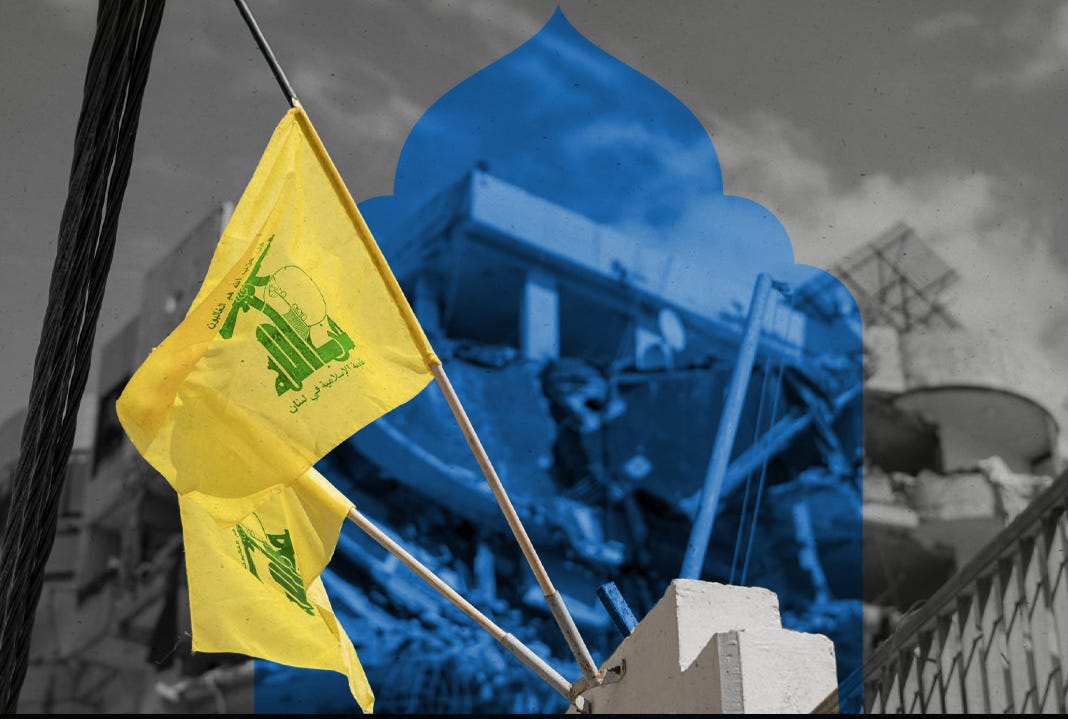
Five hundred kilograms of explosives were traveling toward Beirut. Hezbollah claims they were intended for the “resistance” against Israel. The Lebanese government says it is investigating. And we are expected to take both at their word.
The seizure of explosives at the Dahr al-Baidar crossing (a high mountain pass and village sitting at an elevation of roughly 1,516 meters in Mount Lebanon) has prompted familiar headlines celebrating the return of the Lebanese state. Security forces intercepted a Dodge Caravan carrying roughly 250 kilograms of TNT and 250 kilograms of C4. Hezbollah admitted the explosives were its own and demanded them back. This time, the state broke its long-standing tradition and did not wave the cargo through.
Let’s set aside for a minute the irony that Hezbollah operatives were driving an American car while chanting “death to America.” This is a big development, even if it is not a good enough reason to trust the government.
The closer you look at this case, the less reassuring the official narrative becomes, starting with one glaring contradiction: the explosives were traveling in the wrong direction.
Hezbollah MP Hassan Fadlallah says the shipment was intended for defensive fortifications in southern Lebanon. Yet investigators say it was traveling from Baalbek toward Beirut.
Last I checked, Israel is to the south, while Beirut is to the west. Perhaps Hezbollah threw away its compasses after its pagers exploded. Then again, this isn’t the first time Hezbollah has struggled with directions. Hassan Nasrallah once claimed that the road to Jerusalem passed through Syria.
Why was a shipment purportedly meant for the “southern front” being delivered to Hezbollah operatives in Beirut? What was going to happen to it there?
Then there is the checkpoint. Dahr al-Baidar is a longstanding security post that has been fixed there for decades. Anyone organizing the movement of hundreds of kilograms of explosives along that highway knew it was there.
Why risk that passage? Had the route worked before? Did the organizers expect preferential treatment, perhaps even assistance from within the security apparatus? These are valid questions, yet no one in Lebanon dares answer them.
Early reports raised that suspicion, and parliamentary sources leaked to a local news outlet that those suspicions surround some state actors. Investigators have indeed questioned checkpoint personnel, but an officer and ten security-force members were subsequently cleared. No mole has been identified, yet I do not think anyone is convinced… at least not yet. The organizers’ apparent confidence remains unexplained.
Given Lebanon’s history, the cargo itself raises another disturbing question. The discovery of hundreds of kilograms of military-grade explosives traveling toward Beirut brings back memories of the political assassinations that devastated Lebanon between 2005 and 2008. The Special Tribunal for Lebanon convicted three Hezbollah members for their roles in the assassination of former Prime Minister Rafik Hariri. Prime Minister Nawaf Salam himself recalled Lebanon’s history of political assassinations when discussing the seized explosives. None of this proves the latest shipment was intended for another assassination. But it makes the government’s failure to provide a convincing account of its intended destination all the more troubling. Are the authorities preparing another cover-up?
The fact that the explosives have not been returned to Hezbollah is telling.
For example, in February 2006, twelve trucks transporting weapons for Hezbollah were discovered at a Lebanese checkpoint and were allowed to go through. A UN report recorded the army’s explanation: government policy regarded the movement of “resistance” ammunition as legitimate. Hezbollah’s military logistics effectively enjoyed a political exemption.
Today, security forces have retained the shipment and its transporters, and judicial authorities have moved to question two alleged organizers who are known only by their aliases. Hezbollah did demand the explosives back, but never got them.
It would be tempting to call this a new era, but state authority is not measured by how boldly officials speak once a case dominates the press headlines, but by how institutions behave when nobody is watching. That brings us to the most disturbing part.
Authorities seized the explosives days before the public learned about them. The government’s emphatic promises of accountability arrived only after the story broke.
Prominent Lebanese Journalist and political activist Riad Touq has questioned the seriousness of the initial handling, arguing that publicity changed the investigation’s trajectory. Lebanon24, citing a parliamentary source, reported suspicions that the incident was being contained and that the vehicle was expected to pass without a thorough search.
Security investigations sometimes require secrecy, but they always require transparency. If everything was handled properly from the beginning, why hasn’t the government provided a clear enough account to dispel these suspicions?
If the story had never reached the press, would the case have received the same attention? Did the state really get its act together, or did the story leak and force its hand?
If the government wants public confidence, it should explain the initial chain of command, the transfer of the case between agencies, the timing of investigative decisions, and how it handled alleged interference. It can do that without disclosing confidential evidence.
Instead, Lebanese citizens are left to choose between Hezbollah’s assurances and those of their government. Neither has earned their trust after decades of living under a militia that terrorizes citizens and a state that has bent its institutions to serve the militia’s agenda.
Yesterday, Justice Minister Adel Nassar requested that the case be referred to Lebanon’s Judicial Council, a special court that handles serious national security and terrorism-related crimes and whose verdicts generally cannot be appealed.
Hezbollah opposed the move through its representatives in the government, while its ally, Parliament Speaker Nabih Berri, reportedly pressured President Joseph Aoun and Prime Minister Nawaf Salam to avoid a confrontation with the party.
During the cabinet meeting, Salam delivered a fiery speech defending the state’s monopoly on weapons, only to acquiesce to a political compromise that postponed a decision on the referral. Hezbollah’s parliamentary bloc promptly welcomed the outcome.
Apparently, condemning Hezbollah’s weapons is one thing; taking judicial action that might upset the party is another. Salam managed to do the former while postponing the latter, proving once again that trusting the government to stand up to Hezbollah is like trusting an ashtray to enforce a no-smoking policy.
Those who intercepted the explosives deserve credit. But the state’s responsibility did not end with the seizure. The security agencies and judiciary owe the Lebanese public an account of what happened next, why the information was withheld, and why it took the press to bring the case to light. Above all, the government must explain its reluctance to treat the shipment as a threat to national security, let alone a potential act of terrorism.
You might also like:
The Journalist Taking on Hezbollah From Inside Lebanon

For decades, Hezbollah has claimed to be the voice of Lebanon’s Shia muslims. With its arsenal of weapons, its grip on politics, and its patronage from Iran, the group has constructed a mythology: without Hezbollah, Lebanon’s Shia would be defenseless and voiceless. But listen closely to dissidents inside the community, and a different story emerges.
Middle East Uncovered is powered by Ideas Beyond Borders. The views expressed in Middle East Uncovered are those of the authors and do not necessarily reflect the views of Ideas Beyond Borders.
Good for the government. Can it actually stand up to Hezbollah or will it give in to the ridiculous assertion that it was to fight Israel. It is time for the government to stop being run by terrorists.
Maybe they wanted use the explosives to build bombs and rockets before sending the final product to the south. Reality is you do not know. The issue with the Lebanese government is it is like the PA authority, it will sign any paper and do anything the west wants as it has no other purpose.