


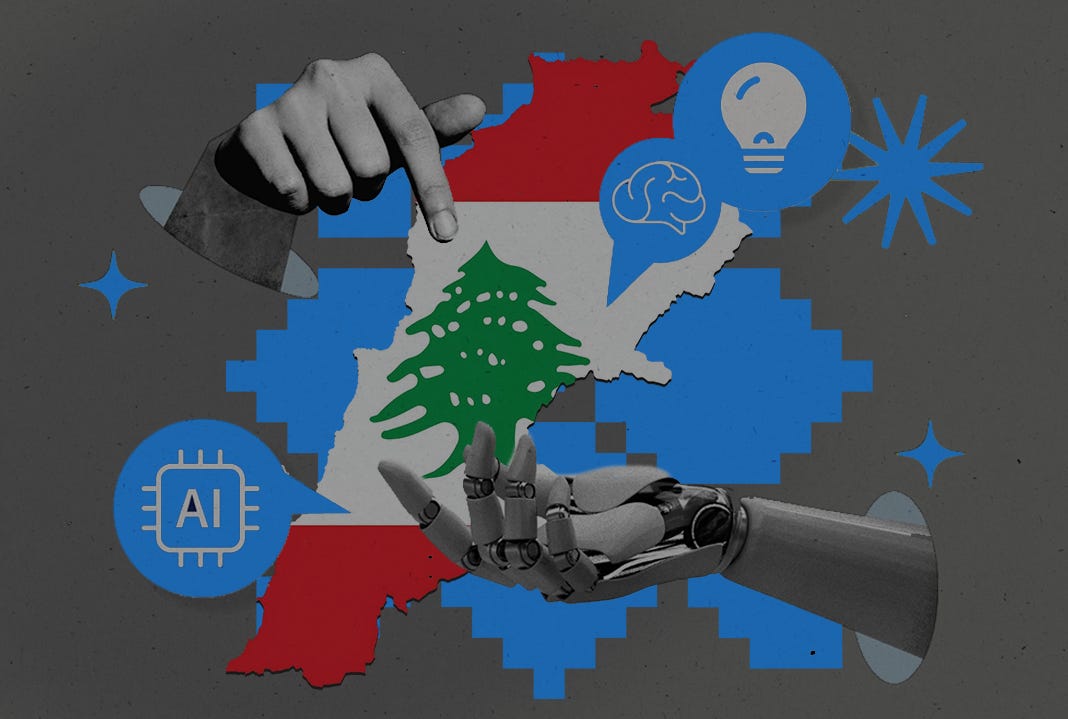
Lebanon appears to have found a remarkably efficient way to produce “expertise.” Years of study in computer science, statistics, machine learning, or software engineering may no longer be necessary. According to the Lebanese Prime Minister, three hours of training should suffice.
In September, Nawaf Salam officially announced an initiative with the extraordinary promise of producing “one million Lebanese AI experts.” The program, launched in cooperation with the United Arab Emirates, aims to train one million people in artificial intelligence. The government described it as an investment in Lebanon’s digital capabilities and future workforce.
On paper, the initiative sounds promising. A closer look at the details makes it considerably less impressive.
According to the Lebanese government, participants will acquire “fundamental and practical skills” in generative AI and prompt engineering. This essentially means they will learn how to formulate instructions and use AI tools more effectively in everyday life and work. A bit less lucrative than training experts, but beneficial nonetheless.
Then the Minister of Technology and Artificial Intelligence, Dr. Kamal Shehadi, clarified further. The program consists of general training lasting roughly three hours, he said.
A three-hour introductory course may build basic prompting skills, but it does not confer expertise. Calling its participants “AI experts” looks more like propaganda with a certificate attached. This is AI-washing.
The technology minister’s explanation divided Lebanon’s AI ambitions into two categories. Roughly one million “prompters,” or ordinary users, will learn how to interact effectively with LLMs (the UAE-backed program). Then there’s a much smaller group of a few thousand “builders” capable of creating digital services and AI-based solutions.
That is a far more honest description than the Prime Minister’s. Prompting is useful; workers who know how to use generative AI can be more efficient if they use it properly, but learning how to input prompts into ChatGPT or Claude does not make someone an AI expert any more than knowing how to search Google makes them a computer scientist.
These exaggerated claims are unnecessary. The country already has a relatively high AI adoption rate. In fact, 27.7 percent of the population uses AI, placing Lebanon fifth in the region despite its economic woes.
Teaching hundreds of thousands of Lebanese how to use GenAI more effectively could be useful, especially when the program is offered for free and backed by a country like the UAE, which continues to provide Lebanon with support it badly needs. That alone should have been enough for the government to present the initiative as a worthwhile investment in digital literacy.
Instead, the Prime Minister wants us to believe that, thanks to his government, Lebanon will magically produce one million AI experts. In three hours.
The government’s draft National AI Strategy promises that, within five years, AI will contribute $4 billion to GDP, generate $2 billion in AI-enabled exports, and produce thousands of “production-grade AI builders.” According to the document, these efforts aim to place Lebanon among the world’s top 30 countries for digital government, and make 80 percent of government transactions digital and AI-enabled.
The targets are ambitious, but Lebanon is still far from meeting the basic requirements to achieve them.
According to the government’s own administrative reform office, 72 percent of Lebanese government services are still not digitized, casting doubt on the state’s readiness to embrace such extensive AI growth.
It is difficult to imagine a digital-first Lebanon when civil status records, including births, marriages, divorces, and deaths, are still preserved in handwritten registry books. During this year’s war, authorities had to physically evacuate millions of these records from southern Lebanon to Beirut to save them from destruction.
Identity checks are still in-person events in which the local civil registrar, known as the “mukhtar,” compares people’s faces with their ID cards to confirm they are the same person. Applications must be physically stamped, and all files transferred between different registry offices before approvals are granted. It is difficult to imagine how the Lebanese government plans to implement an AI economy in four years while the system still depends on shuffling papers from desk to desk.
Somewhere between the handwritten birth certificate and the AI-enabled economy, a step is missing… or several flights of steps.
This technological revolution requires certain infrastructure.
Electricité du Liban said in July that the average state electricity supply stood at roughly four hours per day (the situation is much worse at the time of writing). It also warned that generation instability meant a nationwide blackout remained a daily possibility. The statistic is so embarrassing that the government made sure it was only available in Arabic.
Any AI revolution will have to work around Lebanon’s fickle electricity supply.
Lebanon’s schools still teach a curriculum that was developed in 1997, before Google even existed. It seems a heavy lift to expect one million AI experts to come out of that system. Can a country that took 30 years to realize that school curricula need updating really build an AI economy by 2030?
And how can a country still struggling to digitize its files, modernize its schools, and keep the electricity on honestly gauge how many billions artificial intelligence will contribute to GDP by 2030? None of this means Lebanon should abandon its AI ambitions. Quite the opposite.
The UAE-backed training initiative is very useful. Lebanon has strong human capital, a decent level of AI adoption, and every reason to invest aggressively in digital skills. The national strategy also contains serious ideas about digital identity, cloud infrastructure, cybersecurity, and online public services.
The problem is confusing the destination with the starting line. A three-hour prompting course is not AI expertise, and publishing enormous targets does not make the institutions needed to achieve them suddenly materialize out of thin air.
Perhaps Lebanon will reach those targets. But before becoming “AI by design,” as the strategy puts it, becoming digitally literate across institutions may be a useful first step. The Prime Minister’s announcement suggests that producing one million AI experts takes three hours. In reality, it will likely require a little longer.
You might also like:
Can Hydroponics and AI Rescue Farming in Kurdistan?

In the early days of her health food business, Dilpak Yousif got a dose of reality. Her plan to make healthy food delicious and promote better eating habits in the Kurdistan Region of Iraq hinged on quality ingredients. Her mistake was assuming they would be easy to source.
Middle East Uncovered is powered by Ideas Beyond Borders. The views expressed in Middle East Uncovered are those of the authors and do not necessarily reflect the views of Ideas Beyond Borders.
