


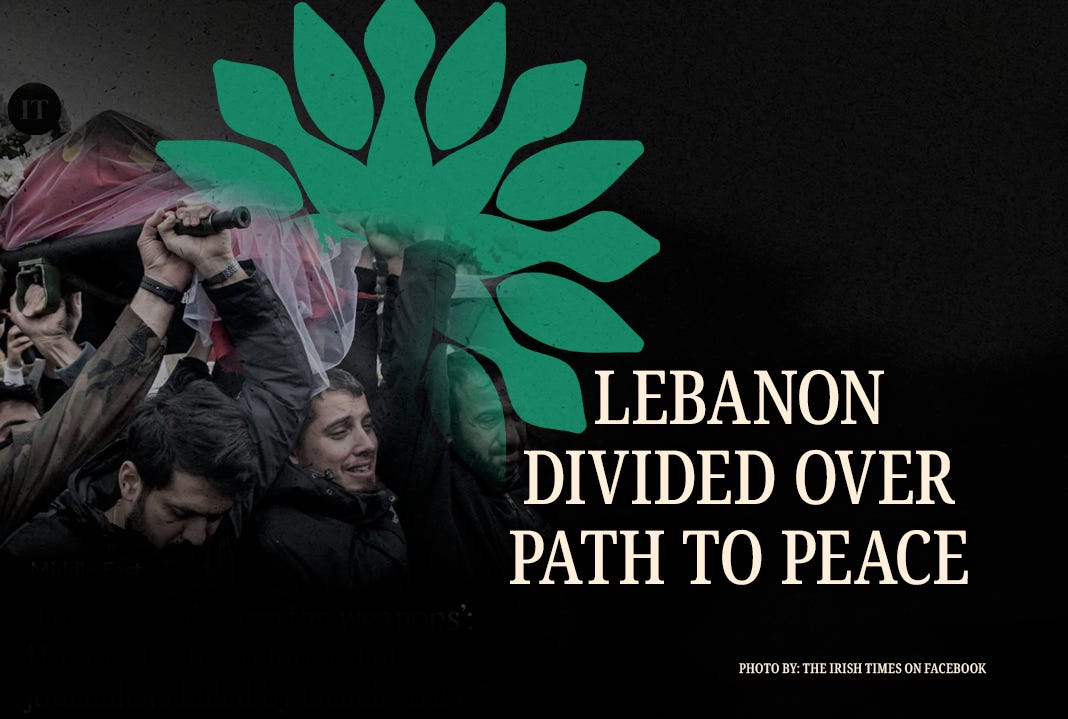
In the forest-covered slopes of Mount Lebanon, hundreds of people gathered last week for the funeral of Pierre and Flavia Mouawad. Two days earlier, an Israeli airstrike on Easter Sunday killed the couple and their neighbor in an attack on Ain Saade, a town northeast of Beirut, sending shockwaves across the country.
The conflict, which began soon after US-Israeli strikes on Iran, has intensified calls for the disarmament of Hezbollah as critics accuse the group of dragging Lebanon into another devastating war with Israel. Supporters say the Lebanese army is too weak to defend Lebanon in the face of Israeli aggression. As a 10-day ceasefire agreement between Lebanon and Israel gets underway, the controversy over Hezbollah’s weapons is expected to be a critical sticking point in direct negotiations between the countries.
Pierre, an official in the Lebanese Forces (LF), was a staunch opponent of Hezbollah. Israeli media claimed the intended target of the strike was a member of Iran’s elite Quds Force, which is closely aligned with Hezbollah. However, the attack never killed the alleged Quds Force member. Instead, it took the lives of three innocent civilians.
In the wake of the Ain Saade strike, LF followers and other Lebanese blamed Hezbollah for the tragedy, accusing the group of hiding its affiliates among civilians. Supporters of Hezbollah blamed Israel for targeting a residential building. The ensuing debate has highlighted mounting division in Lebanon over Hezbollah and its role as an armed resistance movement.
Hezbollah emerged as a Shia militia in the 1980s amidst the chaos of the Lebanese civil war. It gained popularity and support as it waged a years-long insurgency against Israeli troops occupying the country, culminating in their withdrawal from Lebanon in 2000. Alongside its military feats, Hezbollah also entered into Lebanon’s political scene, providing political representation to the Shia community along with essential services in sectors like health and education.
But while those efforts proved successful in winning over much of the Shia community in Lebanon, not all of the country is so fond of Hezbollah. The group has long been criticized for acting above the state, especially in matters of war and peace. Such criticism has grown louder in recent years, especially in the wake of Hezbollah’s decision to enter into two wars with Israel since 2023.
Anger towards Hezbollah was still raw two days after the death of the Mouawads as family, friends, party officials, and political allies gathered for the funeral in Pierre’s home village of Yahchouch. On the stairs of Saint Simon Church, LF parliamentarian Chaouki Daccache lambasted Hezbollah as he criticized the government for failing to stop the group.
“The one who dragged Lebanon into a destructive and futile war, committing a crime first against the state and against all Lebanese—it is Hezbollah, the agent implementing Iran’s agenda at the expense of Lebanon and its people,” Daccache said.
Earlier that day, the Lebanese military published the findings of an investigation that cast doubt on whether the alleged Quds Force member had really been staying among the Mouawads. Fouad K, a member of the local LF branch and a friend of Pierre, was skeptical. “Things are more complicated than that,” he said. “The Lebanese army, while it is a national army, has been infiltrated over 30 years by Hezbollah,” he added, emphasizing that his views are personal and not representative of the Lebanese Forces.
In the weeks prior to the Ain Saade strike, Israel carried out similar attacks in parts of Beirut that were once considered safe. Such attacks have deepened widespread opposition to Hezbollah, which many Lebanese have long accused of acting above the state. That criticism has deepened since Hezbollah attacked Israel on March 2, igniting the second war that Lebanon has faced in less than two years.
More than 2,100 people have been killed in Israeli strikes, which have continued in the face of widespread condemnation. In recent weeks, Israel has bombed huge swathes of the country and launched a ground incursion into southern Lebanon, displacing 20 percent of the population.
Despite the devastation, some Lebanese say there is no other way to disarm Hezbollah. “Israel is not doing us a favor. They’re doing themselves a favor. But we are benefiting from that,” said Fouad, who described the group as “a cancer infiltrating everything in Lebanon.”
Pointing across a deep valley, he picked out Shia and Christian villages dotted along the mountain slope. “People live together, but the poison is Hezbollah’s ideology,” he said. “It poisoned them over three generations.”
After the Easter Sunday attack, tensions bubbled over. Shia families who had been renting homes in Yahchouch left. Those who refused “were forced out by the people who rented (to) them,” Fouad said.
Since the start of the war, local officials and residents have placed restrictions on renting homes to Shia families in case they are affiliated with Hezbollah. Communities say they are afraid of being targeted by Israel if Hezbollah members or allies stay among them.
Less than 24 hours after the funeral in Yahchouch, there was a brief sense of relief as US President Donald Trump announced a two-week ceasefire with Iran. Hours later, however, Israel carried out its largest attack on Lebanon since the start of the war, killing at least 357 people and wounding another 1,223 others, according to the Lebanese health ministry.
As debate raged over Lebanon’s inclusion in the ceasefire, Israel announced that it would enter into direct negotiations with Beirut to discuss the disarmament of Hezbollah. The talks marked the first conversation between Lebanese and Israeli leaders in 34 years. The two countries do not have diplomatic relations.
While the Lebanese government has already taken steps since the last war to disarm Hezbollah, many people are skeptical of its ability to carry out the job.
On Friday and Saturday, Hezbollah supporters took to the streets in Beirut to protest the talks. “We want peace, we want a ceasefire,” said Ali, a middle-aged father displaced from Dahiyeh, a Shia-majority suburb south of Beirut. “Let Israel withdraw and mind their own business and let us mind our own. But to sign a peace agreement with them is impossible. They killed half of our people. It’s impossible to sign a peace agreement with them.”


Ali is staying in a tent on Beirut’s Corniche, which has turned into an unofficial displacement camp for people uprooted by Israeli strikes across the country. Unable to find work since the last war, Ali said he can’t afford to rent a place for his family of seven. The restrictions on renting to Shia families are a further barrier.
“Some people are scared. You can’t blame them… But it’s not the fault of women and children. Rent at least to women and children,” Ali said.
Ali’s only other option is one of Tripoli’s displacement shelters, which are typically overcrowded and underequipped. Not wanting to subject his family to these poor conditions, he took them to the waterfront.
Rain trickled on an overhead tarp as he ate and drank coffee with family and friends who were also displaced. Other than initial cash assistance from Lebanon’s Ministry of Social Affairs, Ali and his friends said they had not received any support from the government.
“The government is not seeing us at all,” Ali said. “The state is with Israel against us. They’re killing us.”
Following the attack on Wednesday when Israel bombed more than 100 targets across Lebanon in less than 10 minutes, Lebanese Prime Minister Nawaf Salam declared a day of mourning. To Ali’s family and friends, it seemed hypocritical. “How many martyrs (from southern Lebanon) have gone so far, and he hasn’t done any mourning day?” said Ali’s wife, Wafaa.
“People in Beirut are Lebanese, but people in Dahiyeh, the South, and the Beqaa are not,” her friend Susan added, pointing to areas across the country that are home to large Shia communities.
As she spoke, news broke of an Israeli airstrike on the southern city of Nabatieh. The attack killed 19 people, including 13 members of Lebanon’s state security.
In a country repeatedly battered by war, ordinary Lebanese are forced to find an increasingly unlikely path to peace. For some, Israeli attacks are the only way to dispel Hezbollah’s hold over the country. For others, each strike deepens opposition to disarming Hezbollah. Across society, there is little faith in the ability of Lebanon’s military to defend the country, whether from foreign incursion or internal unrest. While the ceasefire agreement announced on Thursday by US President Donald Trump offers hope of some respite for battered Lebanon, it is a far cry from resolving the issues that brought the country to this point in the first place. If Lebanon is to reach lasting peace, it will have to confront its most divisive challenges, particularly those pertaining to national security.
“How will the army protect me now? They can’t protect me. Only the Resistance can protect me,” said Ali, referring to Hezbollah.
Middle East Uncovered is powered by Ideas Beyond Borders. The views expressed in Middle East Uncovered are those of the authors and do not necessarily reflect the views of Ideas Beyond Borders.

This was convincing and an excellent analysis. I have no expertise on the Middle East. I’m just a long-term Peace activist who supported the JCPOA in an op-ed in the Plain Dealer In 2015.
But I’ve been heavily covering and reading everything I can about the Middle East since October 2023. In my most recent post in my Substack, I address the question of the value of putting normalization of relations, including between Lebanon and Israel first, with final status negotiations later.
But part of that has to be for Lebanon and Israel to request that the United Nations security council take seriously the question of non-state armed group groups like Hezbollah and Hamas.
Neither Israel nor Lebanon have the military power to disarm these groups it is clear. They have burrowed underground and it would cost tens of thousands of deaths to try to military disarm them.
Unfortunately, in the case of Israel, this resulted in a decision to just basically flatten Gaza, producing tens of thousands of civilian casualties.
The only solution is for a strengthen United Nations observer force, and for resolutions which insist that Hezbollah and Hamas voluntarily disarm. Already Hamas has offered to destroy all of the weapons it has which could be used to attack Israel. Lebanon should insist that Hezbollah do the same.
But honestly, the issue is much larger than that because as long as there are underground, armed groups, they can terrorize the population and prevent the full sovereignty of both Lebanon and any state of Palestine.
Part of the settlement with Iran also has to be to insist on discontinued support for their so-called proxy forces.