


When the US and Israel launched large-scale airstrikes on Iran, killing Supreme Leader Ayatollah Ali Khamenei, the regional spillover was swift. Within days, Hezbollah fired rockets into Israel, opening a new front in Lebanon amid a widening conflict that has disrupted global energy markets and sparked warnings of a global recession.
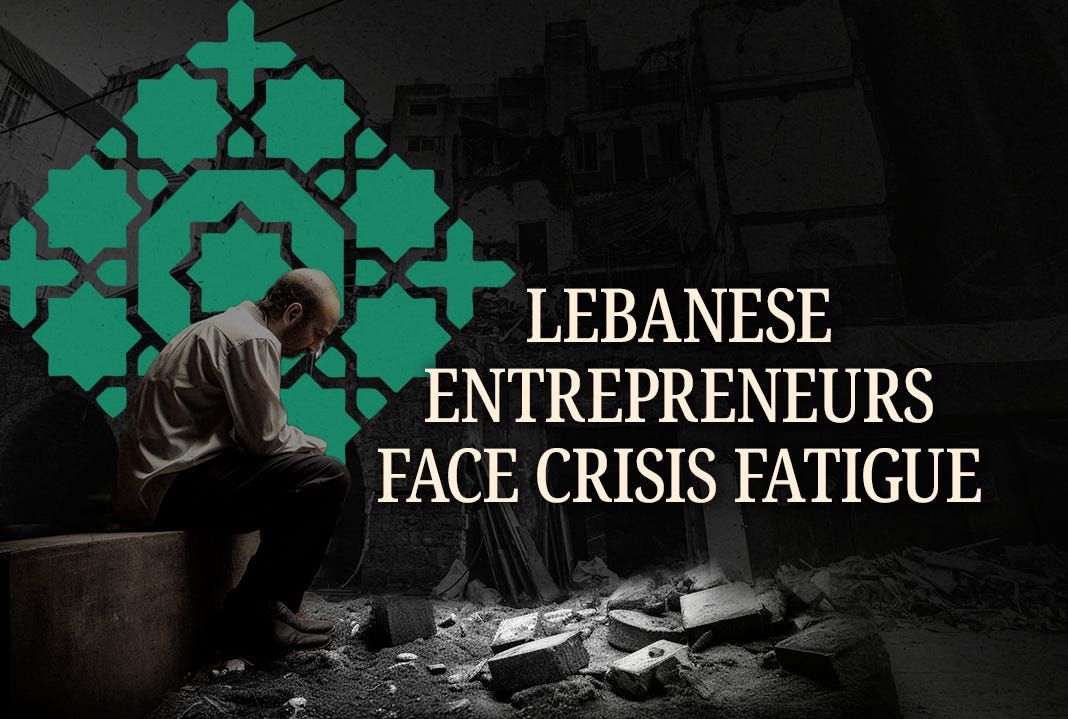
In a country familiar with the ramifications of war, the effect on businesses was immediate. “The moment the attacks started, we received notice upon notice from our clients in the GCC wanting to cancel their contracts,” said Natheer Halawani, who owns a creative agency in Lebanon. “Right now, the company is running on fumes, and I don’t have enough to pay salaries.”
As the conflict escalates, concern is mounting over the economic toll of what US President Donald Trump described as a “limited operation,” which has killed over 3,000 people across the Middle East since strikes began on February 28. Gulf oil flow has plunged, sending prices soaring as production facilities across the Gulf become targets and Iran maintains its chokehold on the Strait of Hormuz.
While Gulf economies absorb the immediate shock, the consequences are reverberating in fragile states like Lebanon, where the financial fallout is already devastating livelihoods.
Entrepreneurs like Halawani, who turned to the UAE for stability and security, are watching that promise wither as clients freeze contracts and place projects on hold. “It takes chunks out of your life to keep rebuilding something that someone else destroyed,” said Halawani, who steered his company, The Cabinet, through multiple crises in Lebanon before pivoting to focus on Gulf markets in 2025, after President Trump shut down USAID, his biggest client.
Unable to rely on Lebanon’s faltering economy, small business owners are now considering their future in a region where nowhere seems safe. “The Gulf was supposed to be stable and secure—everything we lacked in Lebanon,” said Halawani, who worries it may be months before business picks up again while weaker economies like Lebanon plunge deeper into debt.
Years of financial crisis and institutional paralysis have gutted Lebanon’s start-up scene. The country is hampered by one of the world’s highest debt burdens, compounded by decades of fiscal mismanagement and excessive borrowing. Denied growth opportunities at home, Lebanese startups have increasingly adopted a hybrid solution. Staff and ideas are based at home, while business expansion is concentrated in the GCC, particularly the UAE, which has become a hub for entrepreneurship in the region.
For Farah Ghanem, Dubai was the obvious choice for scaling her business. The 30-year-old runs CNSLT Lab, a corporate consultancy that draws 70-80 percent of its business from the Gulf. The UAE’s attractive regulatory environment, infrastructure, and access to regional markets make it “a natural extension for Lebanese businesses that cannot fully grow locally,” she said.
The turmoil triggered by the current conflict has forced her to reconsider. “Rather than changing my perception entirely, it has reinforced the importance of diversification, rather than relying heavily on a single region,” she added.
The scale of Iran’s response to the war has sent shockwaves through the region, with the UAE, Qatar, Bahrain, Kuwait, Jordan, Oman, and Saudi Arabia subject to a bombardment of retaliatory strikes.
Over 20 people have been killed in Gulf states, including 11 in the UAE, where authorities reported more than 2,000 missile and drone attacks in recent weeks. While most have been intercepted by air defense systems, the onslaught has punctured the country’s peaceful image, posing a threat to its reputation as a safe haven for investors and a global hub for business, travel, and tourism.
Commentators have been quick to predict the demise of Dubai, but analysts say recovery is within reach if hostilities end soon.
“The UAE’s value proposition—stability, connectivity and access to capital—remains intact, but the perception of predictability, which underpins it, has been tested,” said Carole Nakhle, CEO, Crystol Energy and Secretary General of the Arab Energy Club. “In the short term, this may lead businesses to adopt a more cautious approach, but it does not fundamentally alter the UAE’s role as a key platform for regional activity.”
The conflict has dealt a financial blow to the UAE and other Gulf countries, which remain heavily reliant on oil, despite efforts to diversify their economies away from petrochemicals. Disruptions to energy exports, aviation, tourism, and shipping routes alongside higher insurance premiums and freight costs are likely costing the region hundreds of millions of dollars a day in economic activity, according to Khaled Almezaini, an associate professor of politics and international relations at Zayed University in Dubai in the United Arab Emirates.
While the risk of a recession rises as the war continues, “if tensions de-escalate relatively quickly, the region is well placed for activity to normalize faster than many expect,” he told Al Jazeera.
Nakhle said most businesses will focus on “diversification and resilience” rather than relocating, maintaining a foothold in the UAE while exploring complementary bases.
It’s a familiar pattern for many Lebanese business owners. Alia el Khatib built adaptability into her business model after the collapse of the country’s banking sector wiped out her savings in October 2019. She relocated to Spain in August 2020 after the Beirut port explosion finally shattered her confidence in Lebanon. Since then, El Khatib has navigated ongoing instability remotely, working with Lebanese freelancers while spreading her client base across the MENA region and further afield.
“After the 2019 collapse, I made a clear decision not to depend on the Lebanese economy,” said El Khatib, who emphasized the personal and emotional toll of running a business as the country lurched from one crisis to the next.
Living abroad has cushioned her from some of the stress at home, but this time, there is no escape. MENA clients account for 70 percent of El Khatib’s business, and most have halted investment in growth and marketing while the war is ongoing. “In the past, instability was more contained. Now, the entire region feels like it’s on pause,” she said.
In Beirut, Karakna, the coffee shop Ghanem launched in 2023, still bustles with customers, but her costs have surged. Rising fuel prices affect all levels of the business, from supply chains to delivery, but she cannot increase prices for a community that’s already under economic pressure.
During the previous escalation, when Hezbollah and Israel exchanged fire over Gaza, Ghanem transformed her coffee shop into a central kitchen and distributed meals to displaced families. This time, she plans to remain open and shift the focus to delivery while moving her consultancy to online training. “Today, in Lebanon, it feels like adaptation is the only constant we live by,” she said.
While Lebanese businesses are accustomed to operating under pressure, Ghanem detects a deeper despair about the current setbacks. With no time to recover between economic shocks, the constant need for resilience is becoming unsustainable, creating a cycle in which survival replaces growth. “Lately, there’s a phrase I keep hearing in everyday conversations between business owners and entrepreneurs: ‘بس هالمرة تعبنا’ (‘but this time, we are tired’),” she said. “It’s not a lack of resilience, but rather the accumulation of continuous crises.”
For a community that has survived multiple setbacks, the impact of regional war could be a tipping point. As businesses that relied on the Gulf lose their lifeline, Lebanon looks increasingly unviable for a generation exhausted by constant blows.
Middle East Uncovered is powered by Ideas Beyond Borders. The views expressed in Middle East Uncovered are those of the authors and do not necessarily reflect the views of Ideas Beyond Borders.