


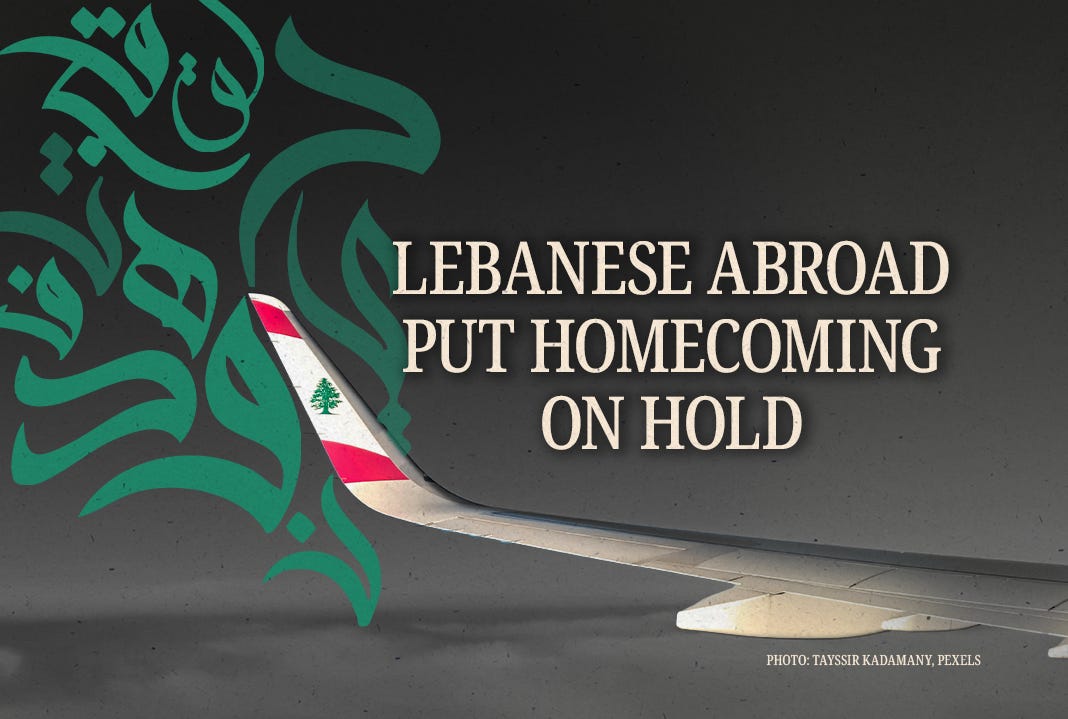
The family table laden with favorite childhood dishes; lazy days at the beach soaking up sun with friends. For some, the hallmarks of a Lebanese summer are noisy weddings that bring everyone together. For others, it’s waking up to familiar smells from the kitchen and being asked whether they want coffee or Nescafé.
When Tala* travels back to Lebanon every year, she looks forward to home-cooked kibbeh nayyeh served with tabbouleh and the constant ring of the doorbell announcing more guests. Her husband is from North Macedonia, and she relishes the chance to share these traditions with him—”The food, the people, the hospitality, the sunsets… but also the annoying things like traffic and noise and politics. Everything, the good and the bad.”
This year, forced to postpone her visit due to the conflict between Israel and Hezbollah, she is unsure. “I’m waiting for reassurance from my family that it feels safe enough to come.”
For millions of Lebanese living abroad, the summer visit is an annual ritual that reaffirms family ties and deepens their connection to a homeland many were forced to leave. In a country of contradictions, instability seems to strengthen the attachment of a dedicated diaspora that typically maintains close links with their homeland, even after decades away. But this year, the unpredictable chaos of regional war has made even the most intrepid Lebanese travelers hesitate before booking flights home. “Part of me wants to continue living my life, go back, and enjoy Lebanon. The other hurts to see what the country and its people are going through,” Tala said.
In a typical year, the summer months bring a spike in arrivals as around one million Lebanese return home to visit family and friends. Lebanon has one of the world’s largest diaspora communities relative to its population, with an estimated 15 million Lebanese people based abroad compared to around 5.7 million living in Lebanon. These communities provide a lifeline to the country’s struggling economy, sending back remittances that account for 33 percent of the nation’s Gross Domestic Product (GDP).
The annual homecoming reaffirms their connection to a country where political instability, financial crisis, and regional conflict have alienated many Lebanese, prompting mass emigration in recent years. It also brings a much-needed boost for the economy. Cafes fill up, festival tickets sell out, usually quiet beaches bustle with people, and shopping malls throng with visitors again.
For Nour Zreika, who moved to Italy following Lebanon’s financial crisis in 2019, it is when a scattered community comes back together. Her immediate family lives in the US, but they visit Lebanon every year, maintaining their connection to a country they still call home.
The 33-year-old looks forward to reconnecting with childhood friends who live in different countries and return to Lebanon during the summer months. “And, of course, the food, the sea, and the overall feeling of being back home.”
This year is different.
Figures for the first quarter of the year show a steep drop in traffic at Beirut Rafic Hariri International Airport, with a 33 percent decline compared to the previous year. Flight numbers also decreased while ticket prices rose considerably on regional routes.
Reem Jabri, who works in HR in London, has canceled her flight back to Beirut. “I try my best to visit regardless of the situation, but it got really bad with the war this year,” she said. “The lack of safety and uncertainty makes me think twice.”
A ceasefire agreed in April, followed by subsequent agreements in June, has done little to restore confidence amid frequent flare-ups of fighting. Around 1.2 million people have been displaced and more than 3,900 killed in the latest round of clashes between Israel and Hezbollah, which began on March 2 following the assassination of Iran’s Supreme Leader Ayatollah Ali Khamenei.
The war is the latest in a series of conflicts that have prompted waves of Lebanese professionals and young people to move abroad, deepening the brain drain that threatens the country’s prospects for economic growth.
When Rami Mehio, 33, left Beirut seven years ago, he planned to build his career then return when the situation improved. As time passed and successive crises pushed Lebanon’s recovery further into the future, he felt his enthusiasm ebb. “I have become less attached to it. If my family was not there, I don’t think I would be visiting as frequently,” he said.
His wife is expecting their first baby in October, and the couple is reluctant to visit a war zone while she is pregnant. With ticket prices soaring and the increased risk of getting trapped if hostilities flare, he may cancel his trip for the second time this year.
“The cost of living has become so high [in Lebanon] that I am weighing up whether it’s better to go there or send the funds to help my parents with living expenses,” he said.
The country’s economy is projected to shrink by seven to 10 percent this year, with the current war expected to cost an estimated $20 billion. Lebanon was already struggling from financial collapse in 2019 and the 2024 war between Israel and Hezbollah. Much now depends on the tense ceasefire between Israel and Hezbollah brokered in June following renewed clashes earlier that month.
In May, Lebanon’s Finance Minister Yassine Jaber said in a Reuters interview that the full extent of economic damage would also be determined by the flow of remittances from the Gulf and the success of the summer tourist season.
Summer tourism brings billions of dollars into Lebanon each year, providing crucial support for the hospitality sector. Visitors come for the beaches, cuisine, culture, hospitality, heritage, scenery, nightlife, and events. They book hotels and eat in restaurants, typically spending more than diaspora visitors who tend to stay in family homes.
Early indicators this year suggest a sharp drop in bookings as foreign tourists avoid Lebanon amid travel warnings and flight disruptions. Traditionally, the country’s tourism sector has demonstrated remarkable resilience, with the 2025 season registering a 44.5 percent increase on the previous year despite the impact of clashes between Israel and Hezbollah linked to the wider conflict in Gaza. However, a new wave of regional volatility and repeated ceasefire violations in 2026 have cast doubt on whether this recovery can be sustained.
In an article examining the financial fallout of a lost tourism season in Lebanon, Libnannews cites the knock-on effects across the economy, resulting in lost earnings, failing businesses, and families under pressure.
“Tourism is often presented as a leisure sector. In Lebanon, it is also a social shock absorber. It employs waiters, maids, receptionists, cooks, drivers, security officers, technicians, musicians, delivery agents, guides, vendors, and seasonal workers. Many depend on a few months of activity to hold the rest of the year.”
After a slow start to the season, July hotel bookings showed tentative shoots of recovery, but the sector remains vulnerable to shocks. “A strike in Beirut, an evacuation order in Tyre, a flight suspension or an embassy alert may be enough to break the momentum… A country cannot build a sustainable tourism strategy if each summer depends on a ceasefire negotiated abroad.” Libnannews reported.
For Lebanese living overseas, watching loved ones endure the impacts of another war adds to their dilemma. “Part of me feels that if they are living through it, then I can manage to visit, but it requires more careful planning and awareness of the situation,” Tala said.
She avoids mainstream media coverage, which she feels paints the situation as “black and white.” Instead, she takes guidance from people on the ground and has booked a trip to Lebanon for the end of August, when she hopes the situation will be clearer.
Sophie Mawad, 33, visits three times a year, at Christmas, Easter and in summer, from her home in Saudi Arabia. She is among hundreds of thousands of Lebanese based in Gulf cities, where the wider regional conflict with Iran has placed economies under pressure. Of an estimated $6 billion in annual remittances, nearly 50 percent come from Gulf countries. However, job losses among expats threaten the flow of remittances back to Lebanon.
In diaspora hubs, including Saudi Arabia and the UAE, the war has disrupted tourism and trade, damaged energy infrastructure, and upended supply chains. Many fear that being stranded in Lebanon could jeopardize their jobs abroad. Others find the anguish of watching their country suffer has only deepened the desire to return home.
Mawad is adamant that she will stick to her travel plans: “I always end up going, no matter what.” However, for those living further away, or traveling with children, trips to Lebanon in the current climate can feel impossible.
After hoping the situation would improve, Lina Hallab has reluctantly decided against visiting this year. “We opted to stay in the US this summer, especially now that we have a toddler,” she said. “There was so much uncertainty…and we are worried if the situation gets worse, we might get stuck there.”
In a typical year, the summer months bring people together from all over the world as Lebanese from Brazil, Canada, the UK, Europe, West Africa, and other countries reunite in the Levantine nation. From June to August, the atmosphere lifts as families celebrate special occasions, young people dance to blaring music, and tanned bodies stretch out on the beach.
This homecoming persists in the face of ongoing crises, replenishing a country that seems constantly on the verge of unraveling. Tourism in Lebanon has weathered geopolitical shocks before. The question this year is whether repercussions from the 2026 Iran war threaten a deeper impact. As the blow to tourism and remittances filters through the economy, wage cuts, job losses and business failures may prompt even more Lebanese to leave.
It’s a dilemma that preoccupied Lebanese students attending the inaugural Cedars Conference in London earlier this year. Aimed at enhancing the sense of community among Lebanese students abroad, the conference featured speakers who discussed the challenging prospects of building their future careers in Lebanon. Speaking to the crowd gathered at the London School of Economics, former director general of the Finance Ministry and current chairman of the Citizen Foundation Alain Bifani captured the contradiction that confronts the next generation. “I would be ashamed to tell a young person in Lebanon to stay, but I wouldn’t like to tell them to leave.”
Now and in the future, practical considerations compete against emotional ties to a country where decades of conflict have alienated some but deepened the connection for others. Nour Zreika has canceled plans to return for her cousin’s wedding in August, but longs to feel the familiarity of home. “If anything, [the situation] has strengthened my connection with Lebanon. Of course, uncertainty and safety concerns affect my decisions, but I still feel a strong desire to return whenever I can.”
For generations of Lebanese abroad, returning home has never been simply a vacation. It is how families stay connected across continents and how many continue to invest in a country they refuse to give up on. Another lost summer risks fraying both.
*Middle East Uncovered uses pseudonyms to protect the identity of vulnerable sources.
Middle East Uncovered is powered by Ideas Beyond Borders. The views expressed in Middle East Uncovered are those of the authors and do not necessarily reflect the views of Ideas Beyond Borders.