


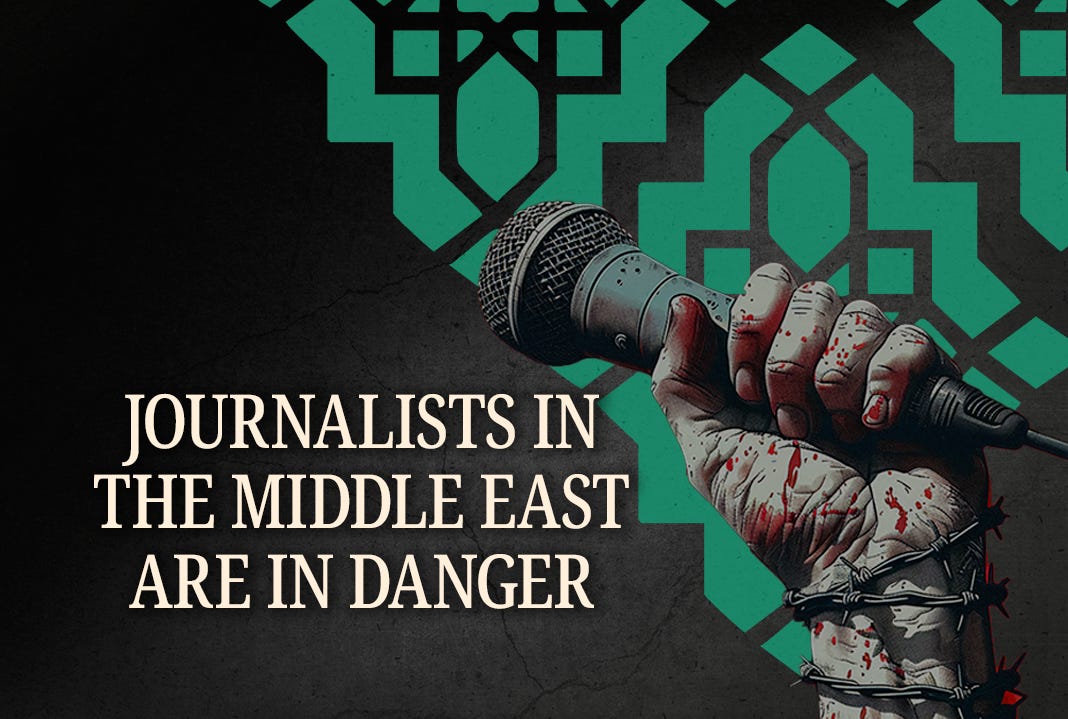
From war, repressive governments, and armed extremist groups, journalists across the Middle East have faced a slew of deadly risks for many years.
Last week, this danger reached as far as London.
Three men were arrested after an attempted attack near the offices of Iran International, a Persian-language broadcaster that has long been in the cross-hairs of the Islamic Republic and many of their apologists. For years, its staff have lived under threat, just as many other journalists across the region are right now.
On the evening of April 15th, a suspicious vehicle was reportedly refused entry at the site. Shortly after, incendiary devices were reportedly thrown into the car park of an adjacent building. The suspects then fled, driving away in a black SUV before being arrested after a police pursuit.
The message is unmistakable. Distance offers no protection from the Iranian regime. Criticize the regime? They, or their lackeys, will come for you. For dissenting Iranians, this has been the norm for years.
And now, that risk is spreading across the region.
Take Iraq. The American journalist Shelly Kittleson was abducted in Baghdad in late March. She was held by her captors—the Iranian regime-backed Kata’ib Hezbollah—for a week before being released. Her kidnapping was a troubling reminder that Iraq is still a place where armed actors will seize Iraqi civilians and Western visitors alike. Journalists are particularly at risk of abduction.
Kittleson’s case is similar to an even longer ordeal: the kidnapping of Elizabeth Tsurkov. Tsurkov, a Russian-Israeli woman, was seized in Iraq in 2023 and held for more than two years by the same group that abducted Kittleson.
Tsurkov is an academic researcher rather than a journalist. But her case is part of an escalating pattern. Researchers, writers, and reporters travel. They ask questions. Sometimes these questions make people uncomfortable. That can place a target on one’s back.
Tsurkov wrote about what she experienced in a piece for The Atlantic titled: “I Was Kidnapped By Idiots”
In Kuwait, too, Ahmed Shihab-Eldin, a Kuwaiti-American journalist, has reportedly been detained since early March. He was charged with spreading false information, harming national security, and misusing his mobile phone. The case appears to center on social media posts connected to the current war between the United States and Iran. This includes footage of a U.S. fighter jet crash near a U.S. air base in Kuwait, which he posted on his Substack.
During the recent escalations between the Israeli military and Hezbollah in Lebanon, there have also been journalists threatened and harmed. Three American freelance journalists told the Committee To Protect Journalists they were assaulted while reporting on civilians evacuating from Beirut’s southern suburbs. The alleged assailants have not yet been publicly identified.
Each of these cases should concern anyone who cares about the future of the Middle East.
Journalism, it bears repeating, should never be treated as a crime or a transgression. Harsh criticism of governments is one of the few effective checks on corruption and abuse. Reporting aggressively, commenting sharply, and exposing corruption, incompetence, repression, or violence are among the best catalysts for a society to correct itself.
Research shows that this matters for both liberty and prosperity. Societies in which journalists are allowed to investigate and speak freely tend to be better-governed. They tend to be less corrupt. They also tend to be more capable of sustained development. A free press makes it much harder for incompetence and state failure to hide and plague us in the dark.
These motivations inspired me to work as a writer and a journalist myself. My colleagues across the Middle East deserve to do their jobs freely without the threat of kidnapping—or worse.
If the targeting of journalists in the Middle East continues, the consequences will be tangible. Fewer reporters will take risks. Fewer stories will be told. The record will thin out, replaced by rumor, propaganda, and silence. That is exactly the outcome these actors want.
Journalists are being targeted because they are effective. They document what others try to hide. They force uncomfortable facts into public view. That is why they are threatened, detained, and, in some cases, hunted across borders.
This cannot be treated as background noise to the regional conflict. It is part of the conflict. Governments that claim to value stability and order cannot look away while armed groups and state-backed actors turn reporting into a liability punishable by violence and false imprisonment.
A region where journalists are silenced is a region where abuse goes unchallenged, and power operates without restraint. That is the direction this is heading unless there is a real cost for those who make journalists their targets.
Middle East Uncovered is powered by Ideas Beyond Borders. The views expressed in Middle East Uncovered are those of the authors and do not necessarily reflect the views of Ideas Beyond Borders.

This is one factor that I think is overlooked in explaining the spread of antizionism: Journalists can operate freely in Israel, enjoy spending time in cool places like Tel Aviv, and can easily just translate into English critical coverage about Israel, because Israel has free and very active press. This creates an availability heuristic: a steady flow of critical coverage of Israel, compared to almost no reporting from places like China, Qatar or Iran.