


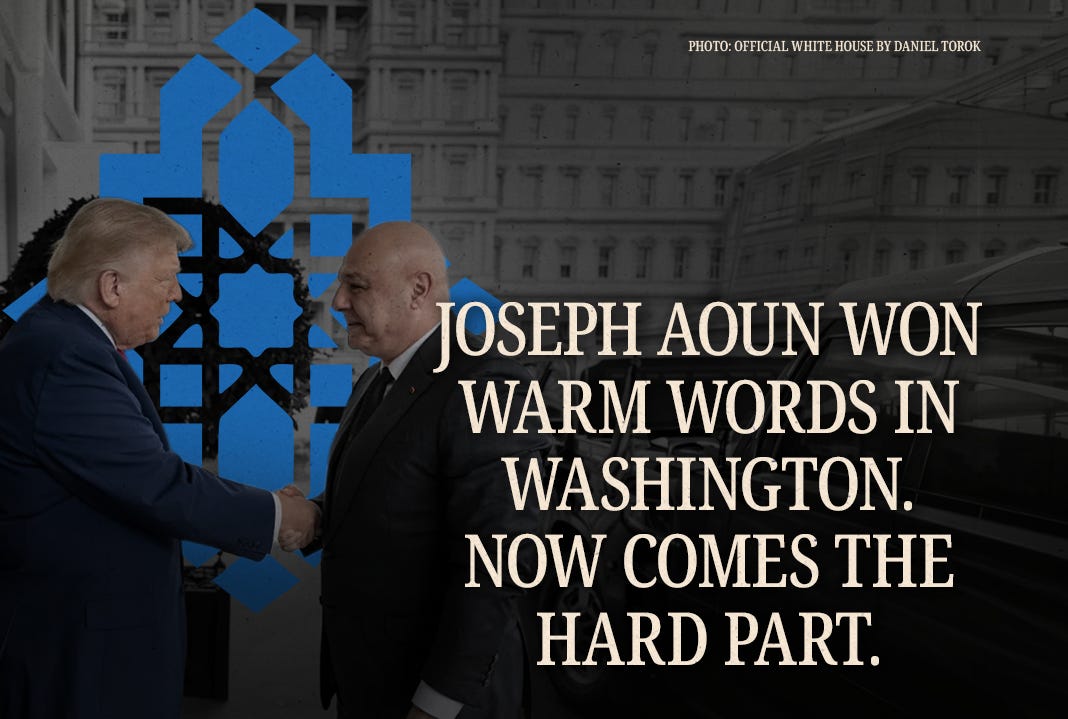
Lebanese President Joseph Aoun arrived in Washington this week with a difficult proposition. Lebanon wants Israeli forces to withdraw from the south and reconstruction to begin. It also accepts that, in time, the state’s authority must extend to every armed group, including Hezbollah. The challenge is persuading each side to move before the others do.
Aoun returned with a decision to restore direct commercial flights between the United States and Lebanon for the first time in four decades, public support from the Trump administration, and the outline of a bargain that Lebanon still lacks the power to enforce.
Aoun’s visit was the first by a Lebanese head of state to the White House in nearly twenty years. He arrived at a moment when Lebanon is expected to restore state authority, even though Israeli forces still hold positions in the south and Hezbollah has no intention of giving up its weapons.
During the meeting, he made the case that Hezbollah’s disarmament could not be separated from Lebanon’s broader recovery. Asking Beirut to confront the group before Israel withdraws and before the state has the capacity to replace it, he argued, will leave intact the very conditions Hezbollah cites to justify keeping its weapons.
Aoun first met Secretary of State Marco Rubio, who praised the Lebanese government’s efforts to restore sovereignty and disarm Hezbollah. Rubio didn’t waste time mincing words after that, stating frankly that Lebanon could not achieve lasting peace while an armed organization remained stronger than, or ran parallel to, the state. Aoun also held talks with members of Congress and senior administration officials, making the visit broader than a single Oval Office meeting.
That outreach may prove to be more consequential than the Aoun-Trump meeting. American assistance to the Lebanese army, reconstruction support, sanctions policy, and long-term backing for any settlement with Israel cannot depend entirely on Trump’s mood. Aoun was trying to solidify Lebanon’s position across Washington, not just woo one president.
Still, charm played its part.
During the meeting, Aoun praised Trump's commitment to peace, told him securing it in Lebanon could become his legacy, and described him as a "great president." Trump smiled, agreed with the compliment, called Aoun handsome, and said the Lebanese president “knows how to get to me,” before adding: “Now he can have anything.”
It was, by diplomatic standards, practically a bromance. Trump, after all, had recently complimented Iraqi Prime Minister Ali al-Zaidi’s looks as well. Perhaps he has a type.
The exchange was amusing, but Aoun understood the man across the table. Trump likes praise, legacies, and agreements that can be presented as personal victories. Aoun did not lecture him on Lebanon’s historical complexity or beg for favors. Instead, he offered something far more useful—the prospect of making peace in Lebanon part of the president’s legacy.
For a small country negotiating with a superpower, understanding who you’re negotiating with is the first step toward good diplomacy.
Following the meeting, Trump directed his administration to allow American airlines to fly directly to Lebanon again, ending a ban imposed after the 1985 hijacking of TWA Flight 847. The decision carries real weight for Lebanon’s large diaspora in the United States, making it easier to maintain the family and cultural ties that connect many Lebanese Americans to their homeland.
The flights will not resume immediately. American officials must first complete a security assessment of Beirut airport, and airlines must decide whether the regional security environment makes the routes commercially viable. The United States also continues to advise its citizens against traveling to Lebanon.
The possibility of a broader agreement was introduced as well.
According to Lebanese media reports, they discussed linking the end of Hezbollah’s military role to a political and economic return for Lebanon that includes Israeli withdrawal, reconstruction assistance, international support, and investment. Economic zones, potential American investment in Lebanon’s offshore gas fields, and Lebanon’s possible place in new regional energy corridors were reportedly among the issues raised.
For now, this is all talk. Nevertheless, the talks show that Aoun was trying to present sovereignty as an economic project, not merely a security operation. A state expected to replace Hezbollah’s parallel military and social structures must be capable of offering citizens more than speeches about sovereignty—and it needs support to do so.
Aoun rejected any Syrian military intervention against Hezbollah. Instead, the discussion turned toward Lebanese-Syrian cooperation to secure the border, stop weapons smuggling, and disrupt Hezbollah’s supply routes. Rubio similarly argued that Syria should focus on securing its side of the border rather than entering Lebanon.
Syria invading Lebanon to fight Hezbollah would reopen old wounds and risk importing Syrian vengeance that could escalate into another Lebanese conflict, but Syria preventing weapons from crossing its territory would be a legitimate contribution to Lebanese sovereignty.
Trump also described Parliament Speaker Nabih Berri as a “good person” who might join the process once he saw progress. Berri responded that Trump seemed to understand him better than some Lebanese did, while warning that neither a complete ceasefire nor the required Israeli withdrawals had yet materialized.
The exchange exposed Washington’s realism. No Lebanese agreement involving Hezbollah can easily bypass Berri, Hezbollah’s closest institutional ally and the gatekeeper of parliament. But relying on him also carries an obvious risk. For decades, Berri has cast himself as a bridge between Hezbollah and the state, but only so long as the path leads somewhere Hezbollah is willing to go.
The visit coincided with the first Israeli withdrawal under the pilot-zone program. Israeli troops left Zawtar al-Gharbiyeh, and Lebanese soldiers began deploying there. The next negotiating round is scheduled for August 4 in Italy, where the timetable for further withdrawals and army deployments will be central to the discussion.
This gave Aoun a concrete sign of progress, but it also demonstrated how fraught the process is. Israel says it will retain territory so long as Hezbollah remains armed. Hezbollah refuses complete disarmament and rejects direct negotiations. Lebanon argues that an Israeli withdrawal would remove the justification Hezbollah has long used for retaining its weapons.
Everyone wants the other side to move first.
Aoun did not return with a commitment to a full Israeli withdrawal, a reconstruction package, or Hezbollah’s agreement to disarm. Nor could anyone reasonably have expected a single White House visit to deliver those outcomes.
The better measure is whether he left Lebanon in a stronger position than when he arrived. He did.
The warmth between the two presidents was genuine. The agreement to restore direct flights, even if implementation takes time, is a tangible result. The broader understanding between the two countries is still taking shape, but Aoun appears to have secured something just as valuable: Trump’s attention and admiration. As the president himself joked, Aoun could now “have anything.”
Lebanon will soon discover whether that includes the two things it needs most: its territory back and a state strong enough to keep it.
Middle East Uncovered is powered by Ideas Beyond Borders. The views expressed in Middle East Uncovered are those of the authors and do not necessarily reflect the views of Ideas Beyond Borders.
Alas, Lebanon's difficulties come from its record of talking big and doing nothing: it was just in January of this year that Lebanon announced, to great fanfare, that it had completely disarmed Hezbollah south of the Litani River. Israel's subsequent operations there, which uncovered large arms caches and tunnel fortifications, show how useless Lebanon's announcements are.
Perhaps the greatest difference between Israel and Lebanon is not religion or language or even politics. It's that Israel thrives on a results-oriented culture where empty talk goes nowhere. That then translates into high-tech innovation, military proficiency and economic strength.
Lebanon's government empty words will lead it nowhere. The results of the pilot withdrawal will be its test on the ground and it's not a test Lebanon has ever passed before.