


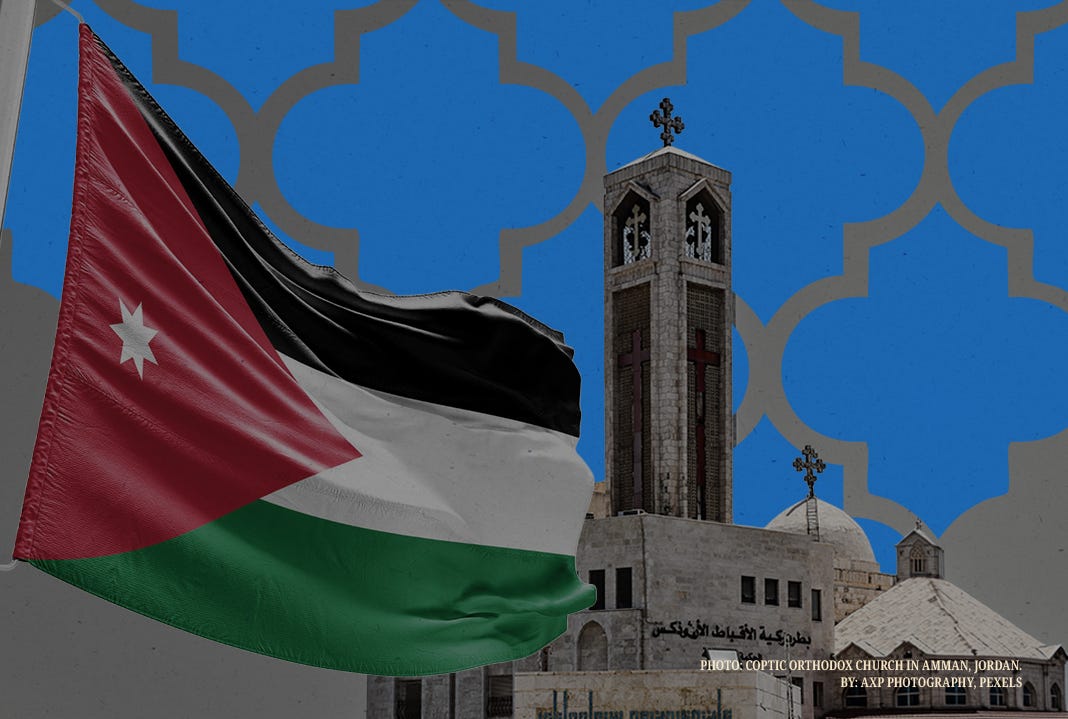
On the afternoon of Friday, October 23, Jordanians were shocked by an armed attack on St. George’s Church in Hamoud, a village of 400 people in the Karak Governorate, about 118 kilometers south of Amman.
Three gunmen stepped out of a blue vehicle and opened fire at close range on mourners attending the funeral of a Christian woman. One of the attackers was masked and carrying a Kalashnikov rifle, while the other two were armed with handguns.
Nine civilians were killed, including a university professor, doctors, and prominent members of the local community. Dozens more were wounded.
The government condemned the assault as “an act of terrorism driven by extremist takfiri ideology.” In the Islamic world, “takfiri” refers to a radical practice similar to extreme excommunication. Adherents of this ideology arbitrarily declare other Muslims—and non-Muslims alike—to be “infidels” or apostates. Militant groups use this label as a theological loophole to strip targets of their legal and human rights and justify violence against anyone who disagrees with their rigid worldview.
King Abdullah II promised a firm response, declaring that “Jordanian blood is precious.” Condemnations followed from across Jordan and the Arab world, with officials and public figures rejecting attempts to undermine the country’s social cohesion and the national unity of its Muslim and Christian citizens.
Yesterday, Jordanian security forces arrested the three suspects after tracking them to an abandoned house in Karak. Three were wounded in a shootout with police before being taken into custody. Authorities say the investigation is ongoing.
I knew some of the victims personally. My friend Lour Adnan Madanat was attending the funeral with her mother and other female relatives when what should have been a final farewell to a family member suddenly became 15 minutes of terror.
Madanat told me how she and her relatives threw themselves to the floor, holding one another beneath the wooden pews as pieces of crumbling walls and shattered glass fell around them. People screamed in panic, she said. Families cried out for loved ones, searching for them among the blood and debris.
When the shooting stopped, Madanat and her relatives rushed to check on one another and help the wounded. Bodies lay scattered across the church courtyard. Residents of the small village worked together to provide whatever help they could before ambulances and security forces arrived about 45 minutes later.
Madanat says she will never forget what happened that afternoon. The images are etched into her memory like a nightmare she cannot wake from. But the suffering was real, and innocent people paid for it with their lives inside a place of worship.
King Abdullah II is well known for his opposition to terrorism and religious extremism. Through the Amman Message, Jordan has promoted a moderate interpretation of Islam, an approach that gained greater urgency after ISIS burned Jordanian pilot Muath al-Kasasbeh alive on camera in February 2015.
Al-Kasasbeh’s murder fundamentally changed Jordan’s approach to counterterrorism. The government expanded its efforts to address the ideological and social conditions that allow extremism to spread, alongside its military and security operations.
Through the National Strategy for Countering Violent Extremism, our country has sought to confront radical ideology at its source. The measures include greater oversight of mosque sermons, training for religious preachers, and revisions to school curricula to promote citizenship and critical thinking.
The strategy also introduced ideological counseling programs inside correctional facilities, intended to challenge extremist interpretations of religion and rehabilitate inmates. Digital literacy and media education initiatives were launched to counter online recruitment and extremist propaganda targeting young people.
But was all of this enough? And has it actually worked?
I’m not so sure.
Since 2017, I’ve used satire and independent media to challenge religious extremism and intolerance in Jordan and across the Arab world. Through Shezomedia, the media company I founded, I’ve seen how difficult it can be to confront deeply entrenched beliefs, and how much work still needs to be done.
Every year, during Christian holidays in Jordan, social media fills with hateful comments attacking Christians and their religious celebrations. So what has the government’s counter-extremism strategy accomplished in practice?
Following the church attack, several hardline Islamic preachers attempted to offer messages of “tolerance.” But the language they chose to use revealed something troubling about how they view their Christian fellow citizens.
In a video, preacher Alaa Jaber declared that Christians in Jordan are a trust placed in the care of Muslims.
Salafi preacher Eyad Qunaibi wrote on Facebook that the “Nasara”—using the Quranic term rather than the ordinary Arabic word for Christians—inside the church were people entitled to protection of their lives, property, and honor. He argued that Muslims should invite them to the “true religion” rather than kill them.
But this same preacher previously declared it religiously forbidden to congratulate Christians on their holidays. He also refused to offer prayers for the soul of Palestinian-American journalist Shireen Abu Akleh after she was killed by Israeli forces in the West Bank.
The Muslim Brotherhood-affiliated Al-Ummah Party also issued a statement condemning the attack. It wished the wounded a speedy recovery but offered no prayers for those killed. The party described what happened as a “criminal incident” rather than a terrorist attack.
What connects these three responses is an underlying religious view of Christians as “ahl al-dhimma”—non-Muslims living under Muslim protection—rather than citizens who enjoy the same rights and carry the same responsibilities as everyone else.
This way of thinking does little to eliminate extremism. In one way or another, it may even help sustain it.
There is no denying the grief that has spread across Jordan, or the widespread expressions of human solidarity and national unity with the victims’ families. I have seen and experienced it myself.
But social media has also exposed a different side of the public reaction.
Extremist comments have prompted some Christian citizens, along with liberal and secular activists, to speak out against what they see as a failure to hold those who incite religious hatred accountable.
Christians are tired of hearing the usual language about “tolerance” and “coexistence,” and some have rejected these expressions as condescending.
Their objection is to what the words can imply: that Christians are people whom others graciously agree to tolerate, as though they occupy a lower position in religion, values, or social standing.
This growing polarization has prompted some Islamist activists to accuse secular critics of exploiting the tragedy to express their hostility toward Islam.
Some Jordanian media figures associated with Qatari media outlets have gone further, calling these critics “secular ISIS” and suggesting they are no different from the terrorists they condemn.
This comparison is both unfair and logically weak.
How can someone who murders another human being for holding different beliefs be compared to a secular thinker whose only action is to express an opinion?
In the same debate, Jordanian activist Rakan Sawalha published a statement titled “Citizenship Is Not a Favor,” which circulated widely among young Jordanians.
Sawalha emphasized that Christianity’s roots in Jordan extend deep into the country’s history and geography. Christians are neither guests nor beneficiaries of someone else’s generosity.
Citing Article 6 of the Jordanian Constitution, which establishes equality in rights and duties, he called for more than seasonal expressions of solidarity and polite gestures, and instead for implementing meaningful legal and institutional guarantees.
He urged revisions to school curricula so that Christian history is properly recognized as an integral part of Jordanian national identity and called for firm penalties against religious incitement and takfiri rhetoric, rather than using appeals to national unity as an excuse to stay silent.
Sawalha also rejected the tendency to confine young Christian voices to traditional community structures or parliamentary representation alone. Christians, he argued, should participate directly in policymaking and national decision-making, rather than being represented only through religious quotas.
So what needs to happen now?
Jordan needs to complete its efforts to revise school curricula and confront religious extremism in education.
Some parents have complained that their children are being exposed to extremist ideological messages from teachers outside the official curriculum. These concerns require closer oversight of classroom activities.
The next stage should involve identifying extremist material and removing it from educational content, while strengthening students’ critical thinking skills so they can recognize and resist ideological indoctrination.
Jordanian activists are also calling for an honest examination of any ideology that encourages hatred toward people because of their religion, beliefs, ideas, or culture.
They want a serious review of Islamist fundamentalist thought, including religious jurisprudence and traditional texts, and public accountability for preachers who promote extremist views.
The starting point, they argue, is honesty with ourselves.
In a country like Jordan, strengthening pluralism and learning to accept religious and cultural differences is hardly a liberal luxury. It is an urgent national necessity.
When ideas that justify killing in the name of religion exist among citizens, the response cannot be limited to polite expressions of goodwill. People’s lives are at stake.
The official response to the church attack, from the king, the government, and state media, was appropriate to the gravity of what happened. Public reactions naturally varied. But the king’s statements and the government’s directives helped establish a clear public rejection of the attack.
That response provides a foundation for the work ahead and for the hope of building a better future.
Here in Jordan, Muslims and Christians have a long history of living side by side, and I think we have good reason to be proud of that.
According to the Citizenship and Social Cohesion study conducted by the University of Jordan’s Center for Strategic Studies, 92 percent of Jordanians said Christians should enjoy full freedom to practice their religion. Another 89 percent agreed that citizenship rights and constitutional responsibilities apply equally, without religious discrimination.
These findings align with the 2022 Arab Barometer report on Jordan, in which more than 91 percent of respondents said religious affiliation had no effect on everyday relationships and social interactions.
The findings also point to an almost complete absence of sectarian tensions across the country’s governorates. Muslim-Christian coexistence here has a real social foundation. People practice it in their daily lives. Christianity is neither a recent arrival nor a foreign presence. It has been part of our country’s identity since the faith’s earliest days.
Jordan is home to some of the world’s oldest Christian sites.
Among them is Bethany Beyond the Jordan, the baptism site on the eastern bank of the Jordan River associated with the beginning of Jesus’s public ministry. Elsewhere are the remains of the ancient Aqaba Church, dating to approximately AD 293–300 and considered one of the oldest known buildings constructed specifically as a church.
Other important sites include the Byzantine churches and mosaics of Madaba, Umm ar-Rasas, and Rihab in Mafraq Governorate.
But the Christian presence in Jordan goes beyond archaeological sites. It is also deeply rooted in the country’s Arab tribal history.
Major Arab tribes, including the Ghassanids, Lakhmids, Judham, and Salih, formed part of the region’s population long before the Islamic conquests. Jordan’s Christian clans trace their ancestry to these longstanding Arab tribal communities.
Christians have been an integral part of Jordanian society for centuries. They defended their homeland, took part in the historical uprisings of Karak and Shoubak, and contributed to the development of the modern Jordanian state through its civilian, military, and cultural institutions.
Jordan’s national unity has deep roots, and I believe it is strong enough to withstand the tensions we are seeing today. Much of the anger and debate unfolding on social media reflects a country struggling to come to terms with a terrible tragedy.
In just fifteen minutes, nine lives were senselessly stolen, and countless others changed forever. We cannot undo what happened, but we can decide how we respond.
No one should have to fear for their life while mourning the death of a loved one. The people killed in that church were our fellow Jordanians, attending a funeral in their own community, in their own country. They had every right to feel safe there. If we are serious about preventing another tragedy like this, we need to confront the prejudices that make such violence possible and ensure that every Jordanian, regardless of religion, enjoys the same rights, dignity, and protection. That is what it should mean to belong to this country.
You might also be interested in:
The Arab Media Startup Taking On Extremists

Osama Essa was born into a home where tradition came first. Raised in a conservative Jordanian family and the eldest of six siblings, he inherited not only the cultural weight of his upbringing but the responsibility to carry it forward. His father, a well-regarded physician whose past was marked by proximity to conflict, loomed large in the household. …
Middle East Uncovered is powered by Ideas Beyond Borders. The views expressed in Middle East Uncovered are those of the authors and do not necessarily reflect the views of Ideas Beyond Borders.
