

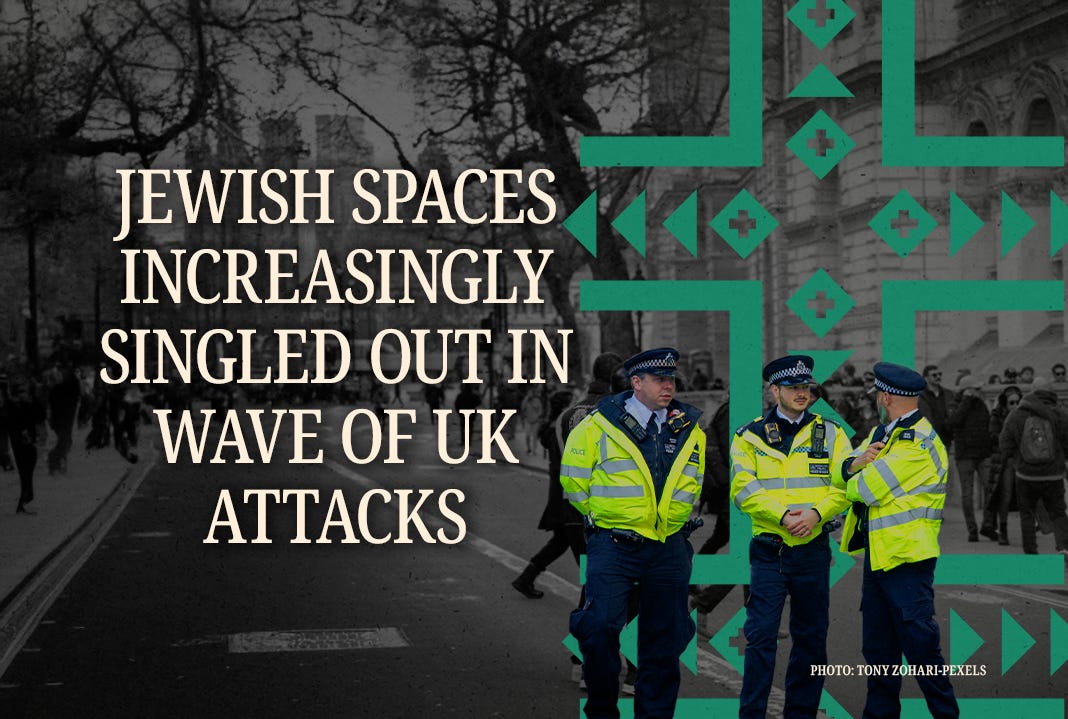
Jewish Spaces Increasingly Singled Out in Wave of UK Attacks
Escalating antisemitic incidents have led to a “severe” terror threat level, alongside government plans to formally designate the IRGC as a terrorist body. Britain's Jews are growing more afraid.

Ruth Topper was asleep in bed when the phone rang shortly after midnight on April 19. Thinking it was a family emergency, she answered the call. Someone had tried to “firebomb” Kenton United Synagogue, of which she is the chair.
She and her husband rushed to the scene. Miraculously, only minor damage was caused to the building, and no one was injured. It could have been much worse.
Footage later posted online showed a figure in dark clothing setting a bottle of liquid on fire and throwing it through the window of the shul in north-west London.
It was enough to keep Topper awake for most of that night. “It was not easy to go to sleep after something awful had happened,” says Topper. “I was still trying to process it.”
A 17-year-old boy was subsequently arrested and charged with arson.
It’s now painfully evident that Jewish spaces are being deliberately singled out.
When two worshippers were killed outside Heaton Park synagogue in Manchester last October, the nation’s Jews feared it would not be the only terrorist attack.
Six months on, that has proven to be the case.
In March, four Jewish charity-owned ambulances were set on fire in a synagogue car park in Golders Green, an area in north London home to one of the largest Jewish communities in the country.
Across April, a pattern of intimidation and hostility toward Jewish institutions became hard to dismiss as isolated incidents. Within days, synagogues in Finchley and Kenton were targeted by arsonists. The government’s terrorism advisor is now calling the sharp rise in antisemitic attacks a “national security emergency.”
By the end of the month, even a memorial in Golders Green, honoring victims of both the Iranian regime and the October 7 attack, was targeted in a suspected arson attack. And then on April 29, two Jewish men were stabbed in Golders Green. The knifeman, Essa Suleiman, was arrested at the scene. He came to the UK from Somalia in the early 1990s.
Following the attack, the UK’s terrorism threat level was raised from “substantial” to “severe.”
Ephraim Mirvis, the Chief Rabbi, said that “words of condemnation are no longer sufficient.”
He’s right. Many British Jews will now feel that such words ring hollow if no meaningful, decisive action is taken to combat antisemitism, as well as the climate that has allowed it to fester.
Yehudis Fletcher, a mother of three in north Manchester, worries about the safety of her boys, who are visibly Jewish.
Does she ask them to hide their kippahs and tzitzis—tassels that hang out of men’s shirts—or ask them to defy and be proud of who they are? It’s something she has to now wrestle with.
“There has always been an awareness of risk,” she tells me. “Previously, we were aware of kippahs knocked off children’s heads, eggs thrown, muggings. Now, this risk is car ramming, arson, or stabbing.”
While it’s not yet clear who is behind the stabbing, other attacks in recent months against Britain’s Jews have been claimed online by one organization: Harakat Ashab al-Yamin al-Islamia (HAYI).
Meaning the “Islamic Movement of the Companions of the Right,” the group emerged publicly in March after a series of attacks on Jewish institutions in Belgium and the Netherlands.
This has raised concerns that Iran is ramping up its activation of sleeper cells and proxies recruited online to wage a campaign of retaliation against Western countries.
“It is highly likely that Iran is behind some of these attacks,” says Roger MacMillan, a counter-terrorism and security specialist. “The M.O. is always the same. Whether it’s a warning, an attack, and then a video posted online claiming responsibility for the attack. HAYI follows the same pattern as other Islamic resistance groups.”
While HAYI’s attacks have been poorly executed, their intention is also to spread fear, Macmillan adds. It’s clearly working.
The British government is now moving to proscribe the Islamic Revolutionary Guard Corps (IRGC) as a terrorist organization. Accountable only to Iran’s Supreme Leader, the IRGC has been accused of supporting militant groups and destabilizing activities across the Middle East. Iran refutes all allegations.
“I do think the IRGC ought to be proscribed,” says Ruth Topper. “There’s a lot of hate coming from abroad.”
Many Jews have also reported feeling unsafe going into central London when there were marches against the war in Gaza. Although the Stop The War Coalition insists that they are not “hate marches,” but “expressions of solidarity and support for those under attack,” Fletcher is concerned about some of the rhetoric heard at these events—phrases like “globalize the intifada,” for example.
“‘Words are violence’ is an accepted position that the Left holds. But that doesn’t apply to all words equally,” says Fletcher. “When we are violently attacked as an extension of these words, there seems to be no reflection, reflection, or responsibility.”
If the trajectory of the past six months has shown anything, it’s that each incident has been followed by another, and then another. What once seemed unthinkable is now a reality.
For many British Jews, it’s no longer the issue of “if,” but rather “when” and “where.”
And the next phone call in the middle of the night following an attack might not end with just minor damage, but something far worse.
Middle East Uncovered is powered by Ideas Beyond Borders. The views expressed in Middle East Uncovered are those of the authors and do not necessarily reflect the views of Ideas Beyond Borders.
The ambulance attack is suspect as is the Israeli-dictioned and hastily created "terror web presence" associated with it. The mentally ill guy who was incorrectly released and proceeded to stab three people first stabbed his Muslim friend: Jews DO NOT get to label every bad luck encounter as that fake label "anti-semitism" and especially do not get to strongarm long existing countries into breaking their thousand year old law and justice systems to please Jews in their endless neurosis.
If the synagogues have been supporting the terror campaigns of the Israelis, or have been behind local attacks on society and government, they can expect to draw fire. And we know they have been doing both.