


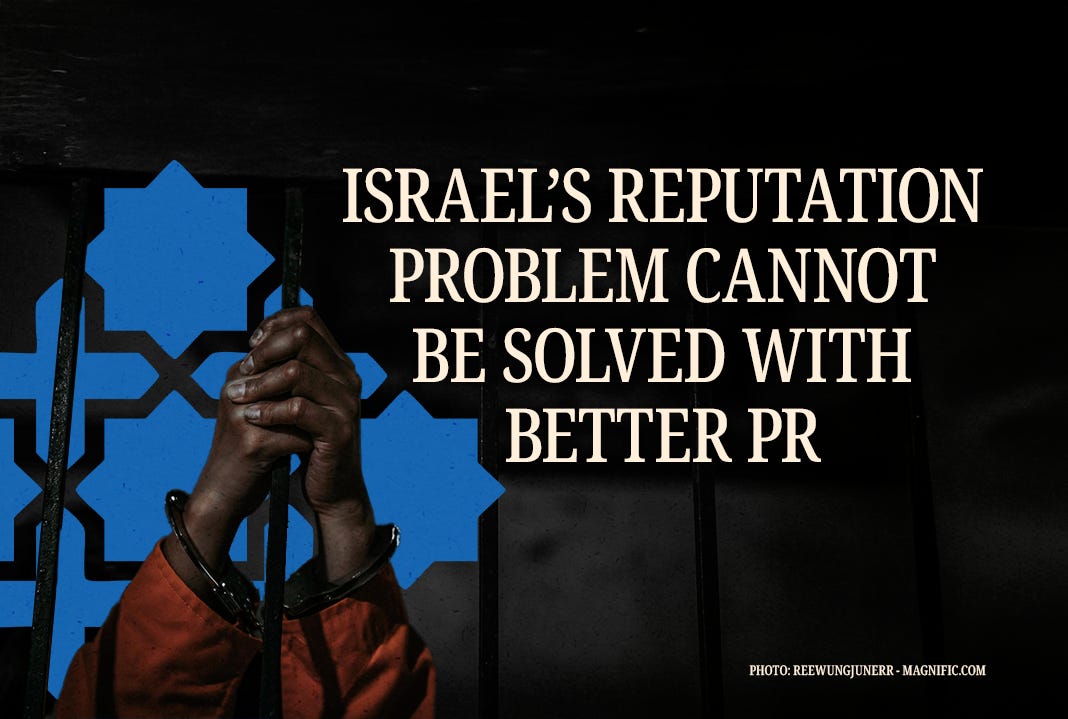
Last week, Benjamin Netanyahu was interviewed on CBS’ 60 Minutes and said something that, a decade ago, would have sounded almost unthinkable from an Israeli prime minister: Israel should eventually stop relying on American military aid, and will start winding down to zero American aid over the next decade.
He argued Israel is a strong, wealthy, technologically advanced country—one that should be able to defend itself without permanent dependence on U.S. taxpayers.
No doubt, a rich, highly developed state should not want to be permanently subsidized by another country. Israel should be able to stand on its own two feet. Today, it has a higher GDP per capita than the UK and Germany.
Netanyahu is saying this at a moment when American support for Israel is collapsing. For the first time ever this year, more Americans claim to sympathize with Palestinians than with Israelis. The old so-called “bipartisan consensus” on Israel is now dust in the wind. And it is not coming back any time soon. While many Republicans still broadly express support—including enthusiastic support—for Israel, the same cannot be said of most Democrats and Independents. And this is especially true among younger voters, who tend to view Israel in a negative light.
You can see the same shift in the way American media now talks about alleged Israeli crimes against Palestinians.
A few years ago, allegations of abuse or systematic mistreatment of Palestinians by Israeli soldiers or guards circulated mainly in Palestinian and Arab media, activist spaces, and left-wing publications already hostile to Israel.
Now, major media like The New York Times have begun to weigh in on these issues. A column by Nicholas Kristof published last week aired allegations of sexual violence, torture, and abuse against Palestinian detainees in Israeli custody. Kristof cited testimony from Palestinian men and women who said they had been raped, sexually assaulted, stripped naked, threatened with rape, attacked with dogs, beaten, starved, denied medical care, or abused in other ways.
Israel’s Foreign Ministry denounced the column as propagating a “blood libel,” and has said that it will sue The New York Times, although no lawsuit has been filed yet.
Since October 7—when Hamas jihadists broke into Israel and murdered, kidnapped, and, according to a report citing testimony from survivors, brutally raped and mutilated Israelis—Israel has carried out enormous military operations in Gaza. It has detained thousands of Palestinians, including some in the West Bank. Many were Hamas fighters. Some were militants from other factions. Others were civilians, unfortunately, caught up in the dragnet of war.
The problem for Israel, here, is that the combination of mass detention, an atmosphere of revenge, fear, and a captive population is combustible.
Such abuse has been perpetrated in many different countries before, including Western democracies. The United States had Abu Ghraib. There, Iraqi prisoners were stripped, humiliated, threatened with dogs, sexually degraded, and tortured. France had Algeria. There, electric shocks, waterboarding, rape, disappearances, and summary executions were used. Britain had Kenya, with detention camps for Kikuyu prisoners and suspected Mau Mau sympathizers where beatings, starvation, forced labor, and sexual abuse were used.
So far, a lot of the discourse in the pro-Israel sphere has focused on trying to discredit the allegations altogether. For instance, many have cited Euro-Med Monitor—whose founder Ramy Abdu has been accused by Israel and pro-Israel advocates of links to Hamas—as proof that the whole story is rotten. That may be a reason to treat some of the material Kristof cited with caution. Not every allegation is necessarily true. Indeed, Kristof has previously had to retract claims made in The New York Times after having been misled by a source.
But Kristof’s column included 14 separate Palestinian testimonies, Israeli media reporting, UN material, HaMoked figures, B’Tselem’s prison report, and the work of Amnesty International. It’s not the case that he took a single allegation and ran with it.
On one hand, there is a real danger here. Allegations like this can be weaponized in ugly ways. People who hate Jews will use stories of sexual abuse by Israeli soldiers as an excuse to demonize them as a whole group, rather than as specific allegations about particular individuals, particular institutions, and a particular war. They will fold these allegations into older antisemitic fantasies about Jewish cruelty, perversity, bloodlust, or hidden power.
That should be rejected completely by all sensible people.
But if Israeli soldiers or prison guards abused Palestinian detainees, the perpetrators themselves should be held accountable. The commanders who enabled them should bear responsibility. The politicians who created a permissive atmosphere should answer for it.
But Jews as a people are not responsible. Jewish civilians in London, New York, Paris, Tel Aviv, or anywhere else are not answerable for the alleged crimes of guards in an Israeli detention facility.
On the other hand, the risk of antisemitic weaponization cannot be allowed to become a shield against a thorough investigation. Individuals who abuse Palestinians must be held accountable, and such abuse, if it has taken place, must be stopped completely and should never, ever be allowed to recur again.
This is the best first step for Israel to rehabilitate their reputation.
Netanyahu seems to understand the reputation problem, but not its cause. In the same 60 Minutes interview, he pointed to social media, TikTok, and the speed with which images now spread around the world. There is some truth there. The information environment has changed. Israel no longer speaks to Western publics through a small number of sympathetic editors, television anchors, and foreign-policy elites. A video from Gaza can travel globally before any Israeli spokesperson has drafted a line.
But social media is the medium, not the disease.
TikTok is not responsible for Palestinian suffering. Israel’s reputation is deteriorating because the effects of the unresolved conflict with the Palestinians are now visible in a way they were not before. Images of destruction in Gaza, videos of settler violence in the West Bank, and growing allegations of abuse against Palestinian detainees are shaping global opinion far more than any propaganda campaign or algorithm ever could.
Israel should hold itself to a higher standard than a terrorist organization. That means taking allegations of sexual abuse and mistreatment seriously rather than dismissing them outright as propaganda. It means investigating abuses committed by soldiers, prison guards, or settlers, and ensuring those responsible are punished.
The real solution, for both Israelis and Palestinians, is not better public relations. It is resolving the conflict itself before the violence and mutual dehumanization destroys what little legitimacy and hope for peace still remain for both peoples.
Middle East Uncovered is powered by Ideas Beyond Borders. The views expressed in Middle East Uncovered are those of the authors and do not necessarily reflect the views of Ideas Beyond Borders.

I hear you as far as general prison abuse increases in Israel and settler violence, especially under Ben-Gvir, but like I commented (perhaps a bit too harshly) on Hamza’s article, our issue is that Kristof’s claims about dog rape are literally physically impossible and no one seems to care. He could have written an article about the actual documented abuse in Israeli prisons, but he didn’t because it wasn’t salacious enough and because he couldn’t directly say “wow they are worse than Hamas!”
There could have been a well-sourced article (not from B’Tselem and Euro-Med or from people who celebrated Oct 7 on the day it happened, but from dissident Israeli guards, court documents, public filings, moderate Palestinians, etc) that would have exposed the real abuses in the prison system with real journalism, but now that Kristof wrote his poorly sourced op-ed Israel will understandably simply circle the wagons and it will be even harder to deal with actual issues.
It feels like someone writing an op-ed about rape in US domestic prisons (which is indeed a real problem) and claiming “wow they are worse than Saddam!”
We prefer to be hated and alive.
One Hundred Years of Antisemitism and Blood Libels
https://behindthenarrative7.substack.com/p/i-accuse-the-new-york-times?utm_source=share&utm_medium=android&r=bpnge