


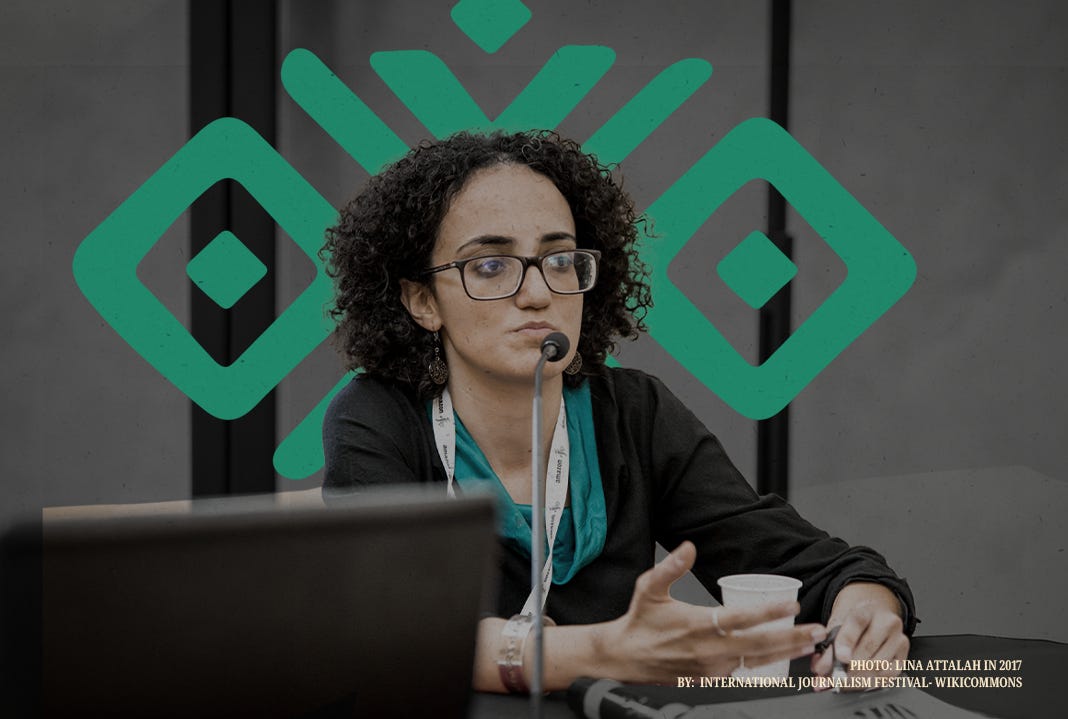
The October 27 trial was unusual. Shortly before sentencing, the judge assigned a new lawyer to represent prominent Egyptian journalist Lina Attalah, against her wishes. He then refused to record her objections before imposing the maximum fine.
His actions “astonished all those present,” said Hossam Bahgat, executive director of the Egyptian Initiative for Personal Rights, who attended the hearing. Speaking to independent news outlet Mada Masr, he recounted the proceedings against its editor-in-chief.
As the sentence was read out, shouts and protests went up from the defense counsel. Attalah was convicted of running an unlicensed website and ordered to pay 3 million Egyptian pounds. The judge also ordered the closure of Mada Masr and the confiscation of its property.
Security personnel then surrounded the long-time press freedom advocate, hoisting her off the ground and carrying her from the courtroom.
The online outlet has survived years of legal attacks against its reporting, but rights organizations fear an intensified campaign against independent media is underway. Amnesty International described the decision as “a crushing blow to press freedom in Egypt,” and Reporters Without Borders (RSF) said that President Abdel Fattah al-Sisi had finally “dared cross the red line.”
“Mada Masr is an essential source of independent information for millions of readers in Egypt and around the world,” said Jonathan Dagher, Head of RSF’s Middle East desk. “This wrongful conviction was delivered following a sham trial, marred by serious and flagrant irregularities.”
The ruling comes weeks after authorities arrested six journalists from fact-checking platform Matsadaash. Mada Masr was among eight independent Arab media outlets that responded by launching a joint newsroom initiative to fill the void created by those arrests.
Hours after signing up, Attalah received a summons to appear before the Supreme State Security Prosecution for questioning. On October 21, prosecutors probed her for more than six hours about the outlet’s reporting on protests inside Egyptian prisons and its licensing status. They also accused her of publishing “false news,” a charge the government frequently uses to prosecute journalists in Egypt.
The following day, Attalah was referred for trial on charges of operating a website without a license, with the first hearing scheduled for October 27. Shortly before being released on bail, she was informed of a separate ruling issued in absentia in 2024 that sentenced her to a year in prison.
Attalah now faces a criminal trial tomorrow, November 11, on charges of “spreading false information.”
Sara Qudah, Middle East and North Africa program director at the Committee to Protect Journalists (CPJ), said the message is clear: “The authorities no longer tolerate independent journalism.”
“A court ordering the closure of Mada Masr is an unprecedented measure, even given Egypt’s poor press freedom record. If the authorities can shut down Mada Masr, Egypt’s leading independent outlet, the few other independent outlets are at extreme risk,” she told Middle East Uncovered.
“When you see that this happened a few weeks after the arrest of the entire Matsadaash newsroom, you realize that Egypt is establishing a new era. Independent media now face not only legal harassment and restrictions, as in the past, but the risk of complete dismantling and eradication.”
The threat against Mada Masr follows a long campaign of harassment and intimidation, with the team subjected to six criminal investigations in six years.
The outlet specializes in the kind of reporting authoritarian regimes dread, exposing corruption and the misuse of public money, investigating intelligence services and security crackdowns, scrutinizing the President’s inner circle, and documenting human rights abuses and conditions inside Egyptian prisons.
Attalah launched the platform in June 2013 amid the mass political unrest that preceded the overthrow of former President Mohammed Morsi. As the new military regime consolidated its grip on power, media organizations were brought under state ownership and platforms that resisted strict censorship began to be barred.
Despite Sisi’s repeated promises to uphold press freedoms, independent journalists have frequently been targeted with legal harassment and prosecution, often under the auspices of protecting national security and countering the spread of what authorities consider to be “false news.”
In May 2017, Mada Masr was among dozens of websites cut off by the Egyptian government as it extended its control over the online sphere. The following year, a new media law authorized the surveillance of social media accounts with more than 5,000 followers.
Today, Egypt ranks 169 out of 180 on the RSF Press Freedom Index and is one of the top jailers of journalists globally, with at least 25 currently behind bars.
“We have always worked in difficult conditions, but I have never been as worried about the future of journalism as I am now,” Nora Younis, editor-in-chief of the Cairo-based independent outlet Al-Manassa, told CPJ. “Independent journalism in Egypt has moved from facing restrictions and threats to facing an existential danger.”
After being blocked in 2017, Mada Masr found ways to reach Egyptian and international audiences via digital workarounds, publishing on social media platforms, through proxies, and eventually via a mirror on the Tor network.
Its stories provided an alternative to state-controlled narratives, investigating the deaths of 37 prisoners who died inside a police transport vehicle bound for Abu Zaabal Prison in 2013 and alleged financial violations within the political establishment.
In November 2019, Mada Masr published a report alleging that Mahmoud al-Sisi, the President’s son, had been sidelined from his position in the intelligence services and sent to Moscow after mishandling his duties. Days later, authorities raided the Mada Masr office, and Attalah was detained alongside several other journalists.
Writing about the ordeal afterward, Attalah described excitement mingling with deep-seated dread in the hours leading up to publication. “We drank endless soda waters and ate one chocolate bar after the other. We agreed to eat koshary after we were done in order to have a meal heavy enough that could send us straight to bed and away from anxiety.”
The decision to publish despite the risks reflected Mada Masr’s roots in the 2011 revolution and the need to make sense of the profound transformation gripping the country. When asked why, she replied that Mada Masr has always been a project of inquiry, delving into the “darker rooms of power.”
By then, almost all mainstream media outlets in Egypt were owned by companies linked to Egyptian intelligence or businessmen with close ties to the government. In the years since, the government has continued to block independent outlets, including 180 Investigations and Disclose in 2021, and Soulta 4 and Masr 360 in 2023.
The Electronic Frontier Foundation (EFF) has warned of the “particular urgency” of defending press freedom at a time when governments are finding new ways to muzzle critical voices. “Whether through internet shutdowns, platform restrictions, surveillance, or the criminalization of reporting, the result is often the same: fewer opportunities for people to understand what is happening around them, to challenge official narratives, and to hold power accountable.”
More than 130 organizations issued statements of solidarity after Attalah’s arrest. However, these must be backed by political and institutional pressure, EFF said. “The cases against Lina Attalah, Mada Masr, and Matsadaash must be dropped. The journalists who remain in detention must be released. And Egypt’s licensing regime, with its profound chilling effects on access to information and independent knowledge production, must be brought to an end.”
Mada Masr has applied for a license multiple times since the country’s new media law was passed in 2018, but Egyptian authorities repeatedly denied receiving the applications or failed to respond.
Qudah said the country’s media law operates as a “tool to punish” rather than regulate journalists. “It was designed as a trap: authorities deny media outlets the right to obtain licenses, then shut them down and force them to pay fines for operating without one,” she said.
The crisis confronting the few independent outlets that remain in Egypt was laid bare in the courtroom last Tuesday. The judge refused to allow Attalah’s defense team time to review the case file and rejected requests to bring in documentation and hear witnesses. The court’s decision to appoint a lawyer for Attalah when her counsel refused to continue under these conditions shows how little leverage independent journalism has to defend itself against Egyptian authorities.
If Mada Masr is forced to close, an already-depleted media landscape will lose one of its few remaining sources of independent scrutiny. With governments around the world finding ever more creative ways to clamp down on criticism, the loss of another voice reporting on state repression will ripple beyond Egypt’s borders, the EFF warned.
“Mada Masr may be thoroughly Egyptian, but it doesn’t belong just to Egypt…its potential closure should concern everyone who cares about a free press.”
You might also like:
The Journalist Fighting for Iraq’s Democratic Future

Hussam al-Haj has become one of Iraq’s most recognizable television anchors and one of its most outspoken defenders of democracy. Sitting down for an exclusive interview with Middle East Uncovered, al-Haj offered a rare look into the personal journey that shaped his political views, the pressures facing Iraq’s civil society, and his hopes for the countr…
Middle East Uncovered is powered by Ideas Beyond Borders. The views expressed in Middle East Uncovered are those of the authors and do not necessarily reflect the views of Ideas Beyond Borders.