


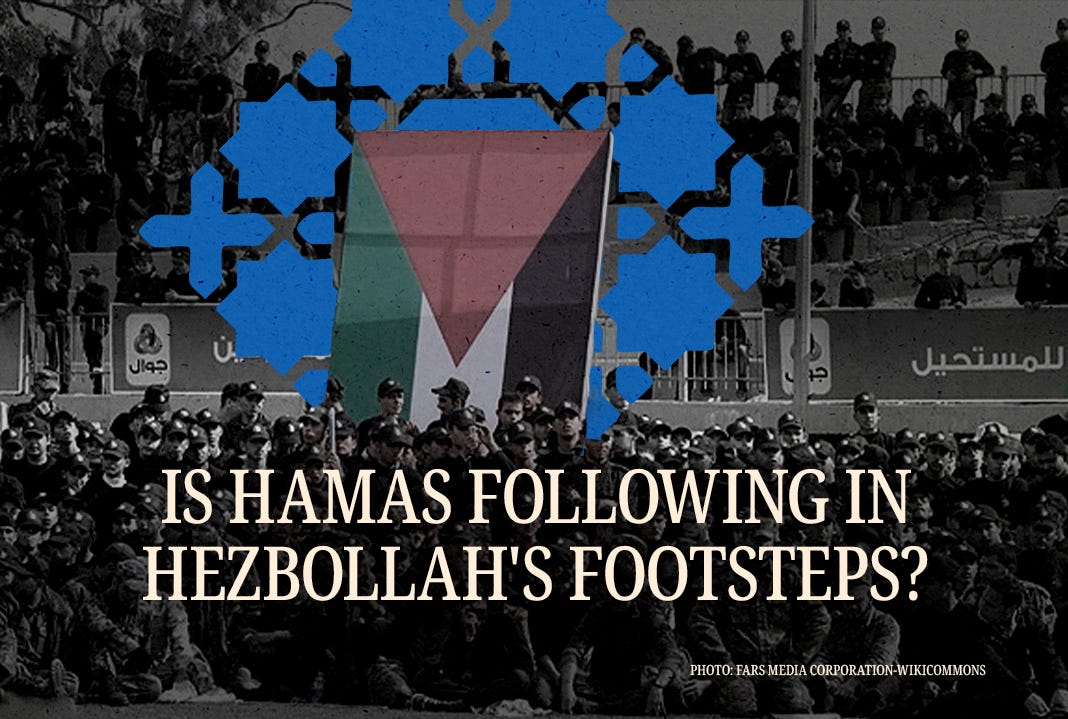
Last week, Hamas dissolved the body through which it has governed Gaza and claimed it was ready to transfer civilian authority to a committee of Palestinian technocrats.
Mohammed al-Farra resigned as head of the so-called Government Emergency Committee. The committee itself was dismantled. In its place, Hamas says it is prepared to accept the National Committee for the Administration of Gaza, led by former Palestinian Authority official Ali Shaath.
Hamas seized control of Gaza in 2007. Since then, it has directly governed the territory. Its power rested partly on its weaponry, but also on the fact that it decided who ran the institutions, who received government jobs, which political organizations could operate freely, and what Palestinian children were taught in schools.
Control of the government allowed Hamas to shape Gaza's institutions—and, through them, Palestinian society.
Hamas coveted that position for years before attaining it. It fought Fatah for it, consolidated it through violence, and preserved it for nearly two decades. So the decision to dissolve the government tells us something about the condition Hamas now finds itself in.
The movement has lost much of the political momentum it once had in Gaza. Its claim to govern rested on the idea that armed “resistance” would eventually lead to victory over Israel. Instead, Gaza has been devastated, much of its population displaced, and its future placed in the hands of foreign mediators, international donors, and an administration assembled in Cairo.
Hamas’s leadership would have preferred to emerge from this war as the undefeated government of Gaza. It also wanted to control the reconstruction money, appoint the officials, and claim credit for whatever recovery followed.
Instead, it is being forced to give up the public face of power. Most of its leadership from October 2023—Yahya Sinwar, Ismail Haniyeh, Mohammed Deif—has been killed.
That creates a real opening. Ali Shaath’s committee has described its purpose as stabilizing Gaza, restoring civilian government, and establishing a single authority for security.
But what does Hamas intend to do from the sidelines?
It has dissolved its government while retaining its armed organization. Its fighters, command structures, and tunnel networks remain, albeit damaged. Its personnel continues to police areas under Hamas control.
The technocratic committee could end up being responsible for the day-to-day work of government, while Hamas preserves the power to set the boundaries within which that government operates.
Imagine that Ali Shaath appoints a police chief who begins investigating corruption involving Hamas officials. What happens then?
Imagine that a newspaper publishes evidence of abuses by Hamas commanders. Who protects the journalists?
If another Palestinian political movement begins organizing in Gaza and attracting popular support, Hamas may still be able to crush it.
This is the Hezbollah model.
Hezbollah entered Lebanese politics, participated in elections, and worked through state institutions. At the same time, it maintained an armed force with its own leadership and strategic goals. This allowed Hezbollah to share in government while preserving a separate source of power greater than its parliamentary representation, insulating the group from real responsibility while rendering the official government largely ineffective.
Lebanese governments shouldered the responsibility for economic decline, public services, and international negotiations. Hezbollah retained the ability to pressure those governments and make decisions that carried consequences for the entire country.
Hamas may now be seeking a similar position.
Direct governance has become a burden for Hamas. Gaza requires an immense reconstruction effort, with damage estimates running into tens of billions of dollars. Whoever governs will face public anger, ruined infrastructure, and intense scrutiny over the distribution of foreign aid.
By stepping away, Hamas can allow the technocrats to absorb these pressures. It can present itself as a “resistance movement” again, rather than the authority responsible for the condition of Gaza.
Shaath’s committee has begun recruiting a new police force. Around 2,000 Gazans applied within hours of recruitment opening, and the international plan envisions training 12,000 officers. Hamas, meanwhile, has sought places in the new system for roughly 10,000 existing police officers and more than 40,000 civil servants.
Realistically, many of those civil servants—responsible for functions such as water and sewage systems, rubbish collection, electricity distribution, public records, schools, hospitals and salary payments—will have to remain in place. They have the knowledge required to keep basic administration functioning.
The police present a different problem. A police officer carries coercive authority.
Existing officers could join a new force as individuals, after vetting and retraining, under commanders appointed by the new administration. But absorbing Hamas’s police units intact would preserve the organization inside the new state.
The same applies to Hamas’s military wing. Disarmament means breaking the organization’s independent capacity to use force. Its weapons need to pass into the custody of the new authority or an agreed international mechanism. Its military units need to dissolve.
This distinction provides a practical test for every proposed compromise. A Hamas member serving as an ordinary police officer under Shaath’s command represents a transfer of authority. A Hamas battalion entering the new police force under its existing commander would just be a continuation of the previous regime.
The negotiations are in limbo because while both Israel and Hamas have agreed that Israel will withdraw and Hamas will give up its weapons, each side is demanding the decisive concession first. Meanwhile, Shaath’s committee is in Cairo, with Hamas still policing the territory it says it is ready to hand over.
A workable agreement therefore needs a reciprocal timetable. As Hamas hands over weapons and dissolves its armed units, the new police force can deploy, and the technocratic committee can assume control. As that authority expands, Israeli forces can withdraw from agreed areas. Outside monitors can verify both processes.
Hamas has already surrendered the formal machinery of government it spent eighteen years building. The next stage asks it to surrender the independent armed power that allowed it to dominate that machinery.
That is the real measure of whether Gaza is entering a new political era or merely rearranging the old one. If Hamas relinquishes both government and its monopoly on force, Gaza could finally have a single Palestinian authority accountable to its people. If it keeps its weapons while others assume the burdens of governing, Gaza will not have replaced Hamas’ rule. It will simply have adopted a different version of it.
Middle East Uncovered is powered by Ideas Beyond Borders. The views expressed in Middle East Uncovered are those of the authors and do not necessarily reflect the views of Ideas Beyond Borders.

Very good point made here. We don't want another Lebanon situation and it seems that could easily happen if Hamas keeps its arms and tunnels. In fact, I suspect that might even be the point of refusing to give up their arms.