


In recent weeks, the Middle East has entered a period of heightened alert. Military forces are adjusting their posture, governments are reviewing contingency plans, and diplomatic channels are being used less to avert escalation than to prepare for its consequences. These measures follow a familiar pattern seen when states prepare for the possibility of a serious regional shock.
The deployment of a U.S. carrier strike group into the region—following a senior Iranian commander’s warning that his forces have their “finger on the trigger”—is one of the clearest signals that deterrence is shifting from rhetorical positioning to operational reality.
If the United States were to strike Iran, the implications for Iraq could be severe and immediate. Iraq would not be a peripheral observer to such a confrontation, but one of the states most exposed to its secondary effects. Iran’s reliance on asymmetric responses means retaliation would likely unfold across multiple arenas, with Iraq at the center of that equation.
The most immediate risk would be heightened activity by Iran-aligned armed groups operating on Iraqi territory, placing Iraqi security, infrastructure, and civilians at risk regardless of Baghdad’s intentions. At the same time, Iraq’s airspace and proximity would make it operationally relevant to both deterrence and escalation, increasing the likelihood of spillover, miscalculation, or unintended involvement.
Beyond security concerns, escalation would deepen Iraq’s political and economic vulnerabilities, intensifying internal divisions and eroding public confidence in the state’s capacity to manage crises.
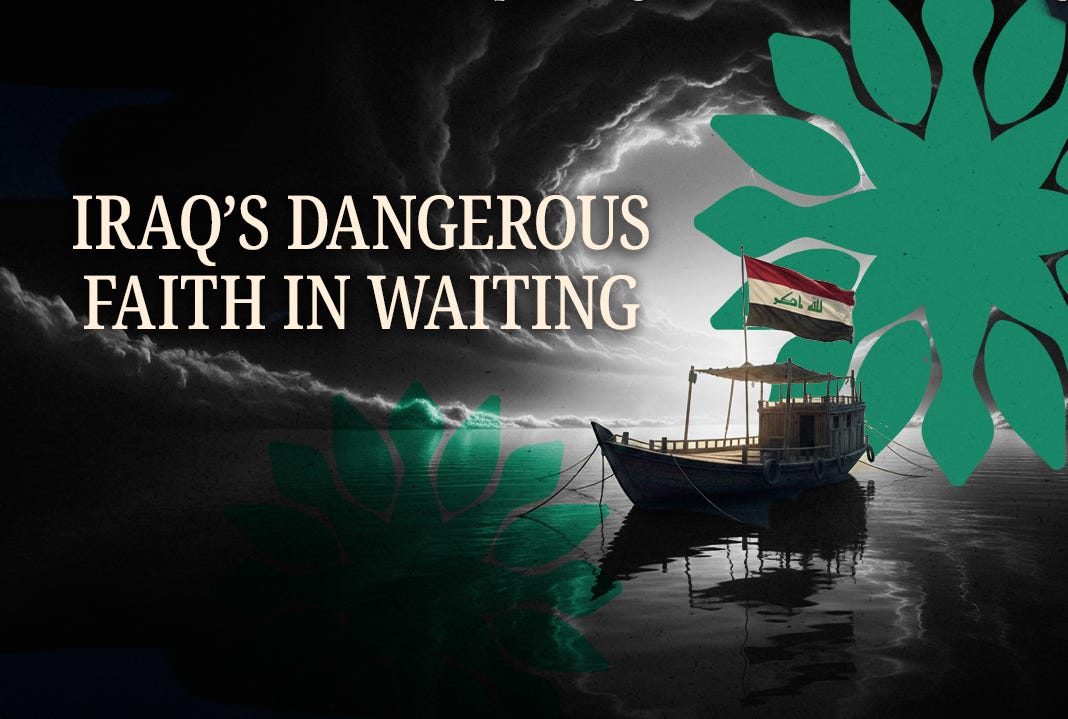
Iraq, however, has responded by delaying decisions, as if simply waiting for the storm to pass will reduce the risks it faces. Political leaders have treated postponement as a strategy rather than defining a clear position. This approach leaves Iraq neither neutral nor protected.
At home, this approach is often described as pragmatic. Outside Iraq, it is understood much differently. Other capitals do not see pragmatism; they see the absence of a position. In international politics, such an absence is rarely respected. More often, it invites intervention by those who are prepared to make tough calls.
The current moment is not defined by a formal declaration of war or the outbreak of open hostilities, but by a series of indicators commonly seen ahead of major confrontations. Coordinated military movements, enhanced logistical readiness, and intensified international coordination are practical preparations designed to be activated quickly once political authorization is given—most importantly in Washington.
Alongside these developments, messages have circulated between regional governments, warnings have been discreetly conveyed, and the tone of international political and media discussion has shifted. The focus is no longer on preventing escalation, but on managing what follows it. Military action against Iran is not the inevitable outcome, but governments refusing to prepare are choosing to operate in denial.
Iraq occupies a central place in these calculations. Geography alone ensures Iraq’s relevance in the current moment. The problem is not Iraq’s location, but its persistent failure to face that reality and assert a coherent sovereign position. Events unfolding around Iraq are treated as external disturbances rather than as developments that demand deliberate national choices from its leadership.
Its airspace, proximity, unresolved political and security files, and the presence of armed militias ensure that Iraq is directly implicated in any escalation or deterrence equation, regardless of its stated intentions.
The key difference between a state that controls its policy and one shaped by events lies in whether it clearly defines its position. When a government avoids setting boundaries or red lines, other actors interpret that uncertainty as a lack of policy and a sign of weakness. Inaction, in these circumstances, does not prevent involvement.
Neutrality for its own sake undermines any claim of Iraqi sovereignty. Indefinite delay weakens a state’s control over how its territory is used. When authority is unclear, other actors fill the gap, increasing the likelihood that Iraq will bear the costs of decisions made elsewhere.
Recent Iraqi history illustrates how political paralysis can produce serious security failures. The fall of Mosul in 2014, for example, was driven less by intelligence or resource gaps than by fragmented leadership, competing decision centers, and the politicization of national security.
Despite changes in context and a reduction in immediate threats, these structural weaknesses persist. Decision-making remains constrained by external pressures and internal imbalances, and preparedness remains reactive rather than anticipatory. The underlying problem has not been resolved.
The most serious danger facing Iraq is not an airstrike or a military maneuver. It is the absence of a clear, rapid, and authoritative decision-making mechanism in moments of crisis. Such fecklessness does not require armed conflict to expose it. Economic instability, public anxiety, and the erosion of trust in state institutions can achieve the same result without a single shot being fired.
Making a decision does not require choosing war, alignment, or escalation. It requires organization, preparation, coordination with regional actors, and a clear definition of boundaries. Most importantly, it allows a state to manage crises from a position of authority rather than reacting to events it does not control.
As the region moves toward a period of geopolitical transition—particularly under the current U.S. administration—Iraq’s continued hesitation is increasingly interpreted as weakness.
When major crises are managed outside the capitals that bear their consequences, ordinary Iraqis absorb the costs. Decisions are made elsewhere, while losses fall on those who neither shaped them nor had the authority to influence them.
States that avoid decisions do not remain on the sidelines; they ensure that their interests are considered last, if at all.
Middle East Uncovered is powered by Ideas Beyond Borders. The views expressed in Middle East Uncovered are those of the authors and do not necessarily reflect the views of Ideas Beyond Borders.
