


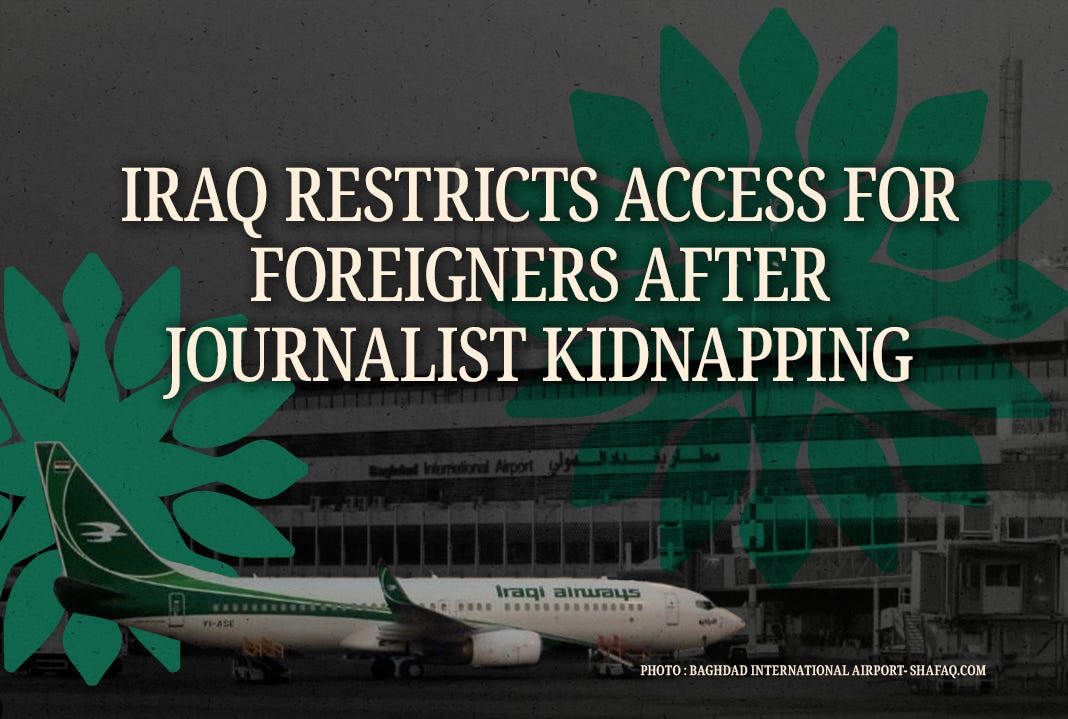
Iraq suspended online visa applications for several weeks following the kidnapping of American journalist Shelly Kittleson in March. The incident prompted Iraq to tighten security measures and triggered a noticeable escalation in diplomatic tensions with the United States amid the ongoing war with Iran, according to officials and diplomatic sources.
Kittleson was abducted in Baghdad by Iran-backed group Kata’ib Hezbollah and released after eight days, in an incident that once again underscored Iraq’s ongoing security challenges.
In response, Iraqi authorities have increased monitoring of foreign nationals and introduced precautionary measures aimed at preventing similar incidents. Security and intelligence units are now providing what officials describe as “discreet protection,” including surveillance and, in some cases, tracking foreign visitors traveling between cities.
“These measures are not meant to restrict movement but to ensure rapid response in case of threats,” one security source told Middle East Uncovered.
Iraq’s Interior Ministry denied reports that electronic visas had been suspended for foreign nationals. However, Iraqi security official Colonel Mohammed Jabbar confirmed the changes were directly linked to the kidnapping.
“The online visa system was stopped because of what happened with Shelly,” he said. “The government will continue assessing the situation until we are sure that foreigners are safe.”
He added that broader regional tensions were also a factor: “As long as the war involving Iran continues, the danger to foreigners will remain.”
In recent years, Iraq has expanded its electronic visa system for citizens of multiple countries, including the United States, the United Kingdom, Schengen Area nations, China, Japan, Russia, Australia, and Canada. However, diplomatic sources say access has become more restricted in practice following the kidnapping, with additional scrutiny applied to applications.
Relations between Washington and Baghdad have grown increasingly strained during the ongoing regional conflict with Iran, which has intensified the risk to US citizens in Iraq. In early April, the U.S. Embassy issued an alert warning Americans to leave the country amid heightened concerns over attacks from Iran-backed groups on US interests in Iraq.
Due to these developments, the U.S. State Department announced a $10 million reward for information on Haydar Muzhir Ma’lak al-Sa’idi, a key figure in the Reconstruction and Development Coalition led by Prime Minister Mohammed Shia al-Sudani.
Al-Sa’idi, known as “Haider al-Gharawi,” is the Secretary-General of Iraqi militia group Ansar Allah al-Awfiya, which Washington has accused of attacking US diplomatic facilities and military personnel.
The announcement signals a significant escalation in Washington’s posture toward armed groups operating within Iraq’s political landscape.
Further intensifying tensions, a statement from the U.S. Chargé d’Affaires sharply criticized Iraqi political actors, particularly within the Coordination Framework, accusing them of legitimizing figures Washington considers tied to militant networks.
The statement specifically referenced the invitation of “Abu Ala” to participate in political consultations over the next prime minister, describing it as evidence of “a profound misunderstanding” of U.S. concerns regarding Iraq’s trajectory. Abu Alaa al-Walaei is a key commander within the Islamic Resistance in Iraq (IRI), a network of Iran-backed militias.
It also names armed factions such as Kata’ib Hezbollah, Harakat al-Nujaba, Kataib Sayyid al-Shuhada, and Ansar Allah al-Awfiya, stating that these groups have contributed to destabilizing Iraq and pose a broader threat to regional stability.
According to the statement, the reward announcement “makes unequivocally clear” where certain political actors stand and highlights what it described as tolerance toward the financing and support of armed groups.
Washington also warned that it will continue to take action against individuals and groups responsible for attacks on U.S. personnel and interests, emphasizing that it will act “at a time and in a manner of its choosing.”
Under the leadership of President Donald Trump, the statement added, the United States will continue to take necessary steps to protect its citizens and strategic interests.
The kidnapping incident and the subsequent U.S. response may carry serious political implications for Prime Minister Sudani. Diplomatic sources indicate that growing dissatisfaction in Washington over security issues and militia influence could affect his future political prospects, although no official position has been announced.
More broadly, analysts say the developments highlight a deeper strategic question facing Iraq: whether it will position itself as a partner to the United States or drift further into alignment with armed factions that complicate its international standing and put foreign journalists at significant risk.
While Iraqi officials have not formally linked the kidnapping to broader policy shifts, the incident has clearly intensified scrutiny over Baghdad’s ability to balance security, sovereignty, and its increasingly strained foreign relations. Managing internal power dynamics while maintaining external partnerships is becoming harder—and the cost of getting it wrong is rising.
Middle East Uncovered is powered by Ideas Beyond Borders. The views expressed in Middle East Uncovered are those of the authors and do not necessarily reflect the views of Ideas Beyond Borders.