


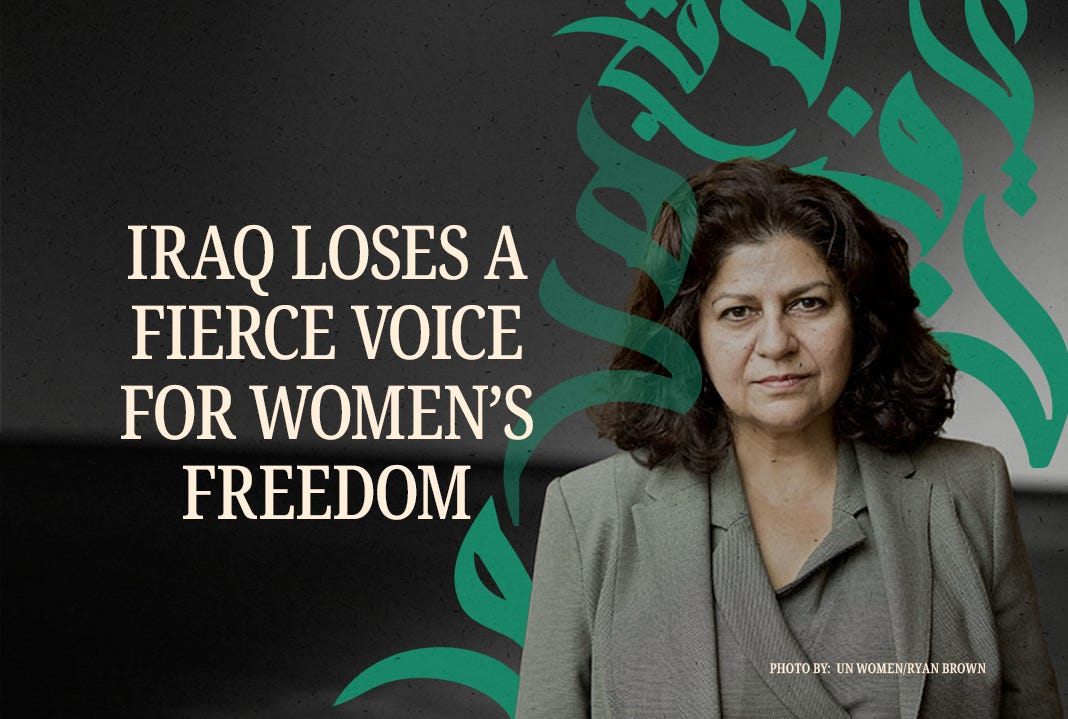
In 2003, Yanar Mohammed made a decision that would change the lives of countless Iraqi women. She looked at her comfortable life as an architect in Canada and decided to return home. The US had just invaded her country and Mohammed believed gender equality would be a vital foundation for Iraq’s future.
Back in Baghdad, she founded the Organization of Women’s Freedom in Iraq (OWFI), which would become one of the most outspoken feminist groups in the country.
“Yanar was an extraordinary woman who relentlessly fought for progress despite being threatened with assassination for more than two decades,” said Yifat Susskind, Executive Director of MADRE, and international women’s rights organization.
“At great personal risk, she transformed the landscape for women and girls in Iraq, building institutions, shifting laws, and creating space for women to live with dignity and power, no matter their status.”
Mohammed’s assassination on March 2 has prompted an outpouring of grief and sparked fresh concerns over the dangers faced by women’s rights advocates in Iraq. The 66-year-old was shot by two unidentified gunmen on a motorcycle outside her home in northern Baghdad and rushed to hospital, but died later from her wounds.
Colleagues at the OWFI described her as “an uncompromising outspoken feminist voice” and a fierce campaigner against discrimination and violence. “The passing of Yanar Mohamed is a tremendous loss to the feminist movement, but her legendary legacy will live on in every woman whose life was restored thanks to her support,” the organization said in a statement shared on social media.
The attack, a week before International Women’s Day, reinforced the precarious position of women’s rights activists in the country. International rights groups have warned of a “chilling pattern of targeted killings” designed to stifle women’s rights campaigners in Iraq.
“The persistent failure of the Iraqi authorities to hold perpetrators accountable for past assassinations has entrenched a climate of impunity that continues to place activists at grave and fatal risk,” said Razaw Salihy, Amnesty International’s Iraq Researcher.
“Human rights defenders, including women’s rights defenders in Iraq must be protected—not silenced and killed.”
The attack comes as rising rates of gender-based violence and discriminatory laws deepen the challenges faced by women and girls in Iraq. Tireless campaigning by women’s rights activists over the country’s Personal Status Code prevented a reduction in the minimum age of marriage for girls to nine last year, but harmful provisions remain.
Prime Minister Mohammed Shia al-Sudani has ordered an investigation into Mohammed’s killing. However, rights groups say attacks against journalists, activists, human rights defenders and protesters persist because perpetrators are rarely prosecuted for these crimes.
The OWFI described the crime as a “direct targeting of the women’s struggle”, and called on Iraqi authorities to “put a limit to the evasion of punishment that threatens human rights defenses in Iraq.” It has pledged to keep the organization’s safe houses open to support vulnerable women in Iraq.
Mohammed opened the first of these facilities in 2003 for women facing violence and abuse. Over time, she would establish a string of secret shelters, helping survivors of honor crimes, forced marriage, and trafficking to rebuild their lives.
Criticized by conservative groups, they were frequently forced to relocate, but Mohammed remained “defiant in the face of threats from ISIS and other armed groups,” Frontline Defenders said.
When she first returned to Iraq following the overthrow of former dictator Saddam Hussein, there was hope that new rights and freedoms could emerge. Instead, the situation worsened across much of the country as Iraq descended into chaos.
In a 2007 interview, Mohammed said women were the “first losers” of the US-led invasion of Iraq, tracing the decline in women’s rights to the years after the first Gulf war when “the modernization of the country went backwards.”
Though sidelined politically, women in Iraq had previously enjoyed better access to education and employment compared with many neighboring countries. “Iraq wasn’t really a third-world country. It was better off because of the income from oil and higher education women got for free,” she said.
But the opportunities for women that emerged in the 1950s and 60s saw a sharp reversal in the 1990s as conflict and sanctions gutted the country. Spiraling poverty eroded opportunities for economic independence and women’s status diminished as the regime targeted female freedoms to appease conservative groups.
The US-led invasion accelerated this reversal. As armed militias and insurgent groups filled the security vacuum, women faced mounting risks of kidnapping, violence and trafficking. Political power shifted towards religious groups, enforcing a stricter interpretation of Islamic values on Iraqi society.
Mohammed described the rapid rollback of women’s rights in an article for Chatham House, citing “massive resistance” to legal recognition for women’s shelters, which are not officially allowed in Iraq.
“I had hoped for a future in which women in Iraq could be respected and treated as equals under a state that upheld human rights. Instead, the US-led invasion solidified existing patriarchal structures and created the conditions for an increase in violence against women,” she wrote in 2023.
At the time, OWFI shelters had supported over 1,300 women and girls, providing emergency refuge alongside psychological services, legal assistance, and skills training for those unable to return home.
In a tribute to Mohammed, Iraq researchers Taif Alkhudary and Hayder Al-Shakeri said the refuges filled a “structural void,” in an environment that was increasingly hostile to women’s rights.
“In a context where police protection is inconsistent at best and directly contributes to gender-based violence at worst, and stigma silences survivors, OWFI institutionalized protection,” they said. “In doing so, it challenged both state failure and entrenched patriarchal norms.”
For more than two decades, Mohammed continued to advocate for women let down by successive governments and society. In 2016, as ISIS began to lose control of key cities, she took in women who endured rape and violence under their rule. Many had nowhere to return to and were “living in the shadows of society,” she said in an interview with Al Jazeera.
That year, Mohammed was awarded the Norwegian Rafto Prize for Human Rights in recognition of her courageous work on behalf of women and minorities in war-torn Iraq. Speaking at the UN Security Council in 2015, she described the “grim” situation in Iraq at the time, where trafficked women forced into brothels, “cannot go back home because they will be killed.”
The concerns Mohammed raised repeatedly over the years persist today. As the US-Israeli strikes on Iran reverberate across the region, Iraqi women face the fallout of yet another conflict and the need for advocates like Mohammed is greater than ever. Her death deprives the country of a powerful voice who refused to accept that Iraqi women should live in silence and fear.
Though her work remains unfinished, the institutions she built and the movement she nurtured endure. In the weeks and months before her death, Mohammed was still following up on the cases of Yazidi women and other survivors of ISIS abuse, refusing, as always, to abandon the women Iraq’s institutions had failed.
Middle East Uncovered is powered by Ideas Beyond Borders. The views expressed in Middle East Uncovered are those of the authors and do not necessarily reflect the views of Ideas Beyond Borders.