


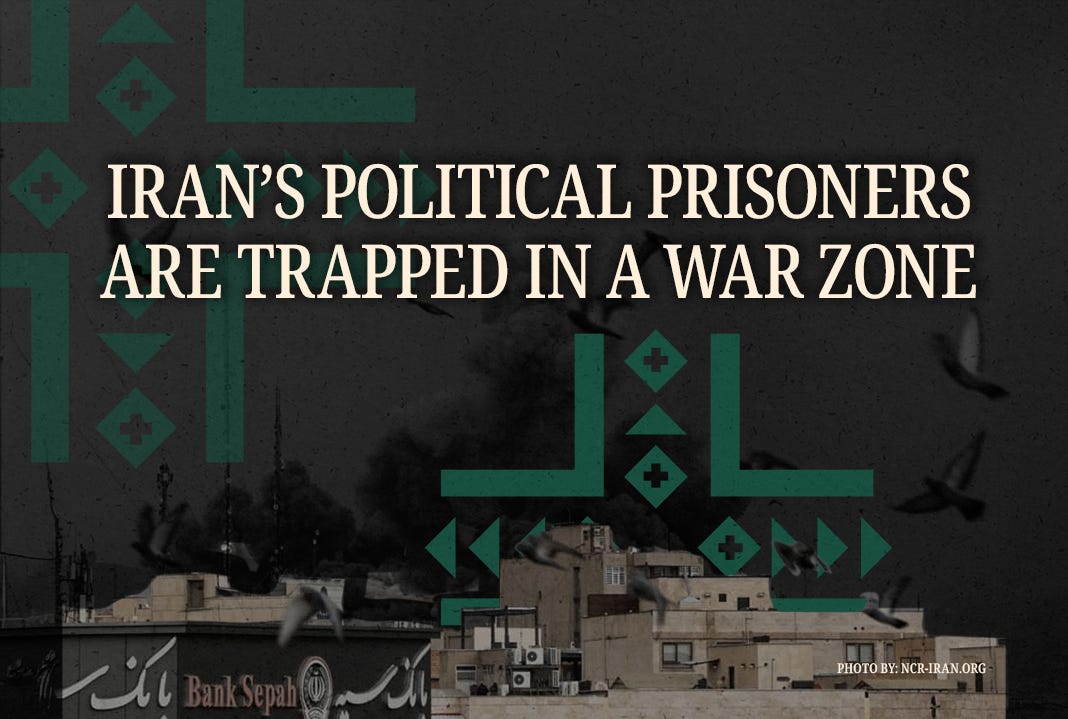
TEHRAN, Iran — Political prisoners in Iran may now be among the most vulnerable victims of the war. Families of detainees warn that the lives of their loved ones are in immediate danger, particularly after new developments inside Evin Prison, one of the country’s most notorious detention facilities.
Evin has long been associated with political detention and human rights abuses, and houses many of Iran’s most prominent political prisoners. Among them are Nobel Peace Prize laureate Narges Mohammadi, a human rights activist jailed for opposing the death penalty and defending women’s rights, and Zeynab Jalalian, a Kurdish activist serving a life sentence since 2008.
It is impossible to determine an exact number of political prisoners currently in Iran due to a lack of transparency, but reports indicate that the regime frequently detains thousands of individuals, including activists, journalists, and protesters, for actions deemed to be against national security. The regime's frequent crackdown on dissent, including arbitrary arrests, ensures that a large number of political prisoners are held at any given time.
According to reports from inside the prison, Ward 209 has been evacuated, and prisoners have been transferred to unknown locations. Other detainees, including political prisoners and individuals imprisoned for financial charges, remain in Ward 7. At the same time, NOPO special forces units have reportedly withdrawn from inside the prison and taken positions in nearby buildings, stoking fears that the facility itself could become a site of violence or military confrontation. NOPO (Nīrū-yi Vizhe-yi Pād Vahshat) is Iran’s elite “Counter-Terrorism” Special Force, operating under the Law Enforcement Command’s Special Units (Yegan Vijeh). Although tasked with hostage rescue and counter-terrorism, it is primarily used for riot control and internal security.
Families say that every hour increases the risk of a humanitarian catastrophe.
The concern is not only about the immediate danger of military strikes. Prisoners are also facing severe shortages of food, a lack of medical care, and increasing isolation from their families. Wartime makes prisons uniquely dangerous. Detainees cannot evacuate or protect themselves if facilities are struck or damaged. In previous attacks on Evin Prison, explosions damaged buildings and left detainees trapped inside damaged wards.
Families report that authorities have moved prisoners between wards or transferred them to undisclosed locations without notifying relatives or lawyers, further intensifying fear and uncertainty.
Across Iran, the issue of political prisoners has become a major public concern. Iranians inside the country and in the diaspora are widely using the hashtag #FreePoliticalPrisoners to draw international attention to the situation and to pressure the Islamic Republic to release detainees before disaster strikes.
These demands, while unlikely to be met, are rooted in existing legal principles. During wartime or emergency conditions, Iranian judicial directives adopted during the Iran–Iraq war require authorities to take measures to protect prisoners’ lives, including reviewing cases, granting temporary release, modifying bail conditions, or transferring detainees to safe locations.
Human rights advocates argue that implementing these measures now could significantly reduce the danger to detainees, especially for those imprisoned for political or civil activities.
Families of prisoners say the solution is clear and urgent. They are calling for the immediate release of political prisoners, at least for the duration of the war, to prevent further tragedy. Keeping detainees locked in prisons that may be targeted or damaged by military operations places them in extreme and unnecessary danger.
Middle East Uncovered is powered by Ideas Beyond Borders. The views expressed in Middle East Uncovered are those of the authors and do not necessarily reflect the views of Ideas Beyond Borders.

• The Evacuation of Ward 209: Ward 209 is traditionally controlled by the Ministry of Intelligence. The fact that it has been evacuated while Ward 7 (general and financial) remains suggests a high-value asset relocation. In the "Architect's" view, the state is protecting its "intelligence architecture" while abandoning the "human surplus."
• NOPO Special Forces Withdrawal: The withdrawal of NOPO (Special Force of the Guardian of the Terror-Counter) to surrounding buildings is a tactical shift from guarding to siege positioning. It indicates the regime expects the prison to be a "Kinetic Zone" and is preparing to contain a prison break or execute a liquidation from the outside.
• The "Legal Foundation" Paradox: The report mentions Iranian judicial directives from the Iran–Iraq War (1980–1988) that mandate prisoner protection. This is the Internal Facade in action: the state has a "Rule of Law" on paper that it is systematically ignoring to maintain its "Revolutionary Axis" survival.