


The Iran Freedom Congress (IFC) was founded in London in March 2026 to bring together opponents of the Islamic Republic around two goals: increasing political and economic pressure on the regime and preparing for a democratic transition if it falls. Its members have engaged with European lawmakers to push for measures including limiting financial ties with Tehran and pressuring the regime over executions, while also confronting the question of what should replace it and how a transition should be managed.
The Congress is not a government-in-exile, and participation does not require its members to agree on every political issue. It is an Iran-wide opposition platform that brings together political parties, civic groups, and individual figures to develop common positions on Iran’s future. Among its participants are three parties from Iran’s Kurdish region, known among Kurds as Rojhelat, or Eastern Kurdistan.
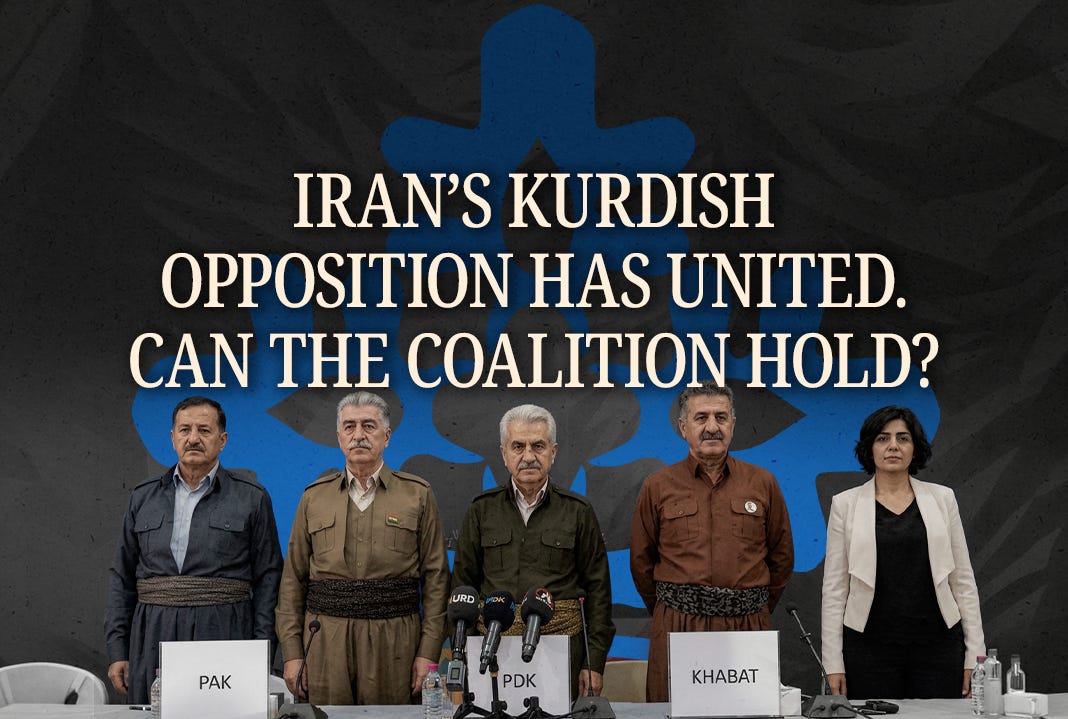
Those Kurdish parties are simultaneously part of another, narrower political project. In February, most of the major parties from Rojhelat formed their own coalition in an attempt to coordinate Kurdish political strategy after decades of rivalry.
The coalition includes the Democratic Party of Iranian Kurdistan (PDKI), the Kurdistan Freedom Party (PAK), the Kurdistan Free Life Party (PJAK), the Khabat Organization of Iranian Kurdistan (Khabat), Komala of the Toilers of Kurdistan (Komala), and the Komala Party of Iranian Kurdistan (KPIK). Most are long-standing organizations that have opposed the Islamic Republic for decades. Several maintain armed wings, while much of their leadership and many of their bases are located across the border in the Kurdistan Region of Iraq.
The two projects therefore overlap but serve different purposes. The Kurdish coalition is meant to coordinate the various Rojhelati parties, while the Iran Freedom Congress brings some of those same parties into a broader Iranian opposition framework.
That overlap has now raised a difficult question. When a Kurdish party participates in an Iran-wide organization such as the IFC, is it acting independently, or is it expected to coordinate its position with the other members of the Kurdish coalition first?
A dispute over an IFC declaration in July brought that unresolved question to the surface. In it, the declaration addressed the war, foreign intervention, and the Iranian people’s right to determine their own political future. It also held the Islamic Republic responsible for the policies that led to the war, rejected foreign military intervention, and argued that opposition to war should not become a justification for preserving the regime. Its central position was that Iran’s political future must be determined by the people of Iran, not external forces.
Three Kurdish parties participating in the Congress subsequently made clear that the declaration should not automatically be read as their position. The PDKI said it had neither drafted nor approved the text. Komala also distanced itself from the declaration. PJAK later explained that participation in the Congress did not mean accepting every IFC position.
The disagreement quickly escalated into a debate about Kurdish unity (or lack thereof). But the IFC is not responsible for the political differences among these parties. They have disagreed for years over whether or not having armed wings is a good idea, relations with other Iranian opposition groups, international alliances, and the future political status of Kurdistan. Some regard participation in Iran-wide opposition platforms as a way to strengthen Kurdish influence over any potential future transition. Others worry that joining such organizations without clear guarantees could weaken Kurdish standing.
The July controversy exposed that the new Kurdish coalition is not at all prepared for how members are supposed to manage those differences. That might seem like an internal political dispute, but the stakes are much higher. If the Islamic Republic begins to unravel, these parties could suddenly face far bigger decisions to make together, with little time to do so.
The parties entered their new alliance at an unusually dangerous moment. Only days after the coalition was announced, war broke out, and the Kurdistan Region of Iraq came under sustained missile and drone attacks. Iranian Kurdish opposition bases, camps, and residential areas were among the targets. The Kurdistan Regional Government (KRG) documented hundreds of attacks within the first weeks of the war, while human rights monitors reported repeated strikes against Iranian Kurdish parties and camps housing their members and families.
By early August, more than 950 drone and missile attacks had struck the Kurdistan Region since February 28, killing 32 people and wounding 154. Not all targeted Rojhelati parties, but their facilities were repeatedly hit. By mid-July, attacks had killed at least 17 members of Rojhelati parties. After a July 19 strike on a PAK base, the party alleged that white phosphorus or another incendiary munition had been used. That claim has not been independently verified.
The coalition has responded politically. On March 20, it issued a joint statement condemning attacks on Kurdish parties and refugee camps. After another coalition meeting on July 23, it described casualties suffered by individual parties as losses for the wider Kurdish movement, and called for an investigation into the reported use of prohibited weapons. The statement publicly presented attacks against individual members as a concern for the alliance as a whole.
But there is much the public still does not know.
Has the coalition established a joint emergency mechanism? Does it have a common system for documenting attacks and casualties? Have the parties agreed on procedures for protecting residential camps? Who coordinates their response when one member is attacked?
These are practical questions for an alliance whose members and their families are living under repeated military attacks. Statements issued afterward are important, but they reveal little about what, if any, systems are in place to prepare for the next strike.
The coalition has shown at least some capacity to cooperate abroad.
On June 22, representatives of five member parties met in the British Parliament and called for a shared Kurdish political position. Other international appearances, however, have been party-based, including Abdullah Mohtadi’s separate address to the Dutch Parliament’s Foreign Affairs Committee.
There is nothing inherently contradictory about that. Political parties in a coalition can maintain independent diplomatic relationships.
The lingering question is how those relationships fit into the coalition. Do parties consult one another before major international meetings? Are there positions that representatives are expected to carry collectively? Do they brief other members afterward? Are some countries or institutions assigned to particular parties?
Without a clear set of public rules, it is difficult to distinguish a coordinated division of labor from six parties conducting parallel foreign policies.
The Iran Freedom Congress has its own issues to address.
If political parties participate in the Congress without endorsing every declaration it publishes, the distinction needs to be clear. The Congress should explain how it consults political parties, how it drafts and approves declarations, and what participation signifies when members disagree with a position issued in the IFC’s name.
As a member of the IFC Central Council, I do not think the organization should be shielded from that criticism. An organization presenting itself as part of a democratic alternative to the Islamic Republic should be able to clearly articulate its democratic procedures.
But criticism of the Congress alone won’t fix its problems.
The Rojhelati parties created their alliance precisely because internal divisions had weakened their ability to act cohesively. Its founding framework identified overthrowing the Islamic Republic, Kurdish self-determination, and establishing democratic governance in Rojhelat as central objectives.
Those ambitions require the parties to make decisions together when they disagree. So far, the public has little information about how that will work.
Can coalition members join outside political platforms independently, or must they consult the coalition first? Can one member sign a declaration that others oppose? Who speaks for the coalition? How are disagreements resolved? Does a leadership structure have the authority to make urgent decisions?
The same questions become more consequential in the event of political upheaval inside Iran.
If state authority weakens or implodes in parts of Rojhelat, who would coordinate security? What happens if two coalition parties disagree about armed deployments? Is there a common plan for administering territory? How would local political authority be established? What relationship would such an administration have with a transitional government elsewhere in Iran?
These are not hypothetical questions invented after the coalition was formed. The political environment in which the parties created the alliance was already defined by instability and the possibility of rapid change. Contemporary accounts of its formation described preparations for both political transition and democratic governance in Rojhelat as central to the project.
The creation of the coalition was significant precisely because these parties have spent decades divided by ideological, strategic, and competitive differences. Bringing six of them under one framework is an achievement in and of itself. But signing a common political agreement is different from building an institution that can survive disagreement.
The first months of the coalition’s existence have already tested its durability. The military attacks, international diplomacy, and participation in the wider Iranian opposition have exposed the same uncertainty about how collective decisions are made and how much freedom individual members retain.
It has been five months since the coalition was announced; its members should publish the procedures they intend to use to work together. Regular reports on meetings and decisions would also let the public judge what the coalition has actually accomplished and where it can improve.
None of this requires the six parties to ignore their political differences. A functioning coalition should not depend on agreement about everything, but on knowing what happens when compromise cannot be reached.
Until those rules are clear, every new military attack, diplomatic invitation, or Iranian opposition initiative risks reopening the same dispute: whether a party is speaking for itself, for the Kurdish coalition, or for a broader alliance of which it is a part.
There may come a moment when Iranians have a genuine opportunity to free themselves from the Islamic Republic, and political movements that hope to shape what follows need to be ready before that moment arrives. For the Kurdish coalition, that means resolving these questions now, not in the middle of a crisis. If an opening for political change comes and the parties are too divided or disorganized to act together, they will have squandered an opportunity the community may not get again for a generation.
Middle East Uncovered is powered by Ideas Beyond Borders. The views expressed in Middle East Uncovered are those of the authors and do not necessarily reflect the views of Ideas Beyond Borders.
