


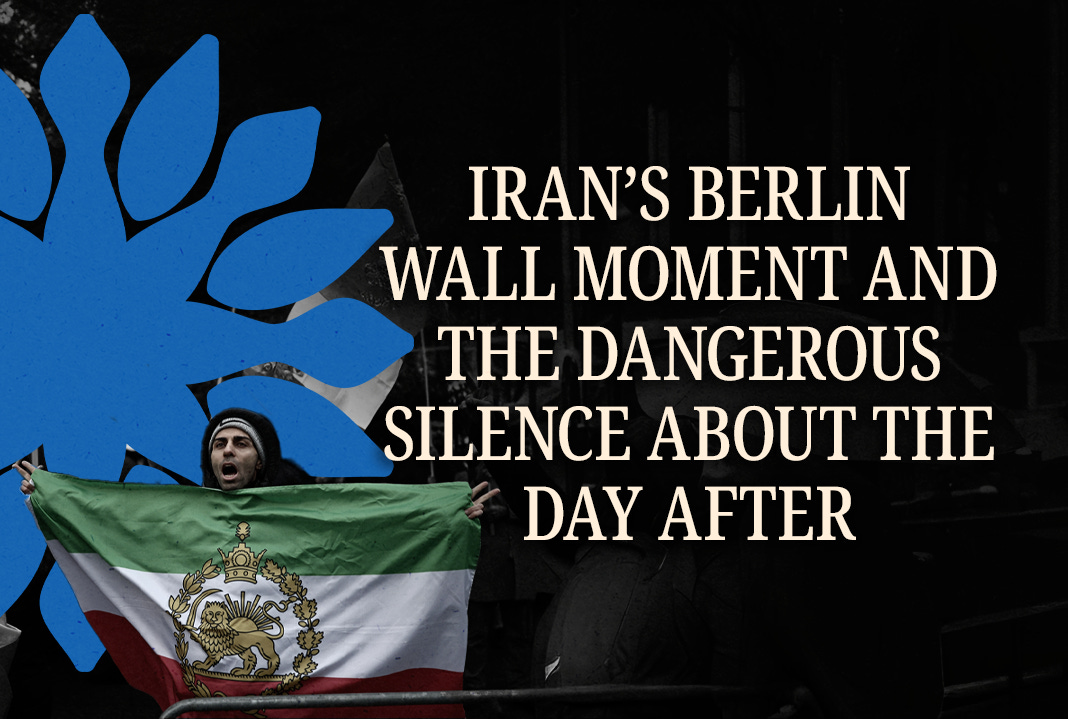
Scroll through X, and you will find a flood of condemnation of the Iranian regime—from governments, ministers, and public figures across the world. What you will not find is anything that matters nearly as much: a plan.
No threats that change calculations. No commitments that shape outcomes. No roadmap for what happens if the regime falls.
Left to its own internal dynamics, Iran now faces two plausible futures. Either the regime reasserts control through mass violence, or it collapses under the weight of sustained nationwide revolt. Both paths are bloody. Only one offers the possibility of something better—and only if the world acts with foresight.
So far, it has not.
The protests are unprecedented in their geographic spread, social breadth, and political clarity. They are unfolding under radically different domestic and geopolitical conditions than previous uprisings. The regime is being tested at an existential level.
Yet no serious international effort is underway to convene the fragmented Iranian opposition, forge a transitional framework, or prepare governing alternatives. This absence is dangerous. The Trump administration’s warnings of retaliation if the regime escalates repression have not stopped the killing. Hundreds are already reported dead. Even if limited military strikes were to occur, the fundamental question would remain unanswered: What is the endgame?
Iran’s system is not reformable. That debate ended long ago. The choice is no longer between gradual change and stability, but between regime survival and regime collapse.
And regime collapse without a “day after” plan is a recipe for catastrophe.
Recent history offers enough cautionary tales. Power vacuums in deeply polarized societies do not produce democracy by default. They produce armed factions, institutional collapse, regional interference, and prolonged civil war.
Some in the diaspora still point to the former crown prince as a unifying figure. However, his support within the country is limited, and previous attempts to consolidate opposition forces under his leadership have failed. No single personality can substitute for a functioning political architecture: a transitional council, a constitutional process, security-sector guarantees, minority protections, and an economic stabilization plan.
None of this exists as of today.
Meanwhile, other scenarios loom. Will the Islamic Revolutionary Guard Corps fracture? Will a general or a group of generals attempt a coup? If so, how will the international community respond—by legitimizing military rule, isolating it, sanctioning it, or attempting mediation between generals and street movements?
These are not academic or theoretical questions. They may become urgent within weeks.
History shows that revolutions are often lost not on the streets, but in the vacuum that follows victory.
Masih Alinejad, one of Iran’s most courageous dissidents, has called this situation Iran’s “Berlin Wall moment.” She is right.
But the fall of the Berlin Wall succeeded not only because people were brave, but because political, economic, and institutional pathways had already been imagined, negotiated, and partially prepared.
Iran today has bravery in abundance. What it lacks is a transitional plan and international seriousness.
Condemnation is cheap. Planning is hard.
If the world truly believes the Iranian people deserve freedom, dignity, and sovereignty, then it must stop performing outrage and start preparing for transition.
Otherwise, we may soon witness not liberation, but collapse, chaos, and a tragedy that could have been mitigated.
Middle East Uncovered is powered by Ideas Beyond Borders. The views expressed in Middle East Uncovered are those of the authors and do not necessarily reflect the views of Ideas Beyond Borders.

Thanks for your insight. Such a tough road for nations coming out of totalitarian rule. In our digital age we have grown to expect instantaneous results.
I am reminded that the US Declaration of Independence was in 1776. There were many people living in the US who were British loyalists (the Tories). It took a year of conflict with the British & between the colonies to establish the Articles of Confederation. The Constitutional Convention didn't happen till 1787. Of course back then England was the most powerful nation in the world and the concept of a democratic republic was in its infancy. And thankfully, the US did not the degree of tribalism and religious conflict that afflicts so many places in the Middle East.
I pray that Iran and other nations suffering with totalitarian governments will be able to gain freedoms quickly. At least they have some templates but also huge hurdles of tribalism & religious conflicts . Given the hurdles, it will take a miracle. My expectations are low. I lament for the those living in these chaotic places and times.
Reza Pahlavi has gathered a group of experts to outline the steps that should be taken: https://fund.nufdiran.org/projects/ipp/