

Iranian Networks Are Operating on British Soil
Recent arrests in north London reveal a broader pattern of Iranian state activity inside the UK. Officials warn that intimidation, surveillance, and proxy activity are no longer isolated incidents.

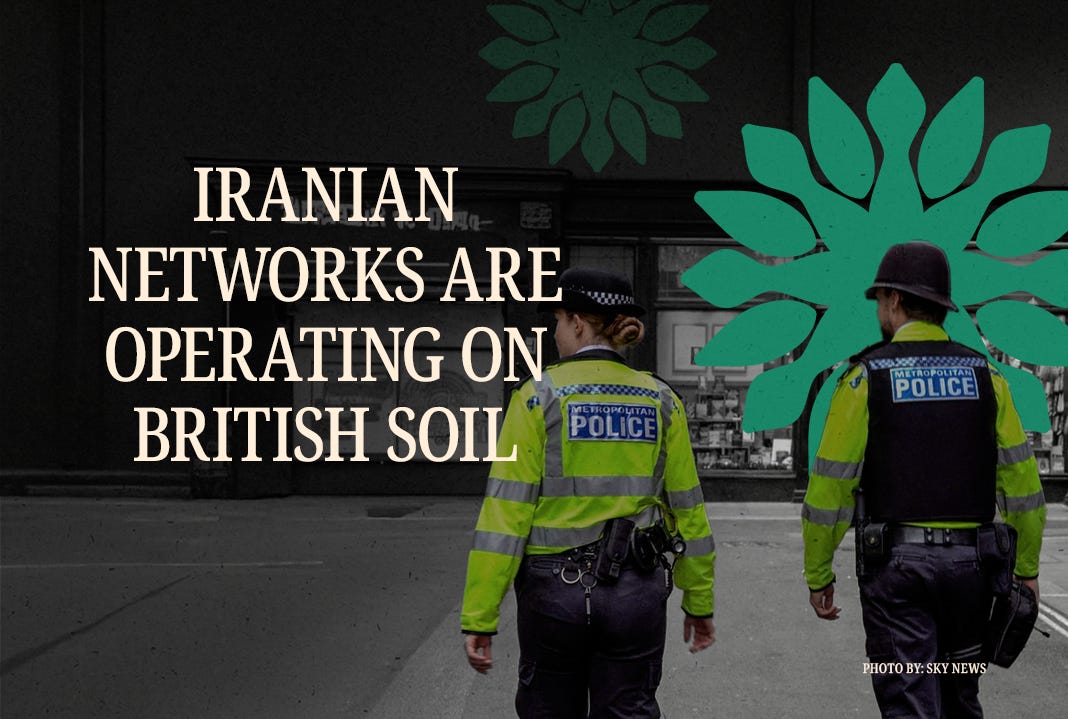
In the early hours of Friday, March 6, British counter-terror police arrested four men—one Iranian and three dual British-Iranian nationals—suspected of spying for Iran and allegedly targeting synagogues and Jews in Harrow, Barnet, and Watford. These areas have some of the largest Jewish populations in the UK.
The arrests were made under the National Security Act and are the first of suspects alleged to be acting in Iran’s interests since the country was attacked by the US and Israel on February 28.
This is not the first indication of Iran’s activities on British soil. In May 2025, Israel’s embassy in London was the target of an alleged terror plot involving five Iranian nationals. Tehran denied any involvement.
These are not isolated cases. Over the past decade, Western intelligence agencies and analysts have warned that the Iranian regime has expanded its efforts to monitor, intimidate, and sometimes attack its perceived “enemies” abroad, often using criminal gangs to do so.
These targets often include members of the Iranian diaspora as well as Jewish or Israeli-linked institutions. The Islamic Republic frequently conflates Jews with the state of Israel.
In the last four years, British authorities have foiled 40 terrorist attacks linked to Iran. “It is clear that these plots are a conscious strategy of the Iranian regime to stifle criticism through intimidation and fear,” said Dan Jarvis, the British security minister. “These threats are unacceptable. They must and will be defended against at every turn.”
Similar incidents have been reported elsewhere. In Australia last year, the Iranian ambassador was ordered to leave in 2025 after being accused of directing antisemitic attacks in Sydney and Melbourne.
Intelligence services linked Iran to an arson attack on a cafe in Sydney in October 2024 and another on a synagogue in Melbourne in December of the same year. Iran “absolutely rejected” the allegations.
Meanwhile, Sweden’s security service Säpo said Iran may have been involved in the explosions and gunfire that took place near the Israeli embassies in Stockholm and Copenhagen in 2024.
“Our response is only catching up,” says Roger MacMillan. “People are finally waking up to how dangerous this particular threat is, but more needs to be done.”
MacMillan was head of security for Iran International, a Persian-language satellite channel based in London, when one of its journalists, Pouria Zeraati, was stabbed by a group of men outside his home in Wimbledon. They were believed to be acting for the Iranian regime.
Leading up to the attack, UK intelligence services had foiled at least 15 plots to kidnap or kill employees of the channel.
Zeraati subsequently left London with his wife, as he believed the UK government wasn’t doing enough to keep people like him safe. He is among a growing number calling for the British government to proscribe the IRGC, an arm of the Iranian state, as a terrorist organization.
Iran’s presence in the UK extends beyond security threats, reaching into religious and community institutions.
A day after Ayatollah Khamenei was killed in joint US-Israeli strikes, candles and photographs of the supreme leader were placed outside the Islamic Centre of England (ICE) in north London, with grief-stricken mourners turning up to pay their tributes.
A video posted online shows a tearful worshipper chanting: “We will obey you, Khamenei.”
It was far from an isolated scene.
Across Britain, mosques and student organizations have organized vigils and tributes to a dictator who oversaw brutal crackdowns on his own people for over 36 years.
“I find this so sad, it’s like mourning the death of Hitler,” says Ellie Borhan, an Iranian dissident and founder of the London-based Stage of Freedom group. “The Islamic Republic has committed crimes against humanity.”
For critics of the regime, such scenes point to a deeper and more organized network of influence.
About 30 charities, community centers, and other organizations in the UK are allegedly linked to Tehran, according to a landmark new report.
The report warns that Britain has been too slow to confront Tehran’s “soft power” infrastructure.
Eight of the ten charities detailed in the report are already under investigation by the Charity Commission, but Walney points to “systemic delays” and a lack of robust action.
Critics also argue that this hesitation is not only due to bureaucratic inertia, but also to a lack of political will, combined with politicians scared of being accused of Islamophobia.
ICE, a registered charity in London’s Maida Vale, has been described as the Islamic Republic’s “nerve center” in Britain. Its past director was appointed by Ayatollah Khamenei.
Last year, the centre was broadcasting daily Ramadan religious messages from the supreme leader. The Intelligence and Security Committee said that ICE may provide Iranian intelligence agents “with a useful base from which to act.”
In 2020, the center received a warning from the Charity Commission, a charity regulator, after it hosted a vigil for Qasem Soleimani, a commander of the IRGC killed by the US. It has been subject to a statutory inquiry since November 2022.
ICE has denied that it acts as the headquarters for any network linked to Iran’s supreme leader, insisting that neither the Iranian political system nor any political figure has influence or control over its activities, and that it does not represent any foreign government.
Lord Walney’s report also details allegations concerning the Islamic Human Rights Commission (IHRC). The Wembley-based center is responsible for organizing the annual Al-Quds demonstration linked to the regime. It was due to take place on March 15, but it was banned by the British Home Secretary Shabana Mahmood to “prevent serious public disorder”. Instead, a static demonstration was permitted, with 12 people subsequently arrested on the day.
Organizers insist the rally, which takes its name from the Arabic word for Jerusalem, is a peaceful event in support of Palestinians. But many others describe it as a “hate march,” accusing IHRC of having links to Iran.
Massoud Shadjareh, the founder and chairman of the IHRC, has previously backed Ayatollah Khomeini’s fatwa against Sir Salman Rushdie, author of The Satanic Verses.
At a vigil for Soleimani, Shadjareh said: “We work hard to make sure there will be many, many more Qasem Soleimanis. We aspire to become like him.”
In 2023, Shadjareh praised the Iranian regime during a three-part YouTube interview for the Masaf Institute, accused of being a propaganda outlet for Iran. The same year, he spoke in Tehran at a student event for the Basij Resistance Force, a volunteer paramilitary group sanctioned by the UK.
In response to these allegations, the IHRC denounced Walney as “an active supporter of Israel,” using “his platform to shield Israel from criticism”. With regards to the claims about Iranian links, the centre dismissed them as “tiresome” and yet another example of linking “British Muslims to the latest so-called ‘bogeyman’ in the Middle East,” which “borders on racism.”
Borhan believes tougher action is needed. She wants to see the IRGC proscribed.
“The government really needs to come down harder on these activists and find out who’s funding them,” she says. “If the UK designates the IRGC as a terrorist organization, then they wouldn’t be able to get as much support, and their assets would be frozen.”
When asked at a recent parliamentary debate if the government would move to proscribe the IRGC, Yvette Cooper, the foreign secretary, simply stated: “We keep all proscription decisions under close review.”
The previous UK government declined to proscribe the IRGC, partly out of concern that it would damage future diplomatic channels with Tehran.
Unlike the Wagner Group—a Russian state-funded paramilitary-mercenary organization which the UK proscribed as a non-state paramilitary organisation in 2023—the IRGC is an official branch of the Iranian state, creating legal and diplomatic complications for its designation under existing counter-terrorism legislation.
When asked to what extent the Iranian state has support in the UK, Roger MacMillan rightly points out that the pro-regime vigils and rallies are vastly outnumbered by the secular dissidents. “But it only takes one person to carry out an attack,” he adds.
The question now is whether Britain’s response will keep pace with the scale of the threat—one that, as the recent arrests in Harrow, Barnet, and Watford show, is already very real on our soil.
Middle East Uncovered is powered by Ideas Beyond Borders. The views expressed in Middle East Uncovered are those of the authors and do not necessarily reflect the views of Ideas Beyond Borders.
Thank you for writing about this, we are quite concerned. Someone was stabbed last week in Finchley at an Iran demo!