


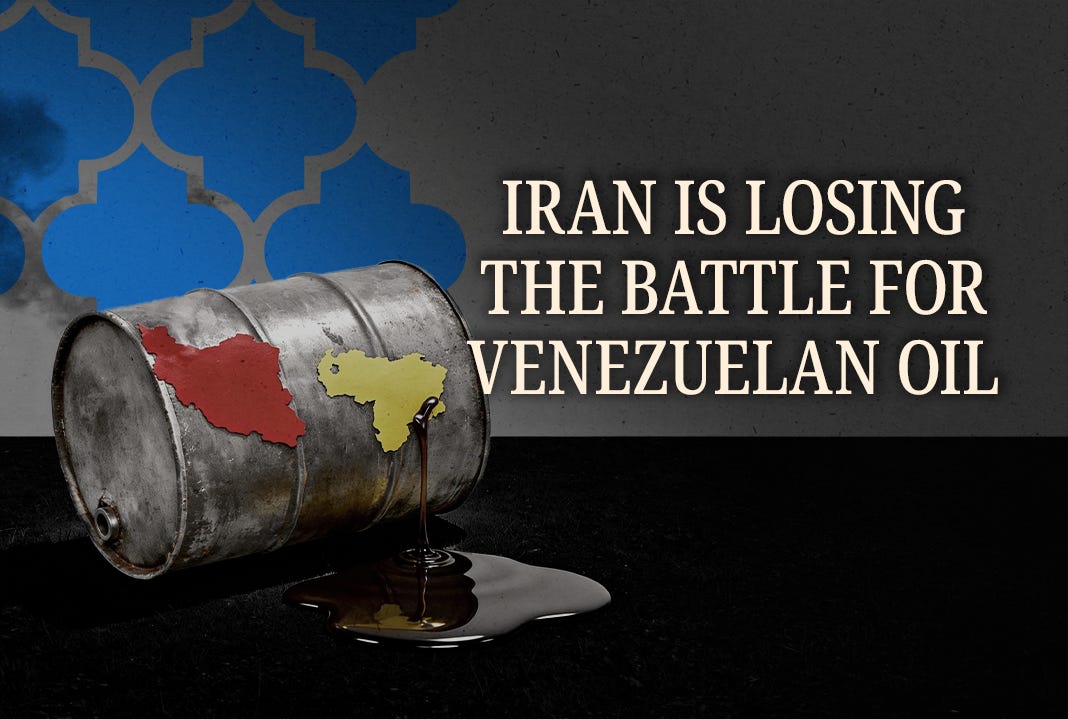
In Iran, weeks of sustained protests and a harsh government crackdown have exposed deeper strains within the regime, strains now compounded by reports of imminent U.S. military action. That backdrop invites a close look at where Tehran is failing to maintain influence abroad—not least in Venezuela, where its once-strategic role in the country’s oil sector is unraveling.
Iran’s access to Venezuelan crude has weakened not because Caracas has broken with Tehran politically, but because legal and financial changes in Venezuela are closing the operational space that once sustained their energy partnership. New oversight and regulatory structures mean Tehran can no longer participate in oil management, access the resource, or funnel revenues through the opaque channels that defined the alliance—effectively cutting Iran out of one of its few remaining footholds in the Western Hemisphere.
The prior oil relationship between Venezuela and Iran followed a specific and functional logic. Both regimes, under international sanctions, developed systems based on opaque exchanges, non-standard payments, and parallel financial circuits. Iran provided diluents, technical assistance, and logistical support; Venezuela supplied heavy crude and offered a political and operational platform in the Western Hemisphere. The relationship was not grounded in economic efficiency or market integration, but in the shared capacity to operate outside regulated global systems.
That arrangement depended on three conditions: closed state control of the oil sector, legal opacity, and financial autonomy from the international system. Each of those conditions has now been dismantled through decisions taken by the Venezuelan regime itself. What once functioned as a sanctioned ecosystem has been replaced by a legal and financial system incompatible with Iran’s mode of external engagement.
The turning point was the reform of the Organic Hydrocarbons Law, promoted by the de facto government of Delcy Rodríguez and definitively approved by the illegitimate National Assembly of the dictatorship on January 29, 2026. The reform does not constitute a democratic opening or a legitimate institutional modernization, but a survival strategy aimed at restoring cash flow, stabilizing production, and partially normalizing oil exports under a new legal framework.
The law alters the rigid control structure of the sector, allows greater private participation, relaxes contractual conditions, and reduces the direct political weight of the state-owned company Petróleos de Venezuela, S.A. In practical terms, oil ceases to function as an ideological instrument serving sanctioned geopolitical alliances and becomes part of a regulated system conditioned by external constraints. This change reforms the operational logic of the entire sector, though without any genuine constitutional foundation.
Venezuelan oil is once again being sold at international market prices. The discounts, barter arrangements, and opaque formulas that characterized exchanges with sanctioned partners have been abandoned. Revenue from these sales no longer flows freely into the discretionary control of the regime. Instead, it is channeled through accounts subject to external oversight, fundamentally reshaping access to and control over oil rents.
For Iran, this is bad news. The Iranian regime does not operate comfortably within relatively transparent regulatory frameworks or financial systems subject to international scrutiny. Its external projection relies on legal gray areas, informal political arrangements, and parallel payment mechanisms. The new Venezuelan legal and financial architecture eliminates that space. Energy cooperation between the two nations is now unviable, not because of a declared political break, but because the operational framework no longer permits it.
The decisive factor is not the oil fields themselves, but the revenue they generate. Control over sales mechanisms, shipping, insurance, payments, and access to final markets determines who can participate in the sector. Actors unable to operate within those channels are automatically excluded. Without access to those systems, Iran has been effectively removed from Venezuela’s oil economy without the need for a formal rupture or diplomatic escalation.
Venezuela previously served as Iran’s primary foothold in the Western Hemisphere. Not only as an energy supplier, but also as a logistical, diplomatic, and symbolic platform. From Caracas, Tehran projected influence beyond its immediate region and demonstrated an ability to operate in a strategically sensitive environment close to the United States. But not anymore.
The strategic consequences have not gone unnoticed in Washington. On January 28, 2026, in testimony before the U.S. Senate, Secretary of State Marco Rubio made clear that Venezuelan oil is no longer viewed as simply a commercial issue. It is now treated as a matter of regional security, sanctions enforcement, and limiting the reach of adversarial regimes.
Rubio made clear that Washington’s concern over Venezuela’s oil is not about commercial markets alone, but about preventing its revenues from being used to support hostile actors and authoritarian networks—a stance that underpins broader U.S. policy toward Caracas.
He emphasized that U.S. objectives do not include governing Venezuela, but ensuring that the country’s principal economic resource is managed under financial oversight and market transparency, conditions that effectively exclude Tehran from the energy sector.
The recent overhaul of Venezuela’s hydrocarbons law, the return to market pricing, and stricter revenue controls have stripped away the opaque mechanisms that once made cooperation with Iran possible. In practical terms, Venezuela no longer functions as an operational theater for Tehran in the Western Hemisphere.
Without access to Venezuelan crude or control over oil revenues, Iran loses a key foothold in the region. In global politics, external partnerships like this offer authoritarian regimes a strategic advantage; when they disappear, so too does a significant source of leverage.
For Tehran, the loss of access to Venezuelan oil is a strategic blow at a time when the regime can least afford one. Venezuela was a rare operational lifeline that helped Tehran bypass sanctions, sustain revenues, and project influence beyond the Middle East. The opaque systems of barter, shadow shipping, and informal financial networks that once underpinned that relationship are now unraveling as Venezuela moves toward regulated markets and external oversight, effectively shutting Iran out.
That loss compounds a series of pressures on the Islamic Republic—domestic protests that have shaken its legitimacy, economic strain from prolonged sanctions, and the looming possibility of military action against its infrastructure. Without Venezuelan oil revenue and the mechanisms that once sustained it, Tehran has fewer tools to mitigate those pressures and less flexibility to absorb external shocks. In geopolitical terms, losing Caracas means losing a rare arena where the Islamic Republic could operate with relative autonomy; without it, the regime’s strategic margins narrow further, leaving it more exposed to economic isolation and regional containment.
Middle East Uncovered is powered by Ideas Beyond Borders. The views expressed in Middle East Uncovered are those of the authors and do not necessarily reflect the views of Ideas Beyond Borders.
