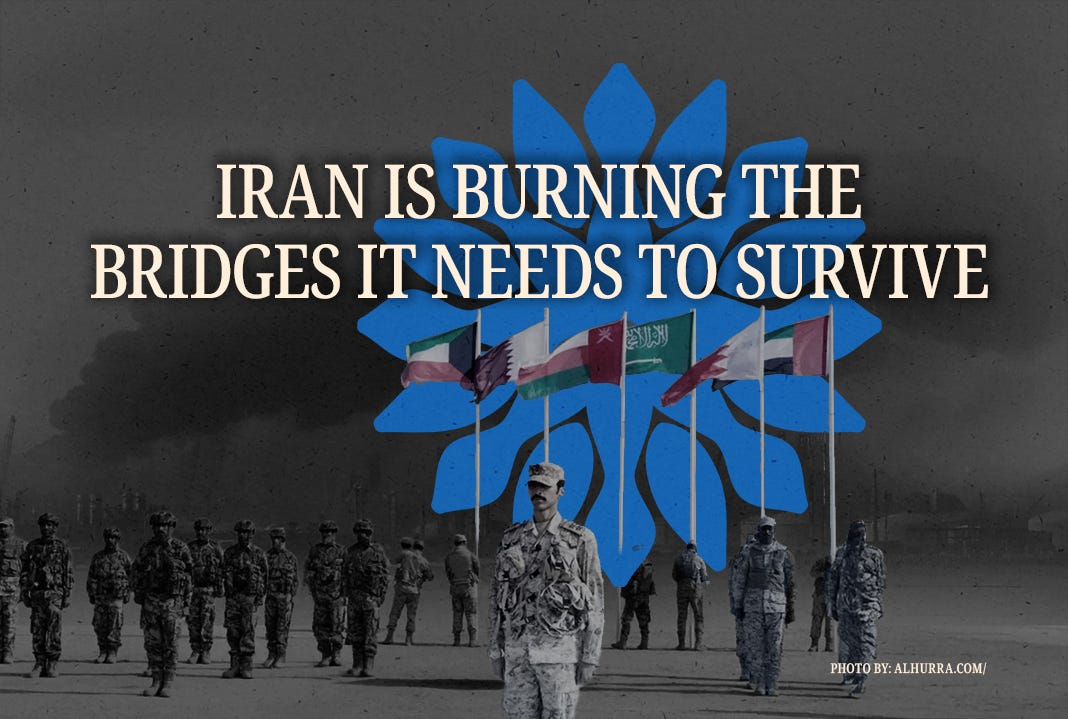
Iran Is Burning the Bridges It Needs to Survive
By attacking Gulf capitals and threatening the Strait of Hormuz, the Islamic Republic is wagering that chaos can substitute for strength. That bet may prove existentially costly.
After airstrikes by the United States and Israel killed Ayatollah Ali Khamenei—the Islamic Republic’s so-called “Supreme Leader”—on day one of the war, the world expected a response.
Israelis braced for missile fire, and Americans braced for attacks on their bases across the Gulf.
What fewer people expected was Tehran lighting up the entire neighborhood: missiles and drones not just toward Israel, but over and into Gulf capitals and “neutral” airspace too—Bahrain, Kuwait, Saudi Arabia, and the UAE, with blasts reported around Abu Dhabi and Dubai, including drone attacks on both the Burj Al-Arab hotel, and the Burj Khalifa, the tallest manmade structure in the world. To be clear, these are all American allies that host American military bases. But Iran has gone beyond targeting these bases, and has also attacked skyscrapers, airports, and other civilian infrastructure that have nothing whatsoever to do with the war.
This even included attacking states that have spent the last decade trying not to be at war with Iran, and in Oman’s case, acting as the region’s designated mediator.
Qatar—a sponsor of Hamas, and which has in the past provided the Islamic Republic with relatively favorable media coverage via its state-run Al-Jazeera network—has said it intercepted Iranian attacks aimed at targets including its international airports. Doha’s foreign ministry spokesperson didn’t dress it up as “miscalculation” or “spillover.” He framed it as a hostile action and said Qatar is not currently engaging Iran diplomatically. Multiple other states, including Saudi Arabia, have threatened a military response against Iran.
And Oman—which until a few days ago was trying to act as a mediator between the United States and the Islamic Republic, and even framed the negotiations as still going well right up until the last minutes before the war—has reported its first Iranian attack of this war, with a drone strike on Duqm port.
Meanwhile, Iran’s paramilitary proxy Hezbollah launched rockets and drones into northern Israel, explicitly framing it as retaliation for Khamenei’s assassination and in defense of the “axis of resistance.”
If you’re thinking, “that makes no sense; it just unites the entire region against Iran,”—you’re not alone. That was my first thought, too. And it seems to have done precisely this: the Gulf Cooperation Council has already issued a ministerial statement condemning Iran’s attacks on Gulf states (and Jordan) as a serious violation of sovereignty and international law. Even the UK prime minister has described Iran as increasingly “reckless” and warned of rising danger to civilians.
One way to make sense of Iran’s behavior is to treat it as a deliberate attempt to make the region feel ungovernable and unsafe unless Washington and Israel stop. The Islamic Republic may be trying to appear unstable and insane as a way to ward off the Americans and Israelis, and their foes across the region.
In that reading, Iran is trying to make the war operationally and politically unsustainable from the Gulf—by forcing airports to pause, ports to slow, cities to shelter, and air defenses to burn through interceptors. Even if every government condemns Tehran, the bet is that their first instinct may still be to pressure the Americans to wind down the strikes on Iran.
And then there’s the escalation that’s designed to frighten absolutely everyone: Hormuz. Iranian officials have now issued their most explicit warning yet that the narrow Strait—through which roughly 20 million barrels a day of oil flowed in 2024 (about 20% of global petroleum liquids consumption)—is “closed” and that Iran will fire on any ships attempting to pass.
But here is the problem for Iran: chaos is not a precise instrument. The same missile-and-drone campaign that is meant to terrorize Gulf capitals into pressuring Washington toward de-escalation can just as easily push them into the opposite posture—treating Iran as the common enemy that must undergo regime change.
To me, Iran’s posture looks like a bad bluff that, far from de-escalating, will simply burn bridges with any states in the region and unify them with the Americans and Israelis.
As one viral tweet from a Palestinian critic of Hamas put it: “Iran has attacked more Arab countries in the last 24 hours than Israel in the last 10 years.”
In some respects, this is the best outcome that Israel and America could possibly hope for. The biggest problem that the Islamic Republic is facing is that it is losing the actual war really heavily.
Alongside Khamenei, a whole cadre of senior Revolutionary Guards commanders and political officials were killed in the initial wave of US–Israeli strikes.
Within the first days of the war, the U.S.–Israeli coalition had already achieved air superiority over key areas of Iran, including Tehran, meaning IRGC air defenses were no longer able to reliably challenge repeated coalition airstrikes and combat flights.
Just as importantly, Tehran is also taking punishment at sea. On March 1st, the U.S. military said it sank an Iranian Jamaran-class warship while it was docked at a pier in Chah Bahar, on the Gulf of Oman. President Trump has claimed the U.S. has sunk nine Iranian naval ships.
Hezbollah’s attempted retaliation has not gone well either. Israel responded to Hezbollah’s rockets by bombing Hezbollah targets in Southern Lebanon. But the bigger news is that Hezbollah’s attempt to enter the war triggered Lebanon’s government to reportedly move to ban Hezbollah from conducting military actions and force the paramilitary group to surrender its weapons.
So what does the Islamic Republic have left? Chaos, derangement, and unpredictability.
If Tehran’s goal was to stop the region uniting against it, it seems to have failed. If its goal was to make the war unsustainable, it may instead be making its own position untenable: burning the last bridges with states that once tried to mediate, and inviting the kind of regional alignment that turns a regime’s strategic problem into an existential one.
Rumors are now swirling that the Gulf states could join the war against Iran within 24 to 48 hours. And as of a few hours ago, breaking news suggests that as regime officials convened to appoint a new supreme leader, the gathering was hit by an airstrike. The building of Iran’s Assembly of Experts was reportedly destroyed.
A new Abrahamic alliance is coming into view—Jews and Arabs coming together to resist a common foe. The Islamic Republic of Iran is actively manufacturing the conditions for it—one drone, one missile, one burning skyline at a time.
Middle East Uncovered is powered by Ideas Beyond Borders. The views expressed in Middle East Uncovered are those of the authors and do not necessarily reflect the views of Ideas Beyond Borders.


Iran has lost decision makers. They need to limit their targets and engage with Arabs ASAP to survive for few more months.