


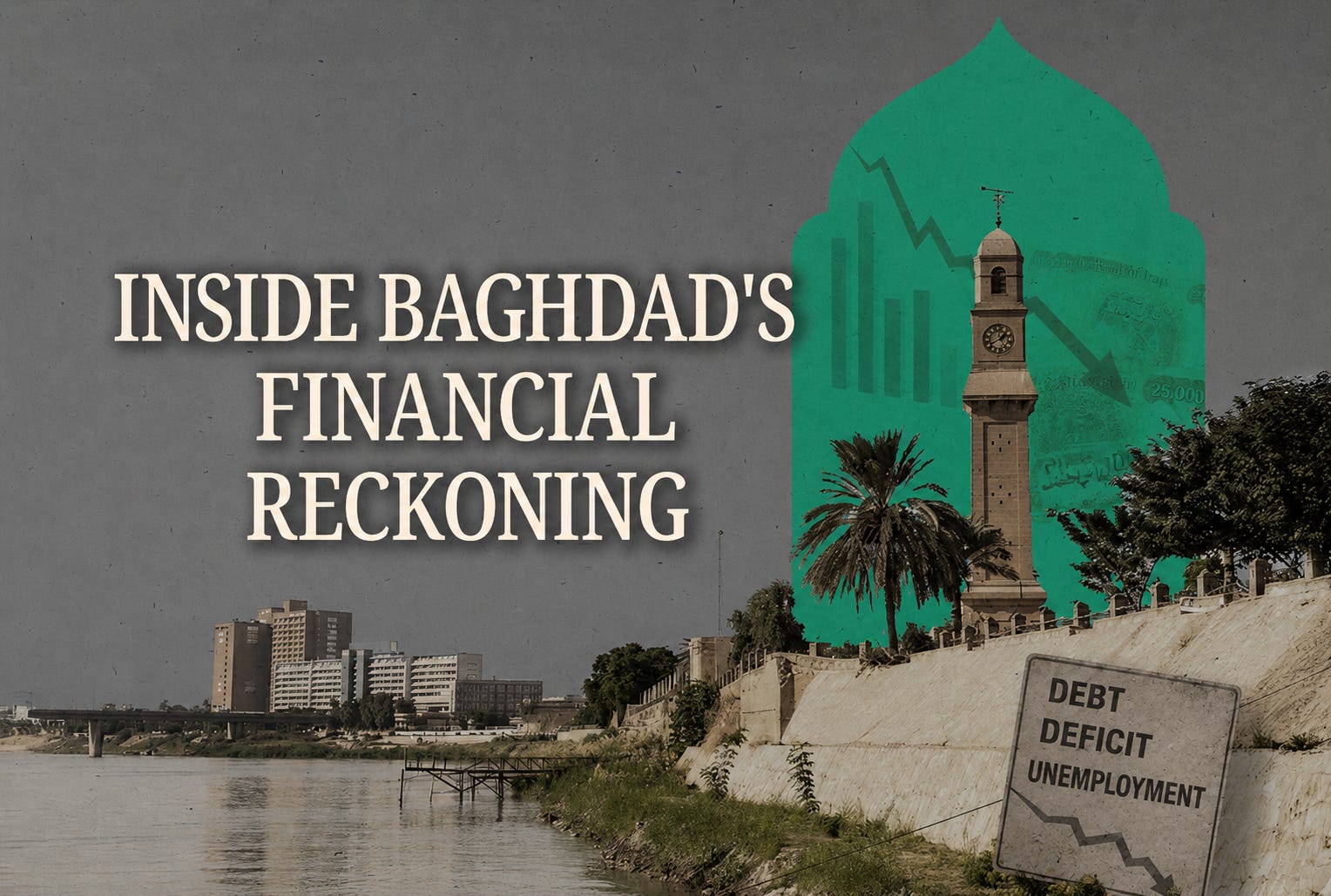
Baghdad International Airport, Iraqi Airways, and some of Iraq’s most valuable state-owned assets have long been considered untouchable. Now, according to accounts from a recent closed-door meeting of Iraq’s ruling Coordination Framework, senior political leaders are debating whether they may need to be sold or transferred as the government confronts one of its most serious financial crises in years.
While international attention remains fixed on the confrontation between Iran, Israel, and the United States, Iraq’s political leadership is trying to solve a problem that has been compounding for years. Liquidity shortages, mounting public debt, American financial pressure, and a rapidly growing workforce are forcing discussions that would have been politically unimaginable only a few years ago.
According to accounts from the meeting, senior figures in the Shiite coalition that supports Prime Minister Ali al-Zaidi spent hours debating the country’s worsening financial position ahead of the prime minister’s expected visit to Washington in July, where economic issues may prove just as consequential as security concerns.
The discussion quickly turned to Iraq’s finances.
Participants described growing concern over debts owed by the Ministry of Finance to local banks and contractors, which have reportedly surpassed 200 trillion Iraqi dinars. Liquidity shortages and mounting obligations have left policymakers searching for ways to reassure both domestic markets and international partners.
The most politically sensitive proposal involved state-owned assets.
According to participants, coalition leaders discussed transferring or selling government holdings—including Baghdad International Airport, Iraqi Airways, and prime state real estate—to strengthen the Central Bank’s position and restore confidence in Iraq’s finances.
Such proposals would be a remarkable departure for a country whose post-2003 economic model has relied heavily on state ownership, oil revenues, and an expansive public sector.
And the urgency extends beyond the government’s balance sheet.
More than one million young Iraqis enter the labor market every year, yet the state can no longer absorb them through public-sector employment. According to discussions at the meeting, unemployment could reach six million people during the current government’s term, raising fears of renewed unrest similar to the protests that swept Iraq in October 2019.
Beyond emergency measures, coalition leaders also debated longer-term structural reforms.
One proposal involved removing three zeros from the Iraqi dinar as part of a broader effort to modernize the banking system and reduce reliance on emergency financial measures.
Another called for the creation of a national development fund with capital ranging from $100 billion to $250 billion. The Central Bank would contribute roughly $10 billion, with additional financing raised through public subscription and outside investment.
Perhaps the most controversial suggestion involved easing scrutiny of contributors’ sources of wealth to encourage money from Iraq’s vast informal economy to enter the formal financial system.
Officials also discussed establishing a dedicated energy fund to expand electricity generation, improve distribution networks, strengthen provincial revenue collection, and accelerate investment in solar power through Central Bank financing programs.
Those domestic pressures have also increased Washington’s leverage.
Internal sources told Middle East Uncovered that participants expressed concern over increasingly direct American warnings that Iraq must stay out of any future confrontation between Iran and Israel and prevent Iran-aligned armed groups from dragging the country into a wider regional conflict.
Washington recently suspended the transfer of a $1 billion cash shipment intended for Iraq’s banking sector following actions by Iran-backed armed groups. Iraqi officials are now seeking to secure the release of the funds, which are considered important for maintaining liquidity in the domestic market.
The U.S. Embassy has also reportedly requested compensation for damages to its facilities, while American oil and security companies operating in the Kurdistan Region have raised similar claims.
The meeting concluded with political backing for al-Zaidi ahead of his Washington visit and a renewed rejection of any discussion of normalization with Israel. Coalition leaders also discussed curbing spending-heavy legislation and advancing a long-term state-building strategy intended to guide government policy over the next two decades.
Taken together, the discussions suggest Iraq’s political leadership increasingly recognizes that the country’s economic model is reaching its limits.
For years, Baghdad relied on oil revenues, an ever-expanding public sector, and emergency financial measures to postpone difficult reforms. Those options are no longer viable options. Policymakers are now debating privatization, monetary reform, and investment mechanisms that would once have been politically untouchable—not because they have embraced economic liberalization, but because the alternatives aren’t working.
Washington’s pressure has accelerated the conversation, but it did not create Iraq’s underlying problems. If Baghdad cannot stabilize its finances and create opportunities for its rapidly growing young population, Iraq risks losing not only its financial stability but also another generation of young people—to unemployment, emigration, and the belief that their future lies elsewhere.
Middle East Uncovered is powered by Ideas Beyond Borders. The views expressed in Middle East Uncovered are those of the authors and do not necessarily reflect the views of Ideas Beyond Borders.
