


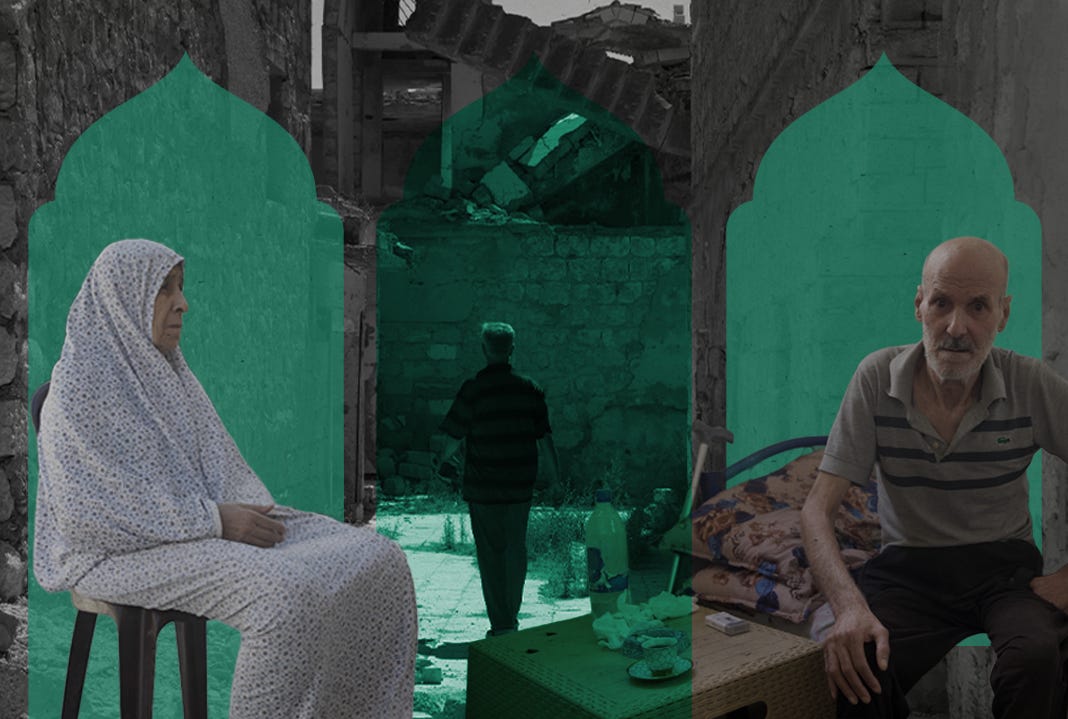
The quiet is striking along the dusty roads of Ein el-Tal (Handarat), an unofficial Palestinian refugee camp near Aleppo once home to an estimated 7,000 to 10,000 people.
From the roof of a building, the scale of destruction is overwhelming. Below, abandoned cars dot the streets, and the occasional passerby is the only sign of life in the ghost town, where returnees live among the hollowed-out shells of buildings.


Perched on a hill 20 minutes northeast of Aleppo—a city scarred by the Syrian war—Handarat is a small community trying to rebuild with what remains after years of fierce fighting between the Syrian government forces and rebel factions.
Inside the camp’s Development Committee building, committee head Ibrahim Abu Hashim outlines a threadbare reality.
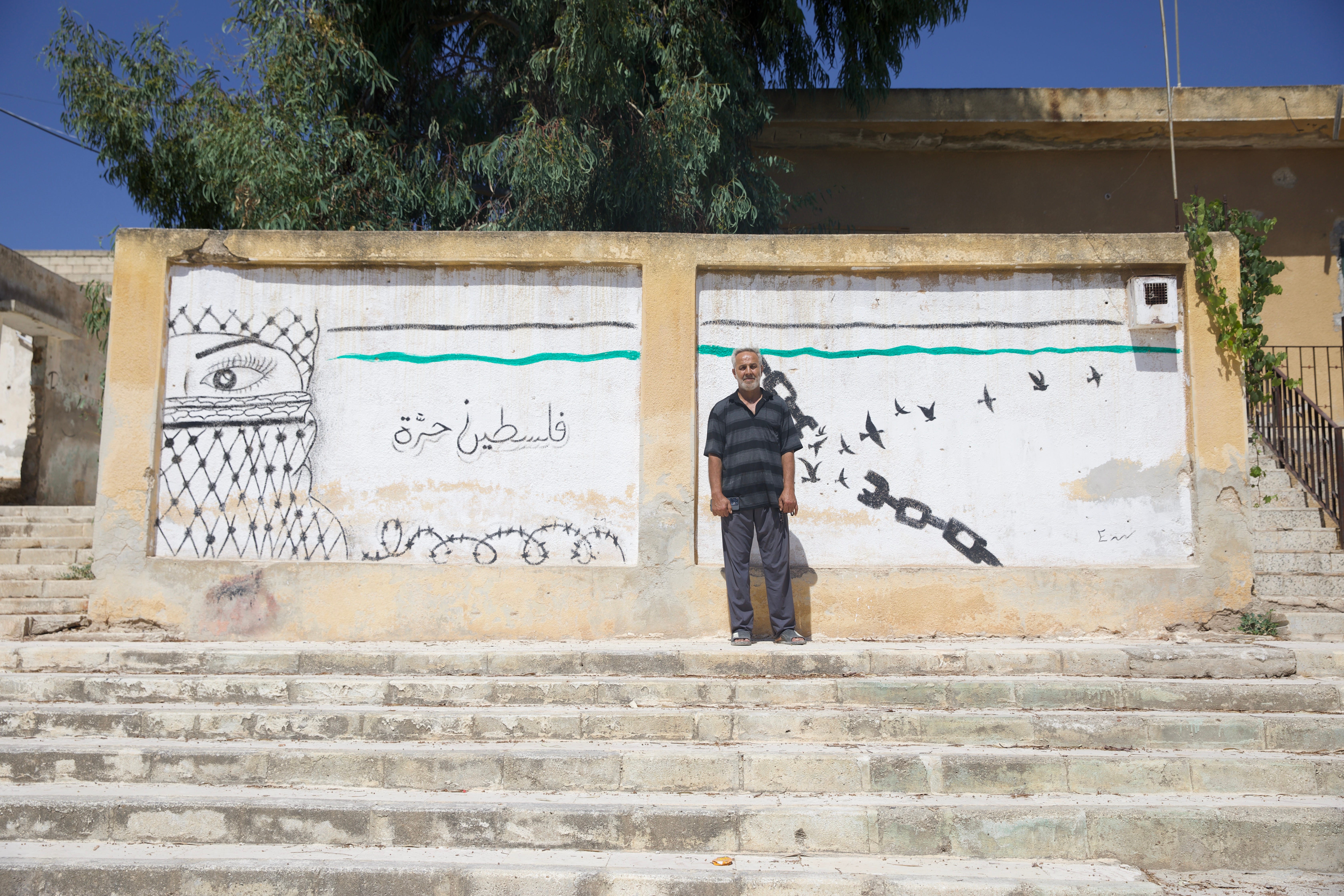
He says essential infrastructure hangs by a thread: the United Nations Relief and Works Agency for Palestine Refugees (UNRWA) and the government provide limited schooling as well as a basic health center. However, 63-year-old volunteer nurse Majed Younis is the first person people call for local medical emergencies.
Damaged water pipes, a broken sewage network, no electricity, and three destroyed bakeries compound daily hardships. Beyond housing, Ibrahim’s immediate priority is clearing rubble and repairing damaged streets.
Though not a rebellion hotspot during the 2011 uprising, insurgents from the Free Syrian Army and Islamist factions seized the camp in 2013, turning it into a frontline given its strategic position overlooking rebel-held districts in eastern Aleppo. Relentless airstrikes by Syrian government forces and their Russian allies turned Handarat into a full-scale battleground, forcing residents to flee. Assad’s regime forces recaptured the camp in 2016.
In 2017, families began trickling back, driven by economic desperation after years of being repeatedly displaced elsewhere in Syria, and pulled back by the longing to reclaim a lost community.
Mohammad Alhawari


Mohammad Alhawari, a 73-year-old Palestinian, shares a two-room house with his family. A former day laborer, he lives with his disabled wife, Ibtisam, 70; his daughter-in-law, Yasmin, 40; and his son and grandchildren. “Our situation was really bad. People helped us financially—we were not able to work anymore because we were old,” he tells me, sitting on the edge of his twin bed, explaining that his wife lost her leg. Of his three sons, only one survived the war; two were killed in airstrikes.
Returning in 2023 to a destroyed house, they started to rebuild from scratch. Yet three years on, conditions are grim. The dimly lit home shelters 11 people—four adults and seven children—crammed into two rooms.
Displacement meant a decade of moving across Aleppo, until funds ran out. “We started to ask people to give us money to build the walls. We only had blankets.” Standing in the bare living space, it is hard to imagine enduring the winter. “We collect plastic from the garbage and burn it. Wood is too expensive.”
Like most of the camp, they lack grid electricity and rely on solar setups, while running water is all but nonexistent. “We have water for two or three hours every ten to fifteen days, and we store as much drinking water as we can,” they tell me.
Healthcare presents another hurdle. Mohammad cannot afford a prosthetic leg for his wife, and UNRWA support is minimal. “If you go to UNRWA sick, they don’t even have paracetamol, aspirin, or simple painkillers.”
Glancing at her mother-in-law, Yasmin notes how difficult routine care has become. “Once she needed a blood test, but with her leg amputated, she suffers, and it’s a struggle to take her there over these broken roads.” Her husband, working in garbage collection, also struggles with injury: “He was hit by a bullet, so his hand no longer works right.”
For daily supplies, residents must make the journey to Aleppo. Many rely on neighbors for rides, while mobile vendors bring bread back at inflated prices. “We only have two markets that sell vegetables in the mountain, and it’s really expensive.” Buying clothes requires another costly trip. “You need to make the decision, either if you want to buy clothes or to eat and survive,” she adds.
Families do what they can to prioritize children’s education, though costs create gaps. Older children attend the local UNRWA school, but Yasmin cannot afford kindergarten for her five-year-old. Agency aid has also shrunk, she says, with UNRWA halting free school supplies this year.
Yet Mohammad still sees UNRWA as a source of hope. “They are the ones to guarantee the right of return to our land,” he says. “We demand that they fulfill their duties. For us, they are the Ministry of Finance, Economy, Health, and Education.”
Asked what gives him the resolve to stay despite the conditions, Mohammad does not hesitate. “The first reason is that this is my house, but our main concern is to go back to our land in Palestine. Our problem won’t be solved unless we go back to our country.”
UNRWA’s funding crisis has made matters worse. In 2024, several donor countries suspended contributions after Israel accused some of the UNRWA staff of involvement in the October 7 attacks. The allegations triggered a financial crisis that severely disrupted the agency’s operations across the region.
Former UNRWA head Philippe Lazzarini projected a $200 million shortfall entering 2026, while acting chief Christian Saunders recently warned of an ongoing $100 million deficit.
For Mohammad, the prospect of Syrian citizenship, as offered to Syrian Kurds, holds little appeal. “We reject any nationality except for the Palestinian,” he says. “We have no choice than our land.”
Thoraya Altayeh
Windows are a precious luxury for those whose walls are barely standing.
For 55-year-old Thoraya Altayeh, glass tops her wishlist before winter sets in. Until she can afford it, her family uses nylon sheeting to shield them from the elements.
She lives with her husband and one of her sons, relying on her husband as their sole provider, working with iron pipes to make ends meet.
Thoraya’s family fled Syria in 2014, taking refuge near the Turkish border. “Those years in displacement were not comfortable; we were homesick,” she recalls. “My husband was a daily worker, and me and my daughter were working in the fields.”
When the regime fell in 2024, they returned immediately. “My son said, ‘Syria is liberated, it’s safe, and we can return to our house.’” Yet walking back through her old streets brought overwhelming grief: “I broke down; I had a mental breakdown. I felt sorry for the whole camp.”
Like many returnees, she was met by the ruins of what used to be her home. Life had to be restored from the debris, but the rebuilding is far from finished. “The camp is dead,” Thoraya says.
She has watched UNRWA’s support dwindle; financial assistance was barely enough to rebuild a single room. Where the agency once distributed food baskets, that aid has now stopped entirely.
Basic provisions require careful budgeting. A single bottle of oil costing 30,000 SYP (roughly $2.20 USD) is a major expense. Donated solar panels offset the grid blackout, but running water comes through only twice weekly—some months pass with none at all. With water so scarce, cooking is difficult, so they often rely on snacks and processed meats.
Her daughter’s health weighs most heavily on the family. The young woman underwent surgery for a digestive condition causing severe abdominal swelling. She is still receiving daily medication to treat it.
Thoraya went into debt for the surgery. Covering ongoing medication is a struggle; much of the support comes from Majed, the local nurse.


As the daughter of a family displaced from Palestine in 1948, Thoraya was born in Syria and holds no personal memories of her homeland. Still, her sense of identity is unwavering. ”We are family with the Syrians, but this is their country. We have nothing here,” she says. “I hope to go back to Palestine.”
Jaydaa Mostafa
A deep sense of belonging drove 44-year-old Jaydaa Mostafa back to Handarat, where neighbors often pull out chairs to sit outside together. “It feels like a little Palestine. Returning felt like going back there,” says Jaydaa, who lives with her extended family.


Fleeing the war in 2013, they moved first into student accommodations in Aleppo and later to a kindergarten shelter in Latakia. When asked about those years, she pauses: “I don’t want to remember.” After ten years of displacement, the 2023 earthquake damaged their rented home, forcing them to return.
“As Palestinians, education is our priority,” Jaydaa emphasizes. Despite tight resources, her eldest son graduated, two daughters attend university, and her youngest attends high school in Aleppo.
Rebuilding has been a slow, collective effort. After initially taking shelter in a caravan, relatives handed over a house that lacked doors and windows for two years. Today, space is tight: her son, his wife, their toddler, and two-month-old baby share a single room.
With Jaydaa’s husband working as a public employee at the water company, the household survives on a meager wage.
Yet she remains grateful for the community around her. “A few days ago we had an event to award prizes to excellent students, and the whole camp took part,” she says. “When we have weddings, we invite each other. And we gather in front of our doors like today.”
Above all, she wants a local high school so camp youth do not have to travel far. When asked what else the camp needs, she smiles bitterly: “Everything. But first, fixing the scene. I would love for our children to leave for school without being affected by the destruction.”
Looking toward the future in Syria, Jaydaa echoes the camp’s collective conviction: “Even when we live with dignity anywhere in the world, it’s nothing like our country. We have faith and hope to go back someday.”
Middle East Uncovered is powered by Ideas Beyond Borders. The views expressed in Middle East Uncovered are those of the authors and do not necessarily reflect the views of Ideas Beyond Borders.

How painful. How painful to read that almost eighty years later, people are dedicating their lives to a fairy tale with an empty promise from an organization like UNWRA. My heart breaks. Dear people, seize the opportunity to build a new life in another country. In fleeing, your ancestors consciously left their homes behind.
UNWRA focused on Gaza and leaves all the rest of the Palestinians scattered around to fend for themselves.