


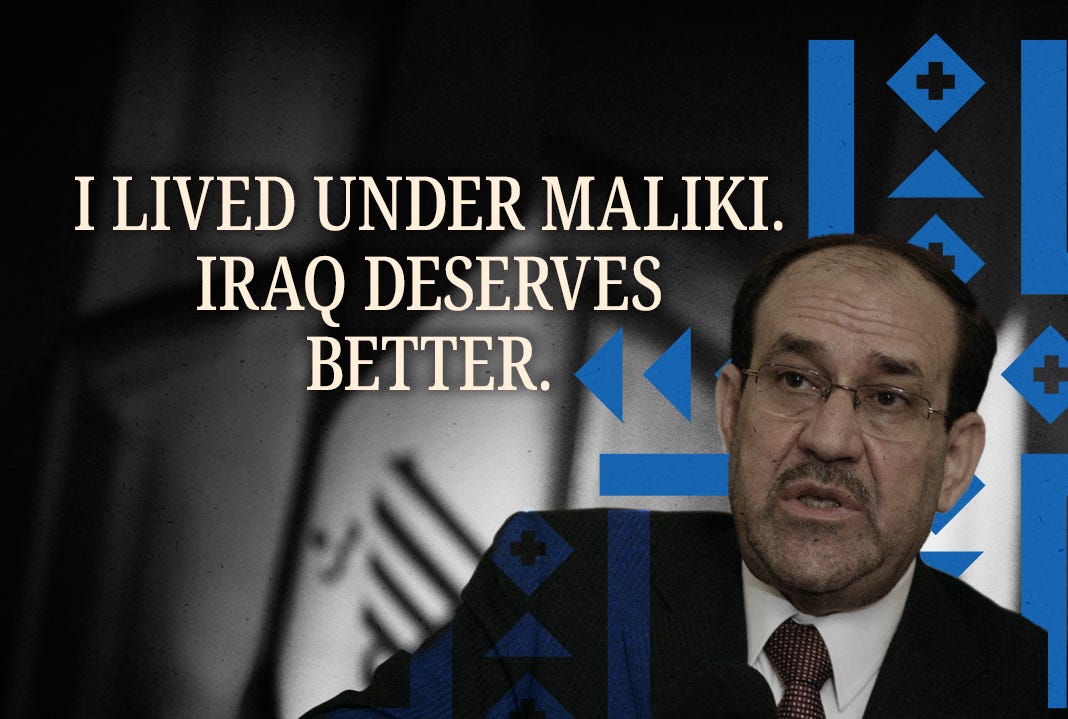
Nouri al-Maliki already had his chance. He governed Iraq from 2006 to 2014, when the country desperately needed reconciliation, institutional rebuilding, and national leadership. What he delivered instead was sectarian consolidation, institutional decay, and a slow but unmistakable slide toward state failure.
Rather than govern as a leader tasked with rebuilding a country after years of conflict, he governed like someone who believed the state belonged to him.
I lived in Iraq during the most formative and violent years of Maliki’s rule, from 2006 to 2009. I watched his model of governance play out in real life. Neighborhoods grew fearful and divided. Public institutions became empty shells, loyal to sectarian interests rather than the people. Slowly, Iraqis came to understand that the promise of a shared future was being stolen from them.
From the beginning, Maliki ruled through a sectarian lens. His party, Da‘wa, believed Shi‘a dominance in politics was not only justified but long overdue. In this view, Iraq was not a shared national project after dictatorship, but a prize finally taken. That mindset defined his two terms and explains much of the damage that followed.
Emma Sky, who worked closely with Iraqi and U.S. leadership throughout this period, offered one of the clearest insider assessments of Maliki’s rule. She wrote that the United States “took the risky gamble of betting on Nouri al-Maliki,” believing he would use the post-surge decline in violence to build a sovereign and democratic Iraq. Instead, Maliki used that moment to centralize authority, bypass parliament, weaken independent institutions, and place the security forces under his personal control.
The consequences were profound. Maliki’s Iraq became increasingly polarized, not only between Sunni and Shi‘a, but within the Shi‘a community itself. Many Shi‘a Iraqis who suffered under Saddam saw fear and exclusion return in a new form. Under Maliki, loyalty mattered more than competence, institutions mattered less than proximity to power, and politics was consumed by identity struggles.
Patrick Cockburn documented how, after the 2010 elections, Maliki deliberately abandoned reconciliation efforts. Peaceful Sunni protests that began in 2012 were met with repression, mass arrests, and lethal force. The Hawija massacre was the logical outcome of a system that treated dissent as treason. Cockburn was explicit that Maliki “played a central role in pushing the Sunni community into the arms of ISIS,” contributing to the violent escalation of political grievances.
This is where the claim that Maliki offered stability falls apart. His “experience” should render him wholly unqualified to hold office in Iraq ever again.
ISIS emerged in Maliki’s Iraq, during Maliki’s second term, within a political environment he shaped. His defenders often portray ISIS as an external invader or an unavoidable regional spillover, but the historical record suggests otherwise. Extremism flourished because the Iraqi state lost legitimacy.
The most damning verdict on Maliki’s rule came in June 2014, when the Iraqi army was defeated by ISIS in Mosul. Cockburn describes a force of hundreds of thousands that “melted away without significant resistance,” abandoning cities, weapons, and uniforms almost overnight.
The blame doesn’t lie with the Iraqi soldiers, but in the breakdown of a government weakened by corruption, political interference, and sectarian loyalty imposed from above.
Maliki’s response made things worse. Instead of rebuilding national institutions or pursuing reconciliation, he leaned further into militia politics. The government increasingly relied on Shi‘a militias—many closely tied to Iran—to defend Baghdad. Sectarian death squads returned, and bodies started appearing overnight. Iraq found itself slipping back toward the chaos we had barely survived years earlier.
All of this is the direct legacy of Maliki’s years in power.
So when Maliki is presented today as an experienced statesman or a stabilizing figure, the question must be asked plainly: experienced at what, and stabilizing for whom? Iraq already tested his model of governance. The result was a country torn apart, its institutions drained of strength, and the rise of the most dangerous extremist movement in modern Iraqi history.
Can the United States prevent Maliki’s return? Not entirely. Washington retains influence, but Iraqi politics ultimately belong to Iraqis. What has changed is the tone of the discussion. American preferences are now stated more openly, while Iran continues to intervene with little subtlety, backing figures aligned with its agenda through political and militia networks.
In today’s climate of U.S.–Iran confrontation, Iraq has a choice to make. Bringing back Maliki would not signal balance or sovereignty, and would risk alienating key Western partners and further entrenching Iraq’s dependence on militias and external patrons.
Iraq’s survival after 2014 depended not only on battlefield support but on sustained international political and economic engagement. That engagement was premised on the expectation that Iraq would move beyond sectarian capture of the state, not return to the man most associated with it.
Iraq does not need to relive the years that brought it to the brink, and it doesn’t need a leader whose record is defined by empty barracks, shattered trust, and cities that fell without a fight.
The consequences of ignoring these lessons would be immediate, destabilizing, and costly. History has already delivered its verdict: Maliki is unfit to hold office.
Middle East Uncovered is powered by Ideas Beyond Borders. The views expressed in Middle East Uncovered are those of the authors and do not necessarily reflect the views of Ideas Beyond Borders.
Absolutely. Iraq deserves much better than this.
Wow, I didn't know this. Leaders matter.