


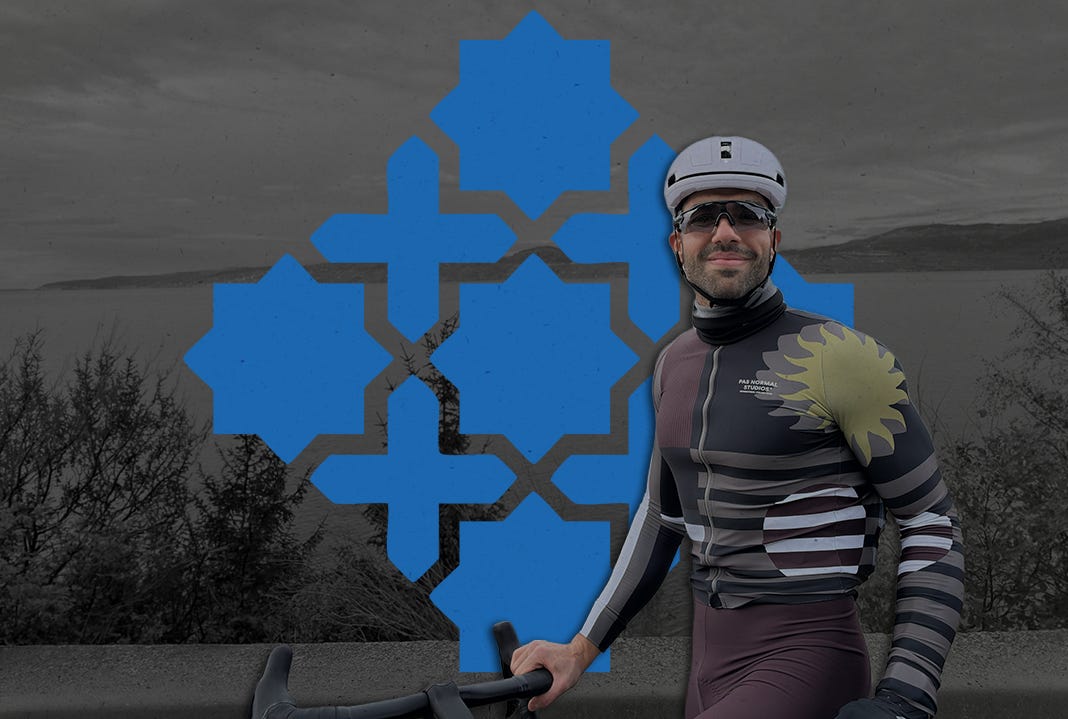
I was eleven when war forced my family to flee from Aleppo to Idlib. My father said we could not take everything. My red bicycle was supposed to stay behind. I protested until they agreed to bring it: my first small act of revolution, inside my own family.
During displacement, I rode it to work in the olive fields and to collect firewood for heating. So much of our lives was decided for us. Pedaling gave me brief moments of freedom.
Those moments were precious, especially as the war brought more suffering to my family. In 2012, regime forces burned our village. That same year, my mother was severely injured in military attacks by the Assad regime. Afterward, my brothers, Ghiyath and Abdo, defected from the army, where they had been serving their compulsory military service.
Ghiyath was so desperate to escape the army that he shot himself in the foot, hoping the injury would get him sent to a hospital where he could make his escape. He managed to flee, but was later kidnapped by a militia and held for ransom. At thirteen, alongside my injured mother, I found myself leading my first negotiation, trying to secure his release. My father was seriously ill, and we were living under intermittent siege, with little food and unreliable communications. After about four months, we brought Ghiyath home.
My other brother, Abdo, was arrested while trying to defect. He endured detention and torture before his release in 2013. In 2018, both he and his wife died by suicide.
My father also suffered because of my brothers’ defections. On his way to the hospital, he was stopped at a regime checkpoint. When soldiers learned that his sons had defected, they detained and tortured him. He spent two weeks in hospital afterward, and I stayed with him. I will never forget the early morning he died, with Fairuz’s “Nights of the Sad North” playing in the background. Her songs often played in the mornings, but that day as I mourned, the words took on a painful new meaning. Our village was in the far north of Syria, and I had just lost my father. The word “north” has since followed me even to Canada, in North America.
After my father’s death, I found myself questioning everything that had happened to my family and what was happening around us. At sixteen, I became involved in political, humanitarian, and human rights activism. By 2016, jihadist groups were tightening their control over northwest Syria. Speaking out about human rights could cost you your life, but I refused to stay silent. I had lost so much that I felt I had nothing left to lose.
My activism made me a target. Extremists kidnapped and tortured me so severely that I ended up in intensive care, in a coma.
After my release, I became even more outspoken, but also more deliberate in how I challenged extremism. I learned to make arguments that people might actually listen to. Drawing on Islam itself, I tried to persuade my school friends not to join extremist groups. Many already had.
By 2018, my advocacy had taken me to international conferences and diplomatic briefings. As one of the few English speakers in our isolated region, I could bring our experiences to audiences beyond Syria. That same year, extremists kidnapped and tortured me again.
Despite the risks, I continued my work. I founded the Guardians of Equality Movement, one of Syria’s first LGBTQIA+ organizations. But when extremists issued an execution order against me in 2020, I had no choice but to flee. I escaped on foot through the mountains, a journey that took an entire week.
Since leaving Syria, I’ve continued working in public affairs and diplomacy, focusing on democracy, human rights, and humanitarian issues. After the fall of the Assad regime, I also founded the Tukhum Institute, which works on public diplomacy and policy.
My experiences in Syria continue to shape my work and what I ask of the world. But finding safety has also given me something I didn’t have for much of my childhood: the freedom to enjoy life and pursue my own interests.
I’m an amateur endurance cyclist and runner, and I love baking sourdough. Increasingly, these interests have become part of my advocacy, offering new ways to connect with people over the causes I care about.
On October 11, my latest peace ride took me 175.65 kilometers around Lake Geneva. I rode in peace for those who do not have it. Two days later, I spoke at the Geneva Peace Forum. My speech, The Red Bicycle: Pedaling Toward Peace, connected that ride to my childhood in Syria.
I had taken a similar idea onto the road before. On October 24, 2025, I cycled from Larnaca to Limassol in Cyprus, with the Mediterranean on my left. Across that water lay Lebanon, Syria and Israel, a region consumed by violence. Peace felt both near and distant, fragile yet possible. Cyprus reminded me that peace could be real, and that it could begin close to home.


October has long carried painful memories across our region. More recently, the massacres of October 7, the war in Gaza, and the wider regional violence have added to them. Both rides were ways of remembering those who have suffered through these conflicts.
I’ve also found ways to bring sport into my advocacy trips. I’ve run with colleagues at the Athens Democracy Forum and made time for runs during Dignity Network’s international roundtable on Canadian foreign policy and LGBTQIA+ issues, as well as the Ottawa Civic Space Summit. More recently, I ran at the Palais des Nations in Geneva while doing advocacy work at the United Nations. I share these moments alongside the meetings and discussions because friendship, humor, and a morning run are part of the experience too.
“Let’s make democracy fun again.”
That’s what a colleague at the Axel Springer Freedom Foundation, where I belong to the Young Leaders Network, said when I told her how I had been bringing sport and everyday interests into my advocacy. She had put words to something I was already trying to do.
There is plenty to care about, but also plenty to exhaust us. Another crisis, another bleak statistic, another urgent appeal. Even people who care deeply about the Middle East can grow tired of being asked to carry the weight of the world.
I’ve come to believe that a bike ride, a run, or something shared around a kitchen table can offer another way into these conversations. People might come for something they enjoy and become curious about a cause along the way. Someone might notice a cycling challenge before reading about its purpose. A conversation during a run might lead to questions neither person would have raised across a conference table.
The lives we are trying to protect need room for friendships, interests, and small pleasures. I want those things to be visible in my advocacy. People should feel welcome in conversations about public affairs before they know all the terminology. Diplomacy also depends on people finding ways to listen to one another, and shared interests can give us somewhere to begin.
I will keep exploring these possibilities through sport, everyday interests, and social media. There are many ways to invite people to care, and I hope to reach those who might otherwise feel disconnected from conversations about democracy and human rights.
My father’s death and the losses my family has endured still demand truth and accountability. Those commitments travel with me. So does the child who once found freedom on a red bicycle.
I rode in peace for those who do not have it. I hope this is one of many ways to invite people to care.
You might also be interested in:
LGBT Syrians Are Being Hunted By Their Neighbors

This article was originally published in Queer Majority.
Middle East Uncovered is powered by Ideas Beyond Borders. The views expressed in Middle East Uncovered are those of the authors and do not necessarily reflect the views of Ideas Beyond Borders.

"Lets make democracy fun again"
Democracy, properly understood, means mob rule, a dictatorship of a majority ver a minority--and the smallest minority on Earth is the individual.
Such naivete, such ignorance about democracy is indefensible and dangerous.