

How Mahmoud Ahmadinejad Went from Holocaust Denier to Alleged Mossad Asset
The explosive allegations, if true, would reveal one of the most audacious intelligence operations in recent Middle Eastern history—and a strategy aimed at shaping Iran's future from within.

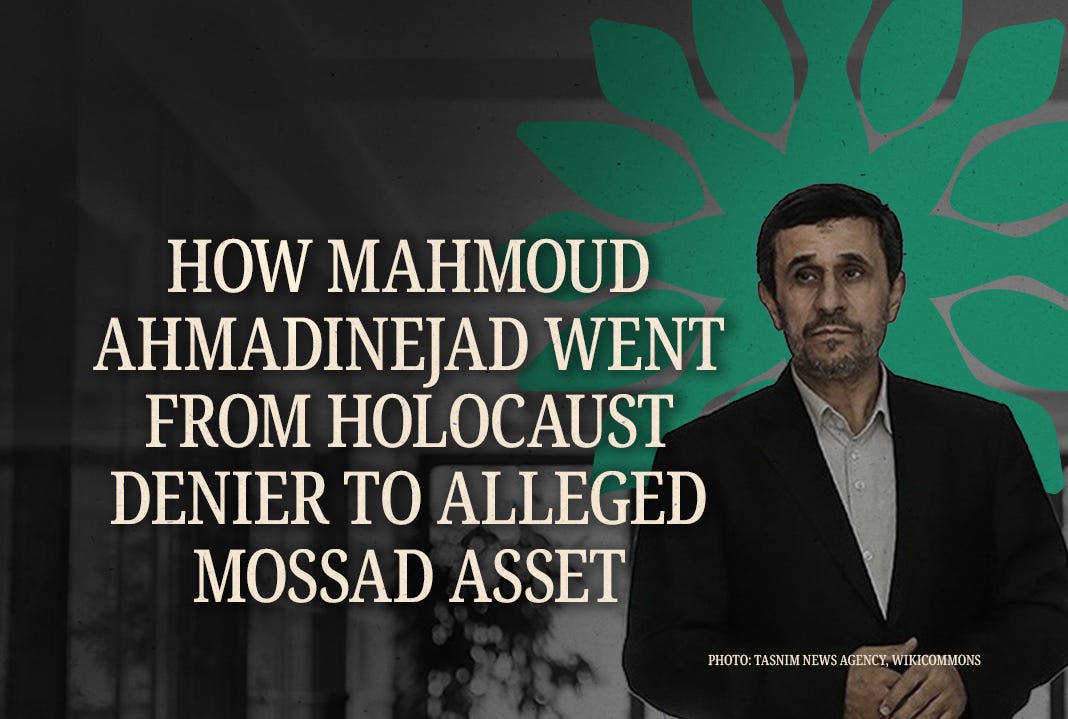
Nearly 20 years ago, a group of Holocaust deniers and anti-Israel activists were invited to Iran to support Mahmoud Ahmadinejad’s supposition that the murder of six million Jews in Europe was a “myth.”
The anti-Zionist hardliner, then president of Iran, also called for Israel to be wiped off the map.
An unlikely candidate, one might think, to become a spy for a country the Islamic Republic has consistently labeled “Little Satan.”
And yet, if reports are to be believed, Ahmadinejad was allegedly groomed and recruited as an intelligence asset by Mossad, which even considered him for a role leading Iran if the Islamic Republic was toppled.
According to a report in The New York Times (NYT), Israel’s most feared intelligence service sent its top spy to Budapest to meet with the anti-Zionist former president. The mission continued even after Israel’s devastating war in Gaza against Hamas after October 7.
The terrorist group has received millions of dollars in funding from its staunch ally, the Islamic Republic of Iran.
It may read like a far-fetched Hollywood movie plot. That’s certainly the line Ahmadinejad’s office is putting out there, which has dismissed the “Hollywood-style claims” that were “not worthy of denial,” before accusing the NYT of publishing “fabricated” material.
The paper also reported that Ahmadinejad is now under house arrest after Iranian authorities uncovered much of his alleged interaction with Israel. His office denies this.
For those who have followed Ahmadinejad’s career after he left office in 2013, the decisions that may have led him down this path are not so incredulous.
“Mahmoud Ahmadinejad has been ostracized out of the political sphere. And his ambitions remain unfulfilled. This motivation could be manipulated to get him on board with Mossad’s tasking. Israel gets control of domestic politics in Iran, and Ahmadinejad gets his old job back, something he believes he deserves,” says Jonathan Hackett, a US Marine Corps veteran specializing in counterintelligence and the author of Iran’s Shadow Weapons: Covert Action, Intelligence Operations, and Unconventional Warfare.
Such an operation is “High-risk, low probability of success,” one which most states would not undertake. But, Hackett goes on to say, “Mossad has an interest in influencing and directing Iran’s domestic politics. If Mahmood Ahmadinejad can achieve this for them, it would make sense.”
Ahmadinejad rose to power with the direct backing of Ayatollah Ali Khamenei, serving as Iran’s president from 2005 to 2013.
He soon became one of the Islamic Republic’s most recognizable figures—not only down to his appalling views on the holocaust, but the violent crackdown that followed his disputed “landslide” re-election in 2009.
Many Iranians believed he didn’t win the election fairly, leading to mass protests on the streets, which became known as the Green Movement.
But it was Ahmadinejad’s relationship with the ruling establishment that was a bigger thorn in his side. The regime which brought him to power steadily deteriorated, and he was repeatedly barred from returning to the presidential race. That frustration would have turned into anger towards the regime, making him easy fodder for recruitment.
“Whilst he is not the most desirable asset from a handling perspective, the placement and access he has may outweigh the costs of difficult handling,” said Hackett, when asked why Mossad would recruit him.
In recent years, Ahmadinejad became a critic of the Islamic Republic, accusing senior officials of corruption and poor governance. His views became more moderate, and he worked on improving his English and getting a makeover. He trimmed his beard and reportedly had Botox.
Iranian-born historian Dr. Arash Azizi recalled arranging an interview between Ahmadinejad and an Israeli journalist, claiming that the former president repeatedly expressed an interest in discussing Jewish history and Israel.
“He seemed to be open to normalization with Israel,” Dr. Azizi told Iran International, a Persian-language satellite channel based in London.
It’s not clear when Israeli intelligence first approached the former president, but the NYT reported that the Islamic Republic traced at least some of Ahmadinejad’s contacts with Israeli intelligence to a 2023 trip to Guatemala.
According to the newspaper, David Barnea—then head of the Mossad—also traveled to Hungary to meet Ahmadinejad, after he had been invited to speak at Ludovika University at a climate conference the year before.
The story was corroborated in the left-wing Israeli newspaper Haaretz, which suggested that the former Mossad director even skipped a security consultation about Gaza with Israeli Prime Minister Benjamin Netanyahu to focus on Ahmadinejad.
Israeli officials reportedly paid him for housing and travel, with Mossad operatives meeting him several times.
Naturally, Ahmadinejad’s behavior started to arouse the Iranian regime’s suspicions. He twice slipped his security detail during a 2025 trip to Budapest—shortly before that summer’s 12-day war between Israel and the US—and confronted him about his disappearances.
The operation reached its most dramatic moment on February 28, according to the NYT, when the US and Israel began military strikes against Iran, killing several Iranian figures including Ayatollah Khamenei.
An Israeli strike also hit Ahmadinejad’s compound, targeting a building used by his bodyguards. But the former president, according to the NYT, had been driven away by four Mossad agents, who then kept him at a safe house in Tehran.
Ahmadinejad had not been seen in public for months, sparking widespread speculation. But then he appeared among mourners at Khamenei’s funeral in July. In video footage, Ahmadinejad looked weary but raised a hand, perhaps to reassure someone off-camera, before nodding and smiling.
If the regime thought there was any truth to the spying allegations, why would he be seen at such a high-profile event?
“The regime is very weak and fractured,” Hackett explains. “They may be prioritizing the show of a unified front in the face of adversity for the time being. This does not mean Ahmadinejad is eternally safe. This is probably a temporary situation. The major figures both present and absent from the funeral were likely chosen deliberately, so having him there was a choice.”
So why reveal this alleged relationship now?
Such details would only have been released by Israel if there were compelling narrative benefits to doing so, according to an intelligence source. It would signal Mossad’s ability to recruit and handle agents who previously operated at the highest levels of a hostile state’s government.
Even then, exposing an alleged agent would carry enormous risks. Perhaps Ahmadinejad became troublesome or threatened Israeli interests.
If these details were authorized for publication, it suggests Israeli officials believed the strategic benefits of the disclosure outweighed the operational cost.
Unless Mahmood Ahmadinejad speaks out, we may never know whether any of it is true. However, if the allegations are accurate, they point to a far broader objective than simply removing Iran’s leadership.
Hackett concludes: “Despite rhetoric to the contrary, Israel is not so much interested in regime change in Iran, as it is in regime control.”
Middle East Uncovered is powered by Ideas Beyond Borders. The views expressed in Middle East Uncovered are those of the authors and do not necessarily reflect the views of Ideas Beyond Borders.