


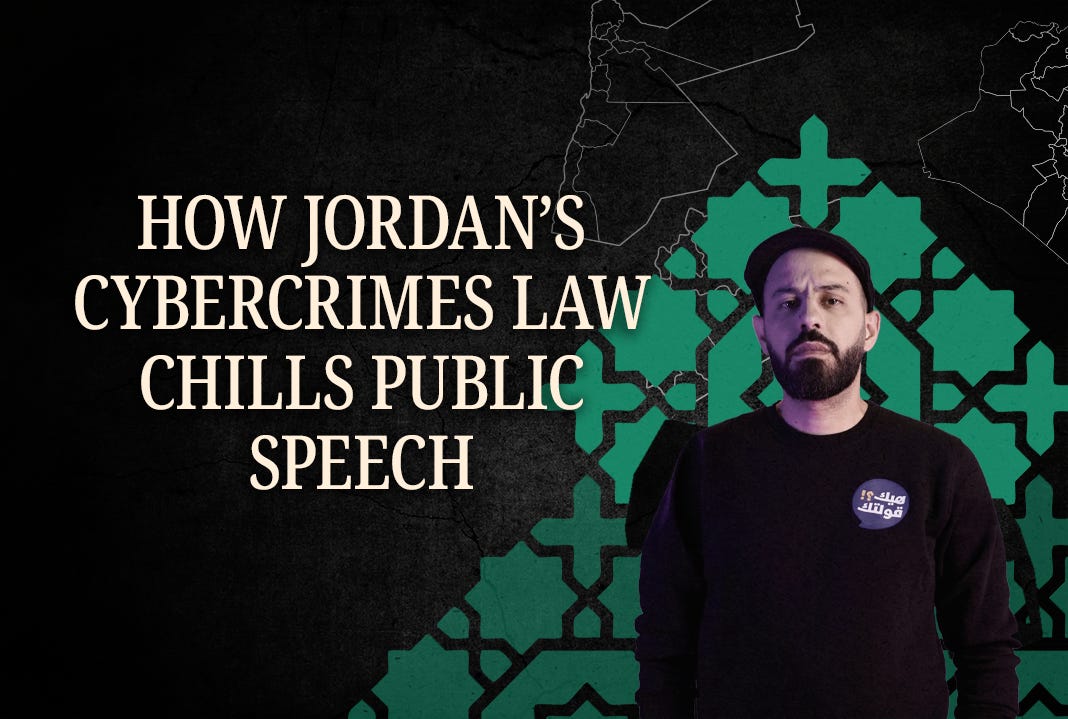
Something has changed on the streets of Amman. When our team at ShezoMedia approaches people for a street interview, the most common reaction is no longer curiosity or engagement, but retreat. People turn away, change direction, offer a brief apologetic smile, or hastily walk away without explanation. This has become a daily pattern that increasingly obstructs our work.
I host Hayk Qoltak (“You Think So?”) and serve as its editor-in-chief. The program does not deal in trivia or entertainment; instead, it opens conversations about social, political, economic, and human-rights issues that directly shape people’s lives. Yet today, refusal—often wordless and abrupt—has become the dominant response.
This was not always the case. For four years, Hayk Qoltak has documented public opinion on political, rights-related, and economic developments in Jordan and the region. The program has reached approximately 70 million views, becoming a rare public platform where people speak honestly in their own words rather than through official narratives.
In its early years, the dynamic was strikingly different. People approached the camera voluntarily, competed to participate, and asserted their right to express opinions—often critical or dissenting—without hesitation.
Between 2022 and 2025, that openness eroded. Today, the challenge is to find people who believe they can safely express themselves. For street crews, every interaction requires reassurance, patience, and an implicit acknowledgment of risk before any journalistic work can begin. This reality weighs not only on participants but on the teams themselves, who confront this daily.
The contrast became most evident when Hayk Qoltak was filmed outside Jordan. In countries experiencing prolonged instability and political violence—such as Syria, Iraq, and Lebanon—people were often more willing to speak openly on camera, even in the presence of clear and immediate security risks. Their willingness to speak under far harsher conditions only deepened the unease we felt back in Jordan, where hesitation has become routine despite the country’s relative stability.
Our team is now being forced to ask a critical question: how does the fear of expressing an opinion become more entrenched in a country defined by institutional stability than in societies living through obvious crises?
In Jordan, people are not typically confronted with visible security crackdowns, mass arrests, or overt suppression of dissent in public spaces. Even so, many approach public expression with caution, influenced more by the current legal framework governing speech than by what happens in the street.
The newly adopted Cybercrimes Law has become one of the most influential forces shaping public behavior. Its impact lies not only in enforcement but also in the expansive, ambiguous nature of its language. Provisions addressing hate speech, defamation, and “false news”—particularly those related to “contempt of religions” or “threatening societal peace”—are drafted in broad terms that collapse the distinction between genuine incitement and legitimate critique.
Article 17, for example, criminalizes publishing content that may “stir sedition or sectarian tensions,” “incite hatred or violence,” or “show contempt for religions and religious beliefs,” without providing precise legal definitions. This vagueness allows wide interpretive discretion, enabling sensitive public discussion or critical opinion to be retrospectively reframed as a criminal offense. In this environment, many people are choosing to withhold their opinions rather than risk crossing an unclear legal line.
This shift has affected not only the public but also media workers. Journalists and content creators have always operated with a degree of editorial caution. In recent years, however, that caution has taken on a different character. Editorial decisions are now made with an acute awareness of legal ambiguity, public reporting mechanisms, and informal social monitoring. The assumption that any statement may later be scrutinized or reinterpreted has become part of the work itself, shaping choices long before publication.
As legal boundaries remain unclear, many people, both inside and outside the media, opt for restraint. Speaking publicly is increasingly weighed against potential legal exposure, including pretrial detention and heavy financial penalties. In practice, the law functions less as a set of defined rules than as a deterrent, influencing behavior before it even occurs.
Although there are no Jordan-specific studies that directly measure the economic impact of declining freedom of expression, a substantial body of international research points to a consistent connection between open information environments and economic confidence. Studies by institutions such as the World Bank and the OECD link restrictions on media and expression to lower transparency, greater uncertainty, and increased investor risk. Where information circulates unevenly or under constraint, accountability weakens, public policy suffers, and confidence among economic actors declines.
In this context, freedom of expression is not an abstract principle. It underpins transparency, access to information, and public accountability—conditions that shape economic stability and long-term growth. When expression is stifled or discouraged, trust in information becomes harder to maintain, uncertainty increases, and foreign investment decreases.
Responsibility for addressing this reality ultimately rests with the legislative authority.
Jordan’s current parliament—the 20th House of Representatives, elected in September 2024—has been in office for roughly 18 months. Despite sustained criticism of the Cybercrimes Law from rights groups and legal experts, no formal amendment bill has been introduced. Reform of the law was part of the campaign platforms of several MPs, yet these commitments have not translated into legislative action. Parliamentary engagement has largely been limited to individual statements, while neither the Legal Committee nor the Rights and Freedoms Committee has launched a comprehensive review of the law’s most contested provisions or announced a clear timeline for reform. As a result, the law remains in force without substantive parliamentary oversight of its impact on public life.
The legal framework has remained unchanged, and public behavior has adjusted accordingly.
International assessments reflect this trend. Over the past four years, Reporters Without Borders has consistently described press freedom in Jordan as “difficult” to “very difficult,” while Freedom House classifies the country as “Not Free.”
What is unfolding in Jordan is a calculated response to legal uncertainty and perceived risk. In such an environment, speaking publicly carries consequences that many people are unwilling—or unable—to absorb.
This moment should concern anyone who cares about Jordan’s future. A society does not lose its voice overnight; it learns, slowly and rationally, to self-censor. When people calculate risk before speaking, journalists hesitate before publishing, and laws rely on ambiguity rather than clarity, it marks a point at which freedom of expression can no longer be taken for granted. How Jordanians—lawmakers, institutions, media workers, and the public—respond to this moment will shape not only the boundaries of speech, but the kind of public life the country sustains in the years ahead.
Hayk Qoltak is produced in partnership with Bayt al-Hikma (House of Wisdom 2.0), a program of Ideas Beyond Borders.
Middle East Uncovered is powered by Ideas Beyond Borders. The views expressed in Middle East Uncovered are those of the authors and do not necessarily reflect the views of Ideas Beyond Borders.

You’re being too kind to the regime in Jordan portraying the issue as one in need of legislative intervention.
The regime is blatantly repressive from it’s inception in the 1920’s.
There is a great divide between the ruler and the ruled and aspirations do not meet. The creation of the Zionist state necessitated the creation of a reciprocal body to rule over and contain the nearly one million refugees coming from Palestine in 1948 and to keep the eastern boarder of the Zionist state safe.
The philosophical foundation of Jordan is built on repressive measures.
Ergo, zebra cannot change its stripes.