


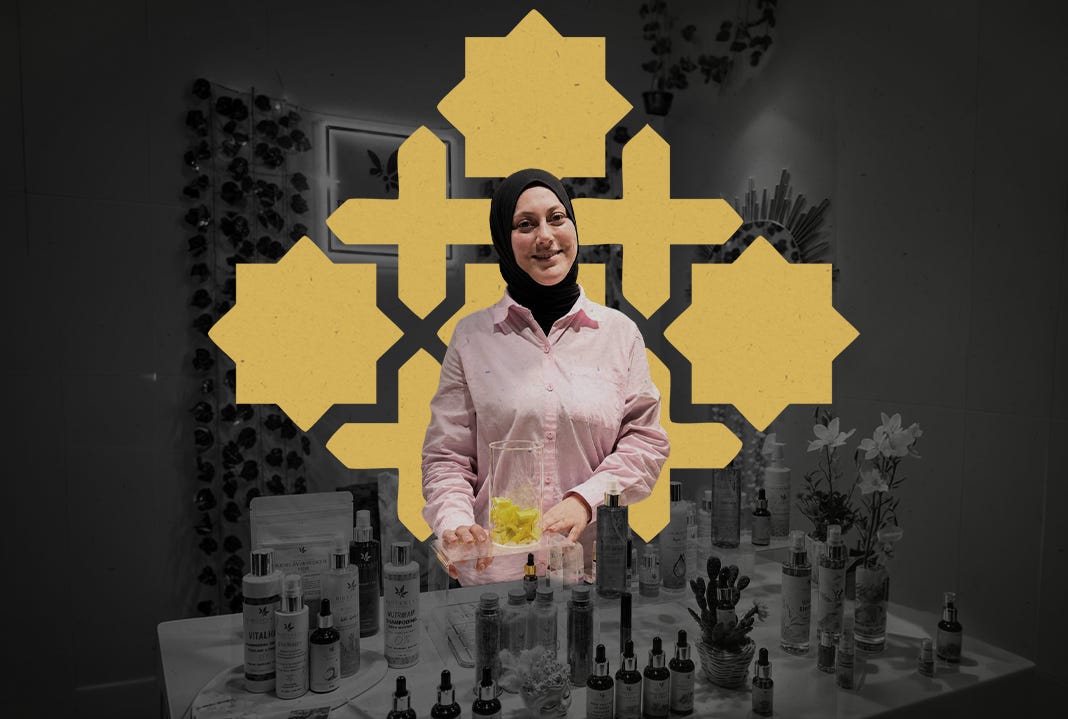
The multiple sclerosis (MS) diagnosis came as Nesrine Abdellatif was completing her undergraduate degree in fine chemistry. By cruel coincidence, her final-year thesis focused on validating a dosage technique for interferon beta-1a, a treatment used for the disease, which can cause extreme fatigue, coordination issues, and muscle spasms, among other symptoms. Now Abdellatif was experiencing it firsthand.
“It was a deep shock, all the more so because the treatment, which I followed for a year, didn’t work for me,” she says. Months of agonizing muscle pain and other side effects made it difficult to focus on her studies, and she feared the future she had planned was slipping away.
But her doctor refused to switch medications, warning that she risked losing mobility if she changed treatments. Determined to reclaim her life, she stopped anyway. The pain eased, and she completed her master’s degree in industrial chemistry, graduating in 2019.
Armed with academic qualifications, Abdellatif revived her dream of building a cosmetics company that harnesses the healing power of local plants. Convinced that the country’s flora and fauna harbor untapped potential, she planned to create a homegrown brand uniting the wisdom of traditional remedies with rigorous scientific research.
“Tunisia has an asset that many people underestimate,” she says, pointing to the country’s rich biodiversity, backed by a long tradition of distillation and extraction. While some species, including neroli and Damask rose, are sought after by beauty brands worldwide, Abdellatif believes many of the country’s best skincare secrets remain undisclosed.
Lentisk is a small evergreen tree or shrub that thrives in dry, rocky conditions. Its berries have been used for generations in traditional Mediterranean medicine, cold-pressed into an oil that soothes inflamed skin. But despite its remarkable healing properties, Lentisk remains little known overseas. “That’s exactly the kind of ingredient I want to introduce as more than a local curiosity,” she says.
Prickly pear seeds, meanwhile, produce an extremely valuable oil that’s highly prized locally for its antioxidant and moisturizing qualities. The prickly pear cactus is widely grown across Tunisia, but a lack of evidence-backed research on its oil in skincare dampens demand abroad.
“My ambition is to valorize these ingredients through scientific research, so they’re recognized for proven efficacy, not just history. I’m convinced the next generation of iconic natural cosmetics ingredients can come from Tunisia,” Abdellatif says.
But health issues once again pushed her dreams out of reach. In 2021, the COVID-19 crisis struck, and she found herself working as a cashier in a local supermarket. Then her mother was diagnosed with lymphatic cancer, and Abdellatif nursed her through illness while supporting the rest of the family, including her younger brother, who has an intellectual disability. “I felt caught in a tangle of hardship and responsibility,” she says.
At the same time, she quietly questioned some of the skincare products they used daily. “I asked myself why certain controversial ingredients, like endocrine disruptors, were still so widely used,” she says. “I don’t claim that cosmetics caused these illnesses, but these experiences made me deeply aware of the importance of making safer, more transparent, and more health-conscious choices.”
In April 2022, she experienced another MS flare-up and was referred to a different neurologist. This time, a change in treatment allowed her to regain her health after a few months. But now, her outlook on the beauty industry had changed. It was not enough to incorporate Tunisian plants into skincare products; the entire formula needed to reflect her belief that “beauty should never come at the expense of health.”
She spent the next two and a half years carving out a new direction for the cosmetics farm she dreamed of as a student. In October 2024, she was ready to launch. Abdellatif’s cosmetics brand, BiotyNess, would draw on her scientific background to subvert standard skincare production. “You never start from the aesthetic result and work backward to the formula. You start from the raw material.”
Two years later, BiotyNess offers 25 products that harness plants native to the Tunisian countryside. Some of the ingredients, like Damask rose and neroli, are familiar, while prickly pear seed oil and rosemary are less widely known, but all are subject to her rigorous research.
This involves digging into the composition of potential ingredients, examining their stability and testing their behavior before making a final selection. The choice is methodical rather than aesthetic, with the same scrutiny applied to the distillation, extraction, and formulation of the final product. “That scientific discipline applied to Tunisian terroir is, I believe, what sets our approach apart,” Abdellatif says.
Her ambition goes beyond cutting potentially harmful chemicals out of cosmetics. She wants to help build a transparent, conscious local industry where consumers understand the products they put on their skin and know where the ingredients come from. “To me, taking care of your skin is also taking care of yourself,” she adds.
She also believes customers deserve proof that natural products are not just marketing claims. Her plan to provide digital traceability for BiotyNess products means that a quick scan will reveal an ingredient’s origin, qualities, and journey from harvesting to production. “My role as an engineer, ultimately, is to turn an internal scientific standard into a transparency the consumer can verify for themselves,” she says.
It’s not only about visibility for customers. She wants the world to know that celebrated natural ingredients come from Tunisia. More than that, she intends to support the growth of a local industry that harnesses Tunisia’s botanical riches at home, rather than building brands abroad. Ingredients like prickly pear seed oils, cultivated here for generations, are sold cheaply to international buyers before foreign brands reformulate them and sell them at a significant markup.
This is the gap Abdellatif aims to close, ensuring the benefits and recognition of these precious natural resources stay rooted in Tunisia. “I deeply believe these ingredients deserve recognition not because they’re ‘exotic,’ but because they’re rigorously documented, characterized, and built into formulations with the same standards as any international cosmetic active,” she says.
It’s also a way to keep the value chain in the country, support local job creation, and build expertise across the sector while reducing Tunisia’s dependence on imported products. “If more Tunisian companies adopted this kind of vertical integration, it would fundamentally shift Tunisia’s position in the global natural cosmetics market,” Abdellatif adds.
Forging this path as a small start-up has not been easy. Rather than building her brand in a logical order, from cultivation to finished product, she was forced to start in the middle. After her initial loan application was rejected, Abdellatif began lab work with her own funds, using ready-made vegetable oils and hydrosols. Only later was she able to circle back and start plantations, gradually developing distillation and cold-press extraction facilities to create her plant-to-product cycle.
“That approach taught me that you can move forward with method even when you don’t start in the ideal order,” she says. It’s a realization she hopes to pass on to other entrepreneurs, particularly women who often face additional challenges to launch their own business in Tunisia. Her advice is never to wait for perfect conditions to get going.
“It’s not a path you choose for ease, but opportunity exists too,” she says, pointing to programs like GreenUp 2.0, run by GIZ, and the Tunisia Association of Women Entrepreneurs, which provided access to a network of support.
After an arduous journey beset by health challenges and financial setbacks, what strikes Abdellatif looking back is how rapidly her company has grown. Six months after launching, Bioytness was accepted into the 41st edition of the International Fair of Creation and Craftsmanship, and within a year the company signed its first B2B partnership with AKWEL, as part of Breast Cancer Awareness Month.
“That was a meaningful milestone: seeing a company choose to partner with BiotyNess to support a cause, not just to sell a product, confirmed that the brand carries meaning beyond the product itself, she says.
More milestones followed, including their first point of sale in a pharmacy and welcoming their first intern. “It means BiotyNess is starting to pass things on.”
Opening the door for other Tunisian women feels significant. Abdellatif knows how difficult it can be to balance family responsibilities with the challenges of launching a business. Her personal experience has been harder than most, but over time it has become a source of motivation on difficult days at work. “Once you’ve survived a diagnosis, a treatment that didn’t work, and a parent’s illness, a loan rejection or an administrative delay just doesn’t weigh the same anymore.”
Financial challenges continue to complicate day-to-day operations, but she remains steadfast in her goal to build a Tunisian brand that blends science with nature to align cosmetic beauty products with better health. “That level of standard isn’t something I improvise,” she says. “It comes directly from my own journey, from what I lived through and came to understand about what our skin actually absorbs.”


Middle East Uncovered is powered by Ideas Beyond Borders. The views expressed in Middle East Uncovered are those of the authors and do not necessarily reflect the views of Ideas Beyond Borders.
Inspirational story. Thank you for sharing.