


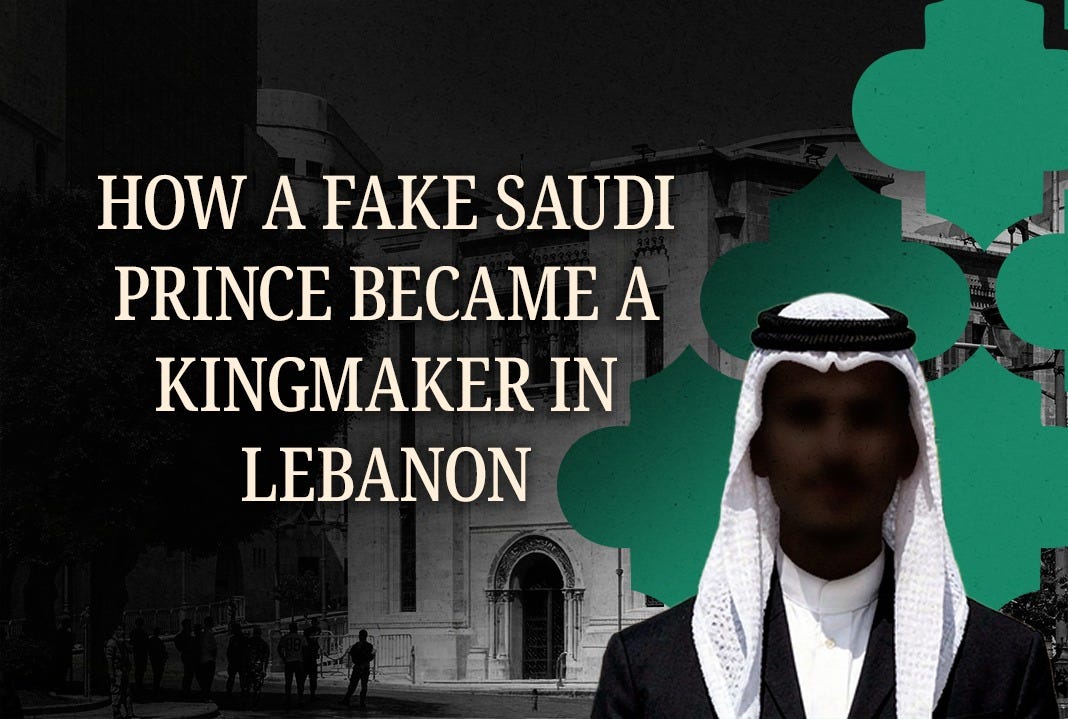
Imagine discovering today that a man claiming to be a Saudi prince had contacted members of the U.S. Electoral College, promised favors and business deals, and persuaded enough of them to switch their votes, handing the presidency to Kamala Harris instead of Donald Trump—only to discover afterward that the Saudi prince never existed.
In most political systems, such a scam would be discovered immediately, because authority must clear institutional thresholds before it can operate. Institutions would check identities and verify mandates. They would intervene before any outcome could solidify in response to faulty or foreign requests.
But Lebanon’s system is deeply flawed.
For several years, a Lebanese auto body repairman named Mustafa al-Hessian was permitted to move through political circles while presenting himself as a Saudi royal. Known as “Prince Abu Omar,” he claimed proximity to Riyadh and the ability to deliver access, favors, and economic opportunities. His claims circulated widely because they aligned with how power is pursued in Lebanon: through personal channels rather than public institutions.
According to multiple Lebanese media investigations, this fraudulent activity reached its most consequential point during the parliamentary consultations that led to the designation of Nawaf Salam as prime minister. Members of parliament were contacted directly by the fake prince, who urged them to vote for Nawaf Salam rather than Najib Mikati and offered explicit promises of favors and business opportunities in return. He offered an explicit quid pro quo: that this vote aligned with Saudi preferences and that cooperation would be rewarded should they cast it.
The vote went through.
Only a year later did the picture unravel. “Prince” Abu Omar was a phantom. His influence rested on his performance, confidence, a credible Saudi accent, and alleged cooperation with a well-known Lebanese religious scholar, whose public standing conferred credibility and social cover. Both men are now under arrest.
The arrests are beside the point. What demands attention is how little resistance this scheme encountered.
Abu Omar was not dealing with political amateurs, but with senior figures acting on assumptions they had long treated as normal. Fouad Siniora, a former prime minister, did not merely observe the ruse from a distance. He reportedly fell for it himself. Lebanese media accounts indicate that Siniora attempted to introduce Abu Omar to Bahia Hariri, a prominent political figure and the sister of the late prime minister Rafic Hariri, treating him as a credible Saudi intermediary. The attempt failed only because Hariri responded by contacting the Saudi embassy directly. She was immediately informed that no such person existed.
Sitting members of parliament, including MP Mohamed Suleiman, operated comfortably within this environment, where proximity and access are valued more than proper governance. In such a system, the boundary between a recognized authority and a convincing performance grows thin.
The faux prince merely exploited a system already primed for deception.
This is why the episode should not be reduced to a tale of gullibility. Con artists exist everywhere. What distinguishes this case is the political culture that allowed such a performance to pass muster—and rewarded it with real influence in Lebanese politics.
Lebanon is often described as a country whose sovereignty is undermined by external forces, particularly Iran. The episode described here suggests a different problem. Political actors do not treat the state as the primary channel through which domestic decisions intersect with foreign influence. Instead, the state often abdicates responsibility, allowing corruption to structure political outcomes.
Decisions take shape through private conversations, promised returns, and implied rewards, as embassies and ministries play a diminishing role. Authority shifts away from formal institutions and into informal networks where accountability is weak. In such settings, verification carries little weight, and perceived social capital confers legitimacy.
The involvement of a prominent religious scholar was central to the scheme. In Lebanon, clerical authority has long been used to confer legitimacy when state authority is weak. Combined with the appearance of foreign backing, that authority proved sufficient to influence political behavior at the highest level.
For Western observers, this episode should unsettle comfortable assumptions. International engagement with Lebanon still rests on the belief that formal state actors can mediate outcomes and enforce commitments. The Abu Omar affair exposes a political elite that no longer instinctively treats the state as real. Strategies built on institutional logic falter when institutions themselves are treated as optional.
For Lebanese readers, the discomfort cuts closer to home. The scandal is not that a mechanic learned to imitate a Saudi accent so convincingly. It is that this was enough to gain access, promise deals, and influence the choice of a prime minister.
Public attention to the scheme will fade, as it does with most scandals. The practices that enabled it, however, remain in place: informal access still outweighs institutional process, transactional politics continues to guide decisions, and verification remains a low priority.
When a political system allows an automechanic to enter elite political circles through deception and influence the outcome of a prime ministerial vote, the issue is no longer an isolated episode. It reflects a ruling class conditioned to respond to performance art rather than institutional legitimacy. If this pattern persists, Lebanon need not fear foreign manipulation; it has already internalized it.
Middle East Uncovered is powered by Ideas Beyond Borders. The views expressed in Middle East Uncovered are those of the authors and do not necessarily reflect the views of Ideas Beyond Borders.

Very interesting. Thank you!